
If you’ve spent any time behind a screen printing press, you already know that ink choice affects everything, color vibrancy, hand feel, washability, and how forgiving a print run actually is. Wilflex plastisol ink has been a go-to for printers at every level, from garage setups to high-volume production shops, and for good reason. It’s consistent, it holds color well, and it plays nice with a wide range of fabric types.
At Dr. Tee’s Design & Screen Printing, we’ve been printing custom apparel in Kansas City for over 20 years, and Wilflex products have been on our ink shelves for most of that time. We’ve tested their lines across cotton, poly blends, tri-blends, and performance fabrics, so what you’ll read here comes from hands-on production experience, not just spec sheets.
This guide breaks down the Wilflex plastisol lineup, covering available product lines and color options, cure temperatures, and practical tips for printing on different fabrics. Whether you’re a fellow printer dialing in your process or a business owner curious about what goes into your custom shirts, you’ll find the technical detail you’re looking for right here.
Why Wilflex plastisol ink stays popular
Wilflex plastisol ink has been a fixture in screen printing shops since the 1960s, and the brand hasn’t held that position by luck. It earned its standing through decades of formulation refinement and a product catalog broad enough to cover nearly every printing scenario a shop can face. Printers keep coming back because the ink performs predictably, and in production environments, predictability saves money.
A brand built on production credibility
Sun Chemical, the parent company behind Wilflex, ranks among the largest ink manufacturers in the world. That scale gives Wilflex the resources to test and refine formulations at a level most smaller ink brands can’t match. When you open a fresh container of Wilflex, you’re getting a product that went through rigorous quality control before it left the facility.
Consistent formulation from batch to batch means you spend less time troubleshooting and more time printing.
Tight tolerances on pigment concentration and viscosity matter most when you’re running a multi-color job across a large order. Color drift between containers can throw off your registration and force reprints, which costs you time and material. Because Wilflex controls these variables closely, the color you mix on the first day of a run prints the same way on the last day.
Performance across fabric types
Another reason shops keep Wilflex on their shelves is that the product line covers a wide range of substrates. Cotton, polyester, tri-blends, and performance fabrics each behave differently under heat and pressure, and Wilflex offers formulations developed specifically for those differences. That range reduces the number of different ink brands you need to stock, which simplifies purchasing and storage.
Tri-blend and high-polyester garments are a good example. Standard inks can dye-migrate on those fabrics, leaving you with a washed-out or discolored print after curing. Wilflex offers dedicated low-bleed and dye-migration-resistant formulas that address that problem directly, so you don’t have to improvise a workaround or swap ink brands in the middle of a job.
Practical reasons shops stick with it
Beyond raw performance, ease of use drives a lot of repeat purchases. Wilflex inks pull cleanly through standard mesh counts without constant adjustment to flood pressure or off-contact distance. That quality makes them accessible for newer operators while still giving experienced printers the control needed for fine detail work and tighter halftone printing.
Supply availability is another practical factor. Because Wilflex is distributed through a wide network, you can typically reorder specific colors or base formulas without waiting weeks for restocking. For shops running active order queues, that reliability keeps jobs moving and reduces the risk of a backorder stopping production mid-run.
How Wilflex plastisol ink works
Wilflex plastisol ink belongs to the plastisol ink category, which means it uses PVC particles suspended in a plasticizer as its base chemistry. Unlike water-based inks, plastisol doesn’t dry through evaporation, so it stays wet on the screen as long as you need it without flashing or skinning over during a press run. That open working time gives you room to adjust registration, swap screens, or deal with a mechanical issue without losing an entire bucket of ink to premature drying.
The chemistry behind plastisol
Plastisol ink is a two-part suspension where fine PVC resin particles float in a liquid plasticizer. At room temperature, that mixture stays in a stable, fluid state because the plasticizer molecules haven’t bonded with the resin. You can push it through a mesh, flood coat a screen, and squeegee a clean print without any chemical reaction taking place yet.
The bond between resin and plasticizer only forms when heat is applied. That’s the core of how plastisol works, and it’s why you can leave a container open on your ink station without worrying about it setting before you’re ready to print. The ink remains workable at ambient temperatures indefinitely, which reduces waste and gives operators more control over the print process.
What happens during the cure
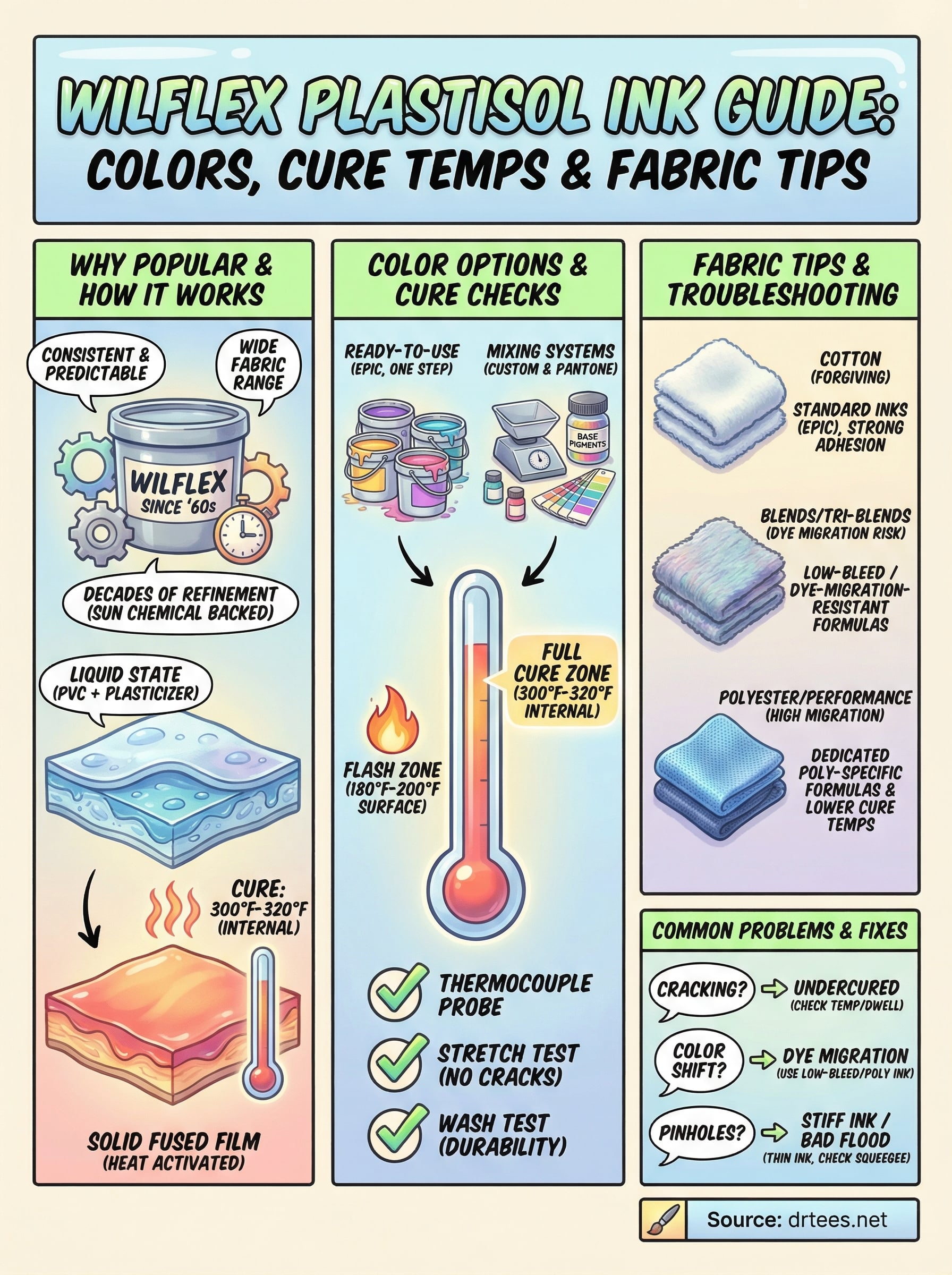
When your printed garment passes through the dryer, the heat triggers a process called gelation and fusion. The plasticizer molecules begin penetrating the PVC resin particles around 250°F, and full fusion happens when the ink film reaches the manufacturer’s recommended cure temperature, which for most Wilflex formulations falls between 300°F and 320°F.
Reaching that full internal temperature throughout the ink film is what determines washability, not just surface temperature or dryer belt speed.
Once fused, the ink forms a flexible, cross-linked film that bonds to the fabric fibers and holds up through repeated wash cycles. Because the ink cures as a solid film rather than soaking into the garment the way dye does, it sits on top of the fabric and retains strong opacity and color vibrancy over the life of the shirt. That surface-level bond is also why you can achieve clean edges and sharp detail on finished prints.
Wilflex color options and mixing systems
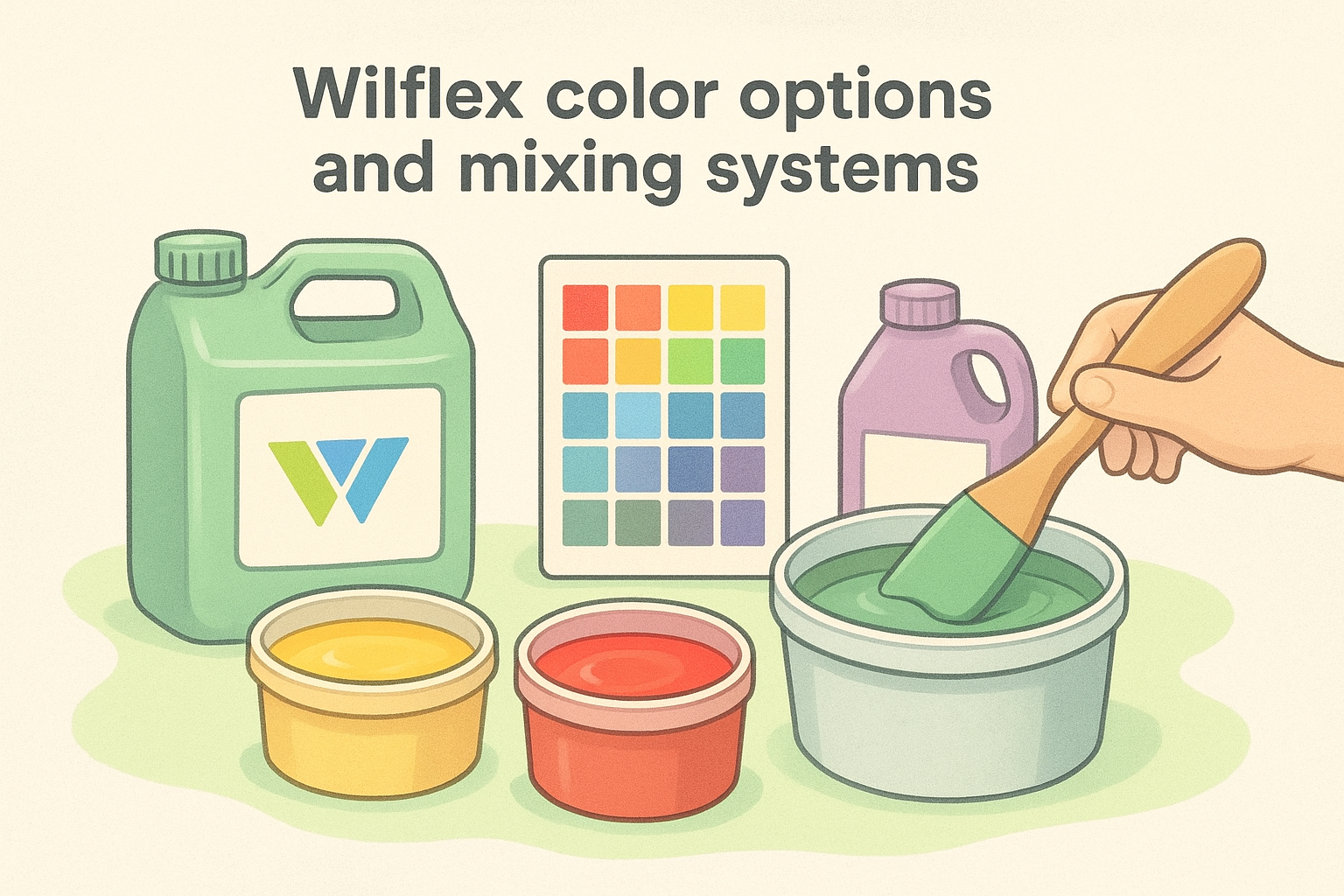
Wilflex plastisol ink gives you two routes when it comes to color: you can pull from their pre-mixed ready-to-use colors, or you can build custom shades using their mixing systems and base formulas. Most production shops use both approaches depending on the job. Standard brand colors usually come from the pre-mixed catalog, while specialty or exact brand-matched colors get built through a mixing system.
Ready-to-use color lines
Wilflex organizes its pre-mixed colors across several product lines, with Epic and One Step being the most widely used in standard production printing. Epic is the flagship line, covering a broad spectrum of standard, fluorescent, and process colors built for opacity and print consistency on cotton and cotton-blend garments. One Step streamlines production further by eliminating the need for a separate underbase on lighter fabrics, which cuts steps out of a multi-color run without sacrificing color quality.
Matching a specific brand color from a pre-mixed catalog is faster than mixing from scratch, but knowing how to mix gives you a safety net when a color is out of stock.
The fluorescent offerings within Epic are worth noting if your customers run event shirts, athletic gear, or high-visibility workwear. These colors hold their intensity under both daylight and UV lighting, which makes them a reliable choice when a client’s design depends on standout color rather than subtle tone work.
Mixing systems and custom color builds
For jobs where you need a color that doesn’t match anything off the shelf, Wilflex offers a dedicated mixing system built around a set of base pigments and clear or white carrier bases. You weigh out the pigment ratios according to the formula reference, blend them into your chosen base, and get a consistent, repeatable color that you can reproduce exactly on future orders as long as you log your measurements.
The mixing system pairs well with Pantone color matching workflows. Many clients hand you a Pantone reference number for their logo, and Wilflex provides formula guides that translate those references into specific mixing ratios. That capability removes the guesswork from color matching and gives you a documented record to pull up the next time that client places a reorder.
Cure temps, flashing, and full cure checks
Getting cure temperature right is the single most critical variable in the entire print process. An undercured print looks fine coming off the press but falls apart in the wash, and no amount of good ink choice fixes a dryer problem. Most Wilflex plastisol ink formulations require the ink film to reach between 300°F and 320°F internally for a full cure, though specialty lines like low-cure products may have lower targets, so always check the technical data sheet for the specific ink you’re running.
Temperature targets and dryer settings
Your conveyor dryer’s air temperature and the actual internal temperature of the ink film are not the same number. A dryer set to 320°F doesn’t guarantee the ink film hits that mark, because variables like belt speed, ink deposit thickness, and garment color all affect how much heat actually reaches the ink. Thicker deposits take longer to reach full internal cure than thin ones, so slowing the belt for heavy fills is often necessary.
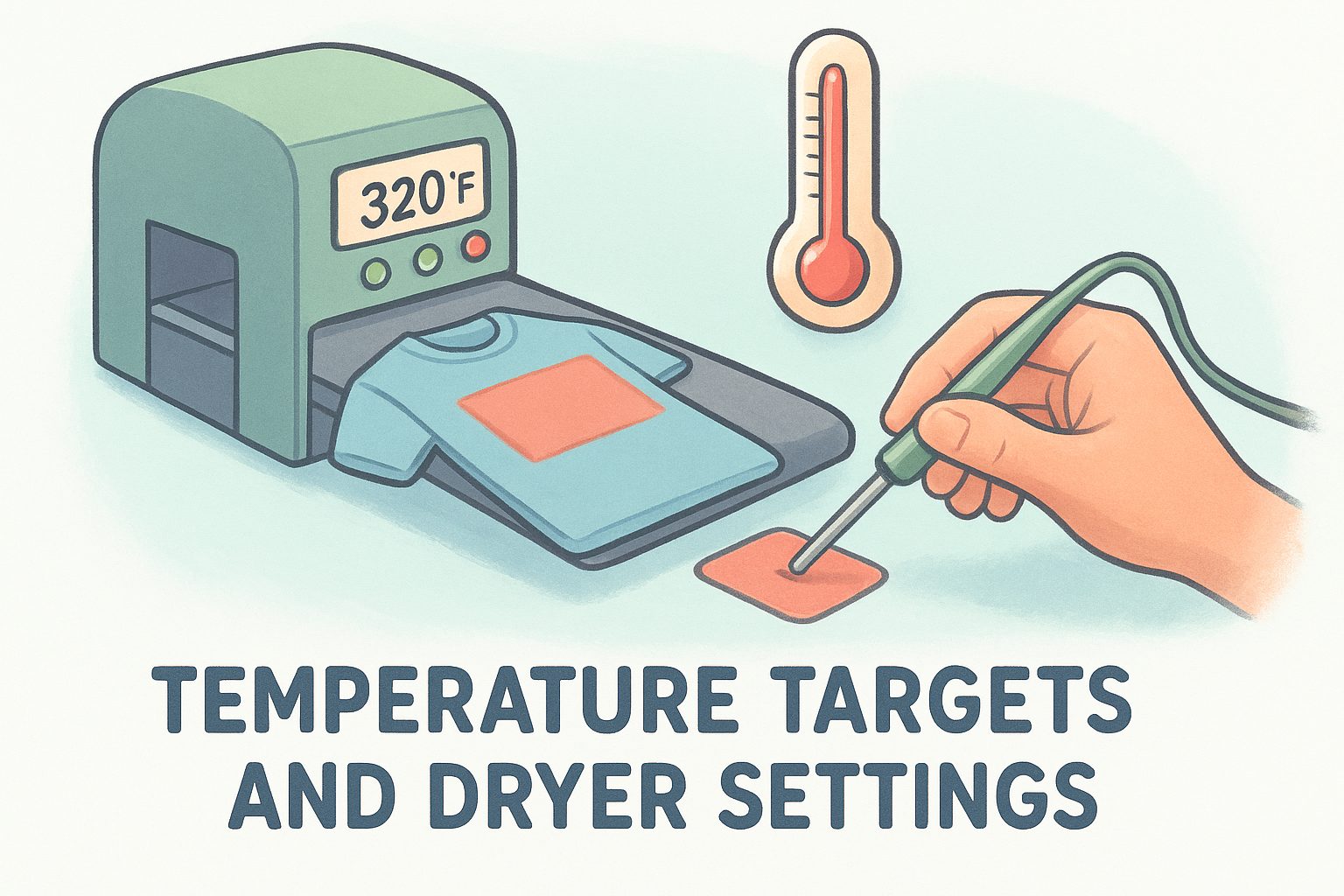
Thermocouple probes and donut thermometers give you a direct reading of what the ink film experiences inside the dryer, not just what the air temperature reads. Running a probe through your dryer with a test print before production saves you from pulling a full run off the press only to find out the cure was short.
Flashing between colors
Flash curing partially gels the ink between color layers without driving it to full cure. That gel state gives you a firm, dry surface to print the next color on without smearing or trapping wet ink underneath, which is critical on multi-color designs and on jobs using an underbase. Most flash units work between 180°F and 200°F at the ink surface.
Flashing too long drives the ink toward full cure, which reduces the adhesion of the next color layer printed on top of it.
Flash time varies based on ink deposit thickness and the wattage of your flash unit. Thinner deposits gel faster, while heavy underbases need more exposure time. A light finger press after each flash cycle tells you quickly whether the surface is ready for the next screen.
Checking for full cure
The stretch test is the fastest field check available. Pull a cooled print firmly in both directions and watch the ink film. A fully cured print stretches with the fabric without cracking or peeling, while any cracking along the edges signals the film didn’t reach full internal temperature.
A wash test confirms durability beyond what the stretch test shows. Running a sample print through two or three normal wash cycles before signing off on your dryer settings gives you confidence that your production run will hold up for your customers long-term.
Fabric tips for cotton, blends, and polyester
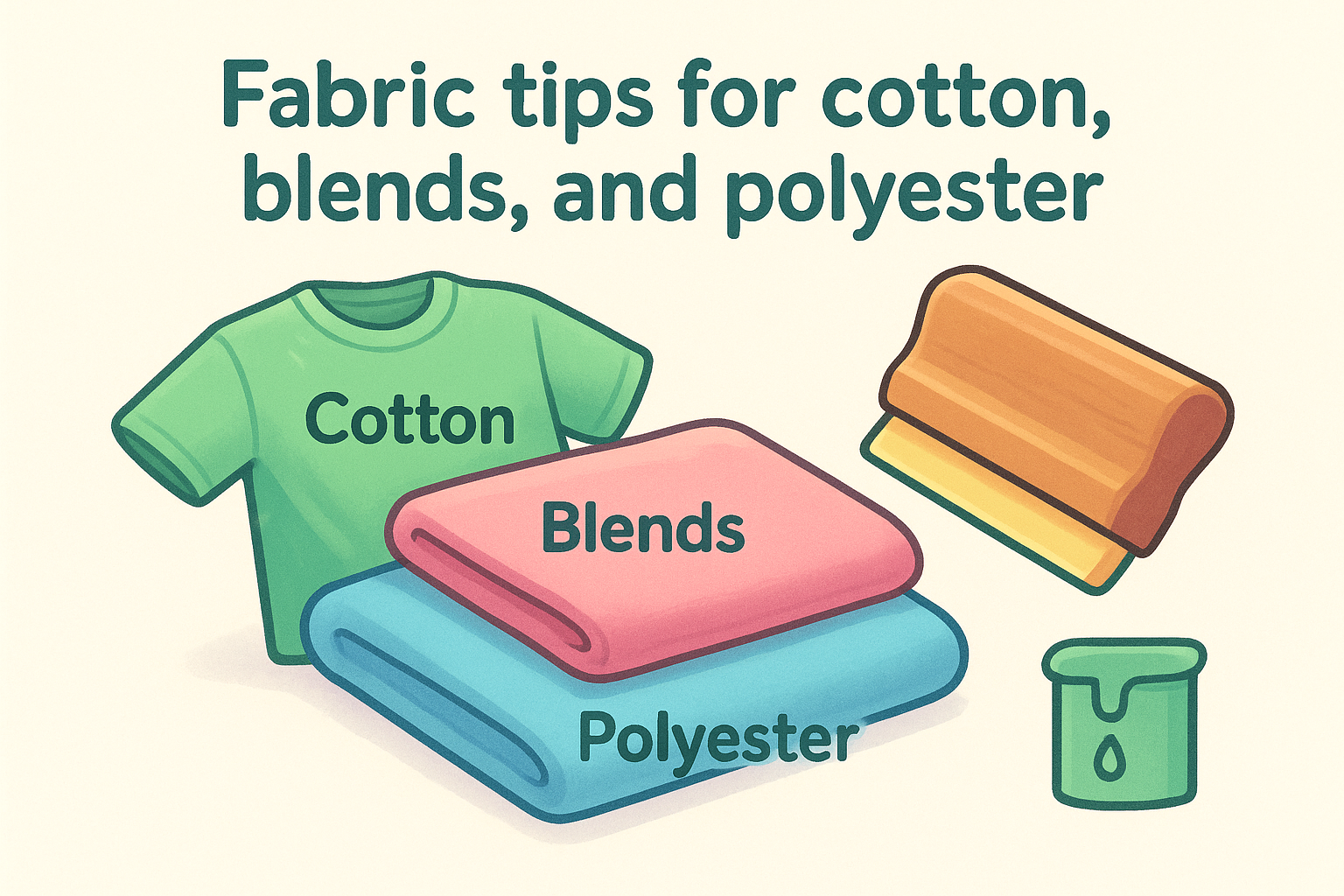
The fabric sitting under your screen changes how Wilflex plastisol ink lays down, cures, and holds up over time. Knowing the differences between cotton, blended, and synthetic fabrics before you start a job saves you from dealing with adhesion problems, dye migration, or a print that looks soft before the first wash. Each substrate has specific demands, and matching the right Wilflex formulation to the right fabric is one of the fastest ways to improve print quality across your production runs.
Cotton
100% cotton is the most forgiving substrate you’ll print on. The natural fibers absorb heat evenly and don’t release dye during the cure cycle, so standard Wilflex formulations like Epic perform exactly as expected. You get strong adhesion, sharp edges, and stable color without needing specialty inks or modified cure settings.
Cotton ring-spun fabrics hold fine detail better than open-end spun options because the smoother surface gives the ink a tighter contact point during the squeegee stroke.
Pre-washing cotton garments removes residual sizing and shrinkage risk, which matters on close-tolerance jobs where a printed graphic needs to land in a specific position after the customer washes the shirt for the first time.
Blends and tri-blends
Blended fabrics combine cotton with polyester or rayon, and that polyester content introduces dye migration risk during the cure process. When the garment heats up, the polyester fibers can release dye into the ink film, which shifts lighter colors toward pink or gray tones once the shirt cools. Wilflex’s low-bleed and dye-migration-resistant formulations address this directly by using barriers that slow or block that dye release.
Tri-blend garments typically run 50% polyester or higher, so the migration risk is greater than on a standard 50/50 blend. Curing at the lowest effective temperature your ink allows reduces dye release without undercuring the film.
Polyester and performance fabrics
100% polyester and athletic performance fabrics push dye migration concerns to their highest level. Your best option on these substrates is a dedicated polyester-specific formula designed to handle extreme bleed conditions. Wilflex offers formulations built for this, and pairing them with lower cure temperatures keeps the polyester fibers from reaching the threshold where dye release accelerates. Always run a wash test after your first production sample to confirm the colors held.
Picking the right Wilflex ink for the job
Choosing the right Wilflex plastisol ink starts with three variables: the substrate you’re printing on, the complexity of the artwork, and the durability the finished product needs to deliver. Getting this decision right before you set up your screens prevents print failures that lead to reprints, schedule delays, and customer complaints that are hard to recover from once an order ships.
Match the ink to the substrate first
Your fabric choice narrows the Wilflex product selection faster than any other factor. Printing on 100% cotton gives you the most flexibility: Epic standard formulations deliver reliable opacity and strong wash durability without requiring adjustments to your curing setup or any specialty additives. Move to a tri-blend or high-polyester garment, and you need to shift to a low-bleed or dye-migration-resistant formula, or color shift after the first wash becomes a real risk.
The substrate should always drive your ink selection before you start factoring in color targets or print deposit thickness.
Performance fabrics and athletic polyester require dedicated polyester-specific formulas that cure at lower internal temperatures to prevent the fibers from releasing dye into the ink film during the cure cycle. Pairing the right formula to the fabric before screens go on the press removes the most common source of production failures before they can affect your output or your reputation.
Factor in your order volume and print complexity
Short runs with clean, solid designs benefit most from ready-to-use colors pulled directly from the pre-mixed catalog. You skip the time and material cost of mixing from scratch, get a consistent result without needing a dedicated mixing station, and keep your setup time short. One Step formulations work particularly well in this scenario because they eliminate the separate underbase layer on lighter garments, cutting steps out of your process without giving up color quality.
Longer runs with multi-color artwork or exact brand color requirements justify using the mixing system instead. Logging your pigment ratios gives you a documented formula to reproduce precisely when the client places a reorder months later, and that level of consistency builds lasting trust with customers who care about brand accuracy. On halftone or process-color jobs, using a lower-viscosity formulation matched to finer mesh counts keeps dot gain under control and holds clean color transitions throughout the full production run.
Common print problems and quick fixes
Even with high-quality Wilflex plastisol ink on your press, production problems still show up. Most of them trace back to a small number of root causes, and recognizing the pattern behind each issue lets you fix it quickly rather than guessing through trial and error.
Ink cracking or peeling after washing
Cracking and peeling after the first wash almost always points to an undercured ink film. The print looked fine leaving the dryer, but the internal temperature of the film never reached full fusion, so the PVC resin and plasticizer didn’t bond completely. Run a thermocouple probe through your dryer on a test print before production and compare the reading to the technical data sheet for the specific formula you’re using.
An undercured ink film that passes the stretch test on press day can still fail in the wash if the internal temperature was even slightly below the cure threshold.
Thick ink deposits are the most common cause of short cures. A heavy underbase or bold fill area holds more thermal mass than a thin layer, which means it needs more dwell time in the dryer to reach full internal temperature. Slow your belt speed when printing heavy deposits and reconfirm with a probe reading rather than assuming settings that worked on a thin print will transfer directly.
Color shifting and dye migration
Color shift after curing on polyester or tri-blend garments usually signals dye migration rather than an ink mixing error. The polyester fibers release dye when they reach high temperatures, and that dye travels into the ink film and changes the color you laid down. Switch to a low-bleed or dye-migration-resistant Wilflex formula and cure at the lowest effective temperature the ink allows to limit the heat that triggers dye release.
Quick checks when you see color shift:
- Confirm your dryer temperature isn’t running higher than necessary
- Swap to a dedicated low-bleed formula if you’re running a standard formulation on a high-polyester garment
- Run a wash test on your first production sample before printing the full order
Pinholes and uneven coverage
Pinholes across a print area typically come from ink that’s too stiff for the mesh count you’re running or inadequate flood pressure leaving dry spots. Thin the ink slightly with a small amount of curable reducer and confirm your off-contact distance allows a clean snap-off after each squeegee stroke. Uneven coverage across a print usually points to a warped squeegee blade that isn’t making full contact with the mesh, so inspect your blades regularly and replace them when you see edge wear.
Next steps for your next run
You now have a working reference for Wilflex plastisol ink across every major decision point in a production run: which product line fits your substrate, how to hit full cure consistently, and what’s causing the print problems you’re already troubleshooting. The gap between a good print and a failed one usually comes down to a handful of repeatable decisions made before the press even starts, and this guide covers all of them.
Put what you’ve read here into practice on your next job by confirming your ink matches your fabric, verifying your cure with a probe, and logging your mixing ratios for any custom color builds you plan to reorder later. If you want to see how this level of detail shows up in finished work, take a look at the custom screen printing process at Dr. Tee’s to see what that looks like from order to delivery.
