
You’ve seen screen printed shirts everywhere, on your favorite band tees, company uniforms, and sports jerseys. But what is screen printing, exactly? And why has this technique remained the go-to choice for custom apparel for over a century?
At Dr. Tee’s Design & Screen Printing, we’ve spent more than 20 years pushing ink through mesh screens onto t-shirts, hoodies, and promotional items for Kansas City businesses. That hands-on experience has taught us what works, what doesn’t, and when screen printing makes sense over other methods.
This guide breaks down the entire process from start to finish. You’ll learn how screen printing actually works, where it excels, where it falls short, and what it typically costs. Whether you’re ordering 12 shirts for your crew or 500 for a company event, understanding the basics helps you make smarter decisions, and get better results from your custom apparel investment.
Why screen printing stays popular
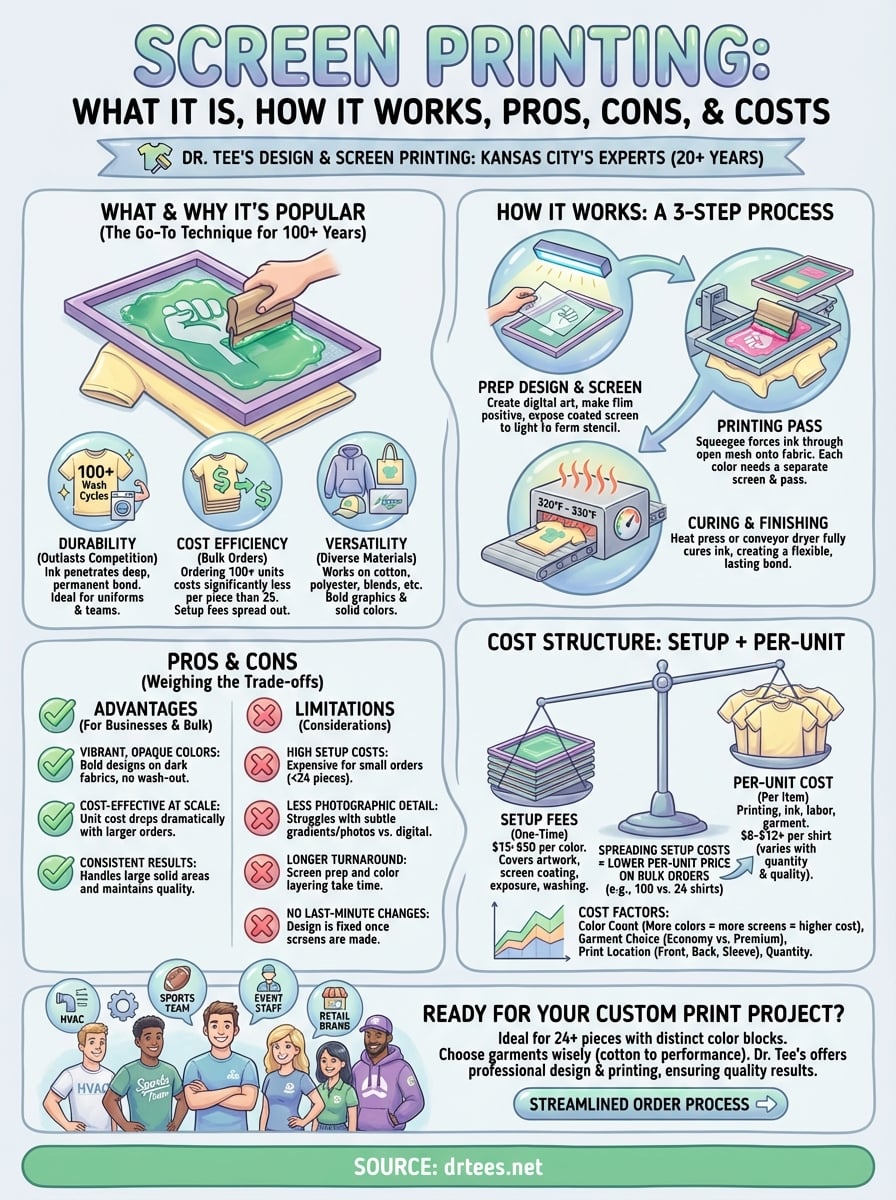
Screen printing has dominated the custom apparel industry since the early 1900s, and it still holds that position today despite newer technologies entering the market. You might wonder what makes this century-old technique so resilient in an era of digital everything. The answer comes down to three practical advantages: exceptional durability, unbeatable cost efficiency at scale, and remarkable versatility across different materials and applications.
Durability that outlasts the competition
Screen printed designs can survive hundreds of wash cycles without significant fading or cracking when done correctly. The ink penetrates deep into the fabric fibers rather than sitting on top like some digital printing methods, which creates a permanent bond that withstands heavy use and repeated laundering. Your work uniforms, team jerseys, and promotional shirts need to look professional after months of regular wear, and screen printing delivers that longevity. Construction crews, landscaping teams, and restaurant staff put their branded apparel through tough conditions, and properly cured screen printed ink holds up where other methods fail.
Screen printing creates a mechanical bond with fabric that can last the entire lifetime of the garment when proper inks and curing techniques are used.
Cost efficiency for larger orders
The economics of screen printing favor bulk production in a way that other printing methods can’t match. You pay upfront costs for screens and setup, but once those are ready, each additional shirt costs very little to produce. This pricing structure means ordering 100 shirts costs significantly less per unit than ordering 25, making it ideal for businesses outfitting entire teams or organizations planning events. Small Kansas City businesses ordering uniforms for their crews of 12 to 20 employees get professional quality at prices that make sense for their budgets. The more units you order, the more you save, which explains why screen printing remains the default choice for large promotional campaigns and company merchandise.
Versatility across materials and designs
Screen printing works on cotton, polyester, blends, and specialty fabrics without requiring different equipment or techniques for each material type. You can print on t-shirts, hoodies, tote bags, hats, and even some hard surfaces using the same basic process. The technique handles bold graphics, solid colors, and detailed artwork equally well, though it excels particularly with designs that use distinct color blocks rather than photographic images. This flexibility lets you maintain brand consistency across different product types, from staff polo shirts to promotional tote bags, all produced with the same printing method and matching colors.
How to screen print step by step
Understanding what is screen printing becomes clearer when you see the actual process broken down into manageable stages. The technique follows a straightforward sequence that professional shops repeat thousands of times, but each step requires precision and attention to detail to produce quality results. You don’t need industrial equipment to grasp how it works, though commercial operations use specialized machinery to handle larger volumes efficiently.
Preparing your design and screen
Your design starts as digital artwork that gets printed onto transparent film, creating what printers call a positive. This film acts as a stencil guide for the next crucial step. You coat a mesh screen with light-sensitive emulsion in a dark room, let it dry completely, then place your film positive on top of the coated screen. Exposing this setup to bright light causes the emulsion to harden everywhere except where your design blocks the light. Washing the screen with water removes the unexposed emulsion, leaving open mesh areas that form your stencil pattern. Different mesh counts work better for different designs: coarser meshes handle thick inks and bold graphics, while finer meshes capture more detail.
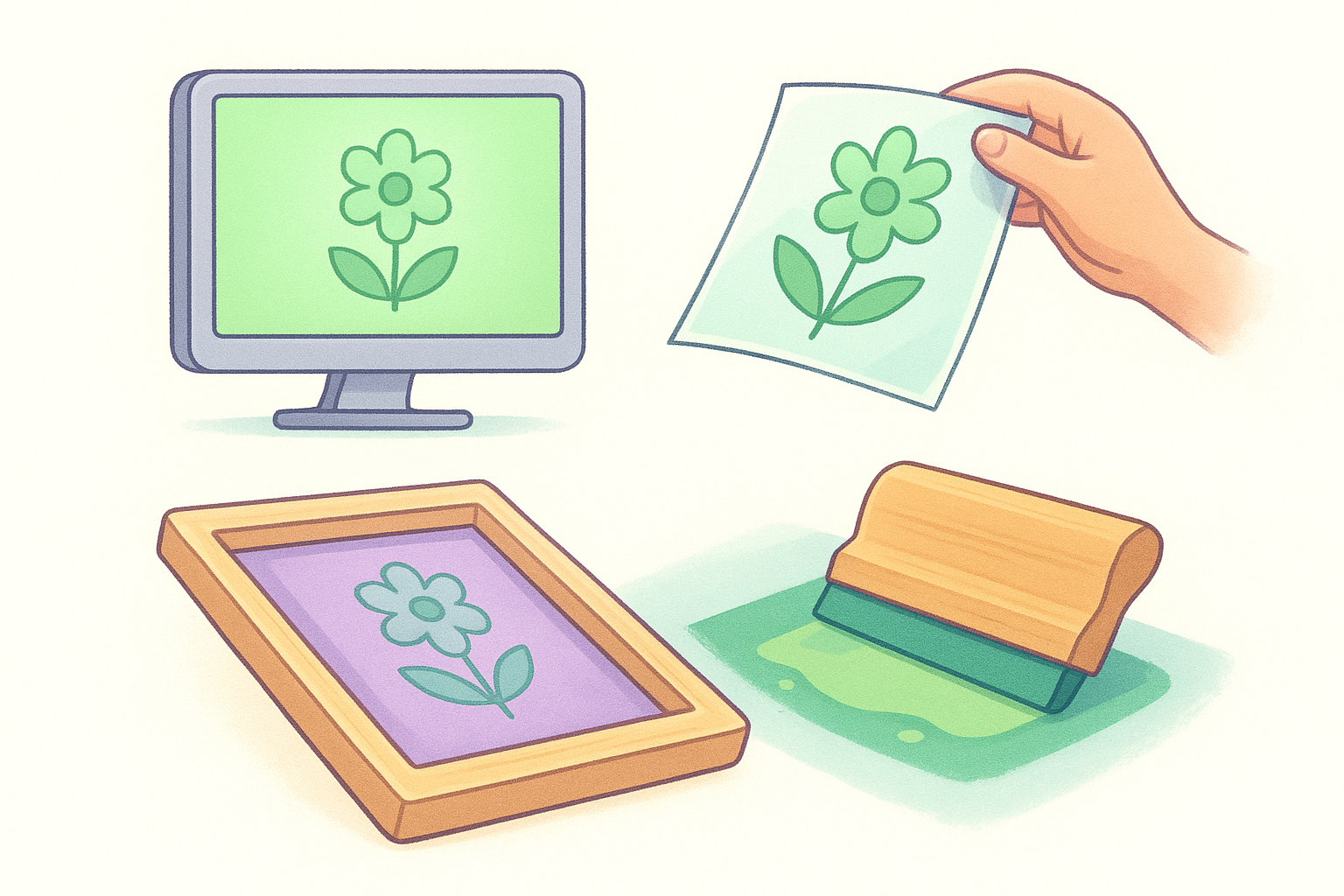
Professional screen printers can achieve registration accuracy within 1/32 of an inch when properly calibrated, ensuring multi-color designs line up perfectly.
Printing and curing
You secure your garment flat on the printing surface and position the prepared screen on top. Spreading plastisol or water-based ink above your design area, you pull a rubber squeegee firmly across the screen, forcing ink through the open mesh onto the fabric below. Each color requires a separate screen and pass, which explains why simpler designs cost less than complex multi-color artwork. The printed garment moves to a conveyor dryer or heat press where temperatures reach 320 to 330 degrees Fahrenheit for plastisol inks, fully curing the design into the fabric. Testing the cure involves stretching the printed area: properly cured ink flexes with the fabric rather than cracking or feeling tacky.
Screen printing types and common applications
When you explore what is screen printing beyond the basic technique, you discover the method branches into different approaches based on your design needs and color requirements. The two primary types handle distinct kinds of artwork, and understanding which one fits your project helps you communicate effectively with your printer while managing your expectations for the final product.
Spot color vs. process printing
Spot color printing uses individual screens for each distinct color in your design, layering them one at a time to create the final image. This approach works best for logos, text, and graphics with clearly defined color blocks, like your company emblem or team mascot. You choose specific Pantone colors that match your brand guidelines exactly, and the printer mixes custom inks to hit those targets. Process printing takes a different route, breaking down photographic images or complex gradients into four standard colors: cyan, magenta, yellow, and black. These CMYK screens print in tiny halftone dots that your eye blends together, similar to how your inkjet printer at home creates full-color photos. Process printing handles detailed illustrations and photo-realistic designs that spot color can’t reproduce effectively, though it typically costs more due to the additional screens and setup complexity.
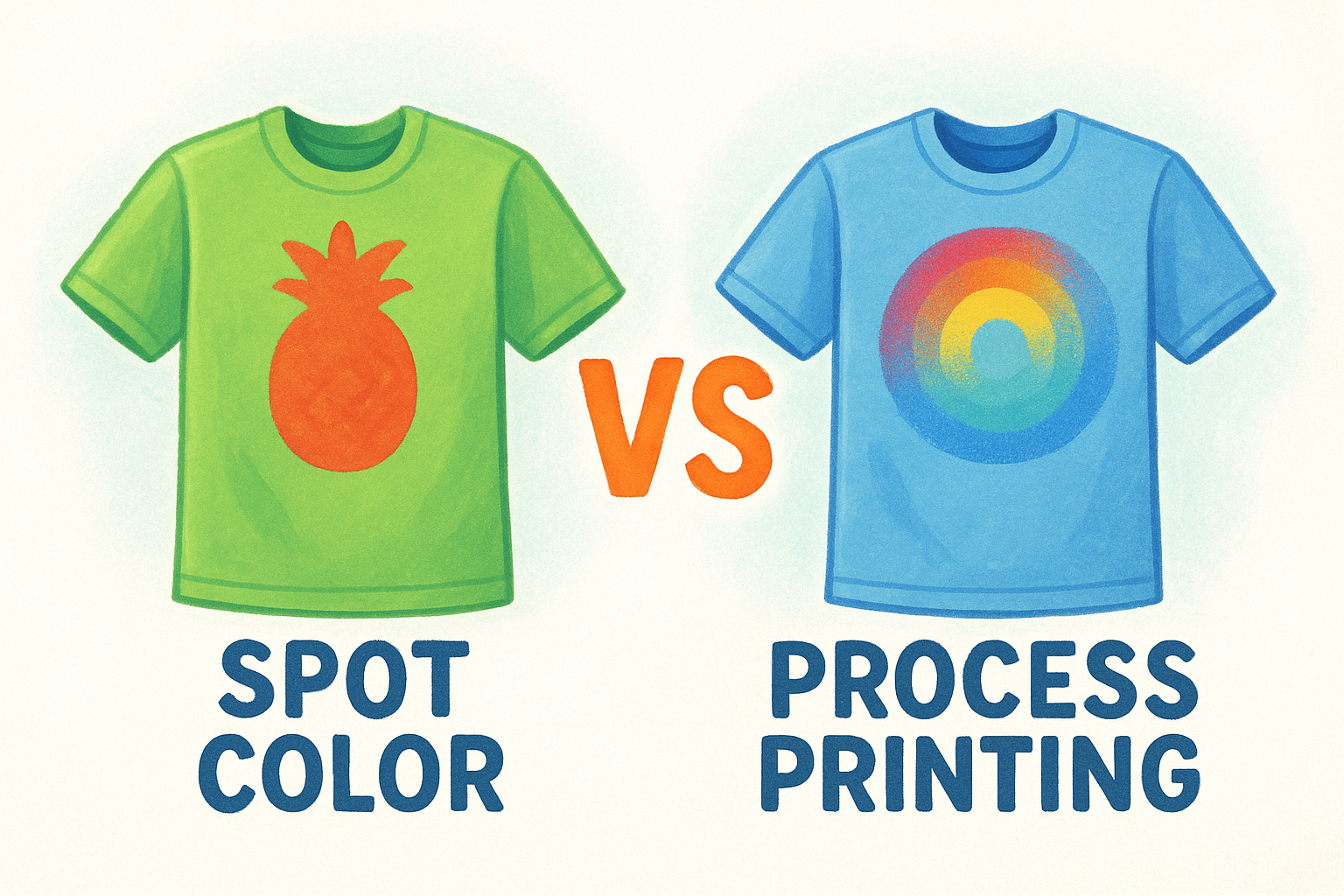
Spot color printing can match over 1,800 distinct Pantone shades with exact consistency across different production runs and garment types.
Common applications across industries
Service businesses rely heavily on screen printed uniforms, from HVAC technicians wearing branded polo shirts to landscaping crews in durable work tees. Schools and sports organizations order team jerseys, spirit wear, and event shirts for everything from little league teams to high school fundraisers. Promotional campaigns use screen printed tote bags, tank tops, and hoodies as giveaway items and merchandise because the technique produces consistent results at quantities that make financial sense. Restaurants and hospitality businesses outfit their staff in matching branded apparel that survives constant washing and daily wear. Event organizers print commemorative shirts for concerts, races, and festivals, while retail brands create their own merchandise lines using screen printing to maintain quality standards across large production runs.
Screen printing pros and cons
Weighing the benefits and drawbacks of screen printing helps you decide if this method matches your project requirements and budget constraints. While screen printing delivers superior results in specific scenarios, it also comes with limitations that make other printing methods better choices for certain applications. Understanding these trade-offs before placing your order prevents disappointment and ensures your custom apparel meets your expectations.
Advantages for businesses and bulk orders
Screen printing produces vibrant, opaque colors that stand out on both light and dark fabrics without the washed-out appearance that plagues some alternative methods. The thick ink deposits create bold, professional designs that maintain their intensity through countless wash cycles, making them ideal for work uniforms and promotional items that see heavy use. Your cost per unit drops dramatically as order quantities increase, which explains why businesses ordering team uniforms or event merchandise consistently choose this method. You can print on diverse fabric types and garment styles without switching equipment or techniques, from cotton t-shirts to polyester performance wear. The technique handles large solid color areas efficiently, producing consistent results across hundreds or thousands of pieces in a production run.
Screen printing typically becomes more cost-effective than digital printing once your order exceeds 24 to 50 pieces, depending on design complexity.
Limitations to consider
Understanding what is screen printing means recognizing that the setup costs make small orders expensive on a per-unit basis, since you pay for screen preparation whether you print 5 shirts or 500. Each color requires a separate screen and production pass, which drives up costs and complexity for designs using multiple colors or intricate gradients. Turnaround times extend longer than digital alternatives because screen preparation, registration, and color layering take time, especially for rush orders or tight deadlines. The method struggles with photographic details and subtle color transitions that process printing or direct-to-garment techniques handle more effectively. You commit to specific colors and designs upfront, making last-minute changes costly or impossible once screens are prepared and production begins.
Screen printing costs and how pricing works
Understanding what is screen printing from a cost perspective helps you budget accurately and avoid surprises when you receive your quote. Screen printing pricing operates on a two-part structure that combines upfront setup fees with per-unit production costs, creating an unusual dynamic where larger orders deliver significantly better value than small batches. Your total investment depends on multiple variables that range from design complexity to garment quality, and knowing these factors before you start helps you make smarter decisions about your custom apparel project.
Setup fees and per-unit pricing
You pay screen preparation costs for each color in your design, typically ranging from $15 to $50 per screen depending on the complexity and your printer’s pricing model. These setup fees represent one-time charges that cover artwork processing, screen coating, exposure, and washing, regardless of whether you print 12 shirts or 500. Your per-unit cost then covers the actual printing, ink, labor, and garment, starting around $8 to $12 for basic one-color prints on economy tees and scaling up based on your choices. Ordering 24 shirts might cost $15 per piece after setup fees, while ordering 100 of the same design drops your per-unit price to $8 or less because you spread those fixed setup costs across more units.
Screen printing’s cost structure means doubling your order quantity often increases total project cost by only 30 to 40 percent while doubling your inventory.
Factors that affect your final quote
Color count drives pricing more than any other variable, since each additional color requires another screen, production pass, and quality check. Garment choice matters significantly: economy cotton tees cost less than premium tri-blends or performance polyester shirts, and specialized items like hoodies or embroidered polos carry higher base prices. Print location adds costs when you want designs on both front and back or sleeve prints, as each placement requires separate setup and production time. Rush orders, small quantities below typical minimums, and custom Pantone color matching all increase your per-unit costs compared to standard turnaround times and larger production runs using stock colors.
Next steps for your custom print project
You now understand what is screen printing and how the process transforms your designs into durable, professional custom apparel. The technique works best when you order 24 or more pieces, choose designs with distinct color blocks, and allow adequate production time for screen preparation and printing. Your next decision involves selecting garments that match both your budget and quality expectations, from economy cotton tees to premium performance fabrics.
Dr. Tee’s Design & Screen Printing brings more than 20 years of experience to every Kansas City project, combining professional design services with the personal attention of a local shop. We handle everything from logo creation to final printing, ensuring your custom apparel looks exactly right before it leaves our facility. Whether you need work uniforms for your crew, promotional items for an event, or team jerseys for your organization, our streamlined order process makes getting professional screen printed apparel straightforward and stress-free.
