
You need custom printed apparel for your business or organization, and you’ve narrowed it down to two methods: screen printing vs. direct to film transfers. Both can put your logo on a t-shirt. Both produce professional results. But they work in fundamentally different ways, and those differences affect everything from cost per unit to how the print holds up after 50 washes.
At Dr. Tee’s Design & Screen Printing, we’ve spent over 20 years helping Kansas City businesses choose the right decoration method for their specific situation. We’ve screen printed thousands of orders for trade professionals, offices, schools, and sports teams. We’ve also watched DTF technology grow rapidly and change the conversation around short-run and full-color printing. That hands-on experience with both methods gives us a practical perspective that goes beyond spec sheets and sales pitches.
This article breaks down the real differences between screen printing and DTF transfers across the factors that actually matter to you: print quality, durability, hand feel, cost at various order volumes, and turnaround time. We’ll cover where each method excels, where it falls short, and how to decide which one fits your project. Whether you’re ordering 12 branded work shirts or 500 event tees, you’ll walk away knowing exactly which method makes the most sense for your budget, your timeline, and your expectations.
Why this choice matters for your shirts and budget
The decoration method you pick affects far more than just the look of the print on your shirt. It determines your per-unit cost, your minimum order size, how long production takes, and how well the finished garment holds up through regular use. Many buyers focus only on the price per shirt without realizing that the print method itself drives that number. Understanding how each method works before you commit saves you from costly mistakes after your order is already in production.
Your design complexity changes the cost equation
Screen printing and DTF transfers each respond to design complexity in very different ways. Screen printing uses one screen per ink color, which means a five-color logo costs significantly more to set up than a single-color design. DTF, by contrast, prints your full color range in a single pass with no added cost for additional colors. If your logo includes gradients, multiple colors, or fine photographic detail, the print method you choose will directly change what you pay before a single shirt is printed. A design that runs affordably in DTF can carry steep screen charges in screen printing, and that gap grows larger when your order volume is small.
When you compare screen printing vs. direct to film transfers on a complex design, color count is the first variable that shifts the math. A simple two-color logo at high volume almost always wins in screen printing. A full-color gradient at a low order quantity almost always wins in DTF.
The method that fits your design at your actual order size is typically the one that keeps your total cost lowest.
Order volume determines which method makes financial sense
Setup costs separate these two methods more than most buyers expect. Screen printing involves upfront fees called screen charges, which apply per color per design. Those costs spread out and become almost invisible when you order 200 shirts, but they can significantly inflate your per-unit cost on an order of 12 to 24 pieces. DTF transfers carry zero screen setup fees, which makes them far more economical for small or one-time runs. The math flips at higher volumes, where screen printing’s low per-unit ink cost gives it a clear advantage.
Your turnaround time also shifts depending on method and quantity. Screen printing requires physical screen preparation, exposure, and cure time, which adds days to any production schedule. DTF transfers skip most of that prep, which can compress your timeline when you’re working against a hard deadline. If you need branded work shirts for a crew starting Monday or event tees for a fundraiser next weekend, that difference in production speed becomes a real factor in your decision.
Picking the wrong method for your project doesn’t just cost you money at checkout. It can also leave you with prints that wear faster than expected, garments that feel stiffer than you wanted, or a per-unit cost that didn’t need to be that high. Knowing where each method performs best gives you the leverage to make a smarter call before the order is placed.
Screen printing basics and what you get
Screen printing is the older and more widely used of the two methods. The process pushes ink directly through a fine mesh screen onto the fabric surface, one color at a time. A separate screen gets made for each ink color in your design, and each screen goes through a chemical exposure process before a single shirt gets printed. The result is a vibrant, opaque print with ink that sits on top of the fabric yet melds with the fabric underneath it using a heat process that cures the ink.
How the screen printing process works
The shop starts by separating your artwork into individual color layers, then burns each layer onto its own screen using a light-sensitive emulsion. On press, each screen gets aligned to the shirt, and a squeegee pushes ink through the mesh onto the fabric. After every color is applied, the shirts run through a conveyor dryer to cure the ink. The entire setup process takes time and skilled labor before any production actually starts, which is why screen printing carries upfront setup costs that DTF transfers do not.
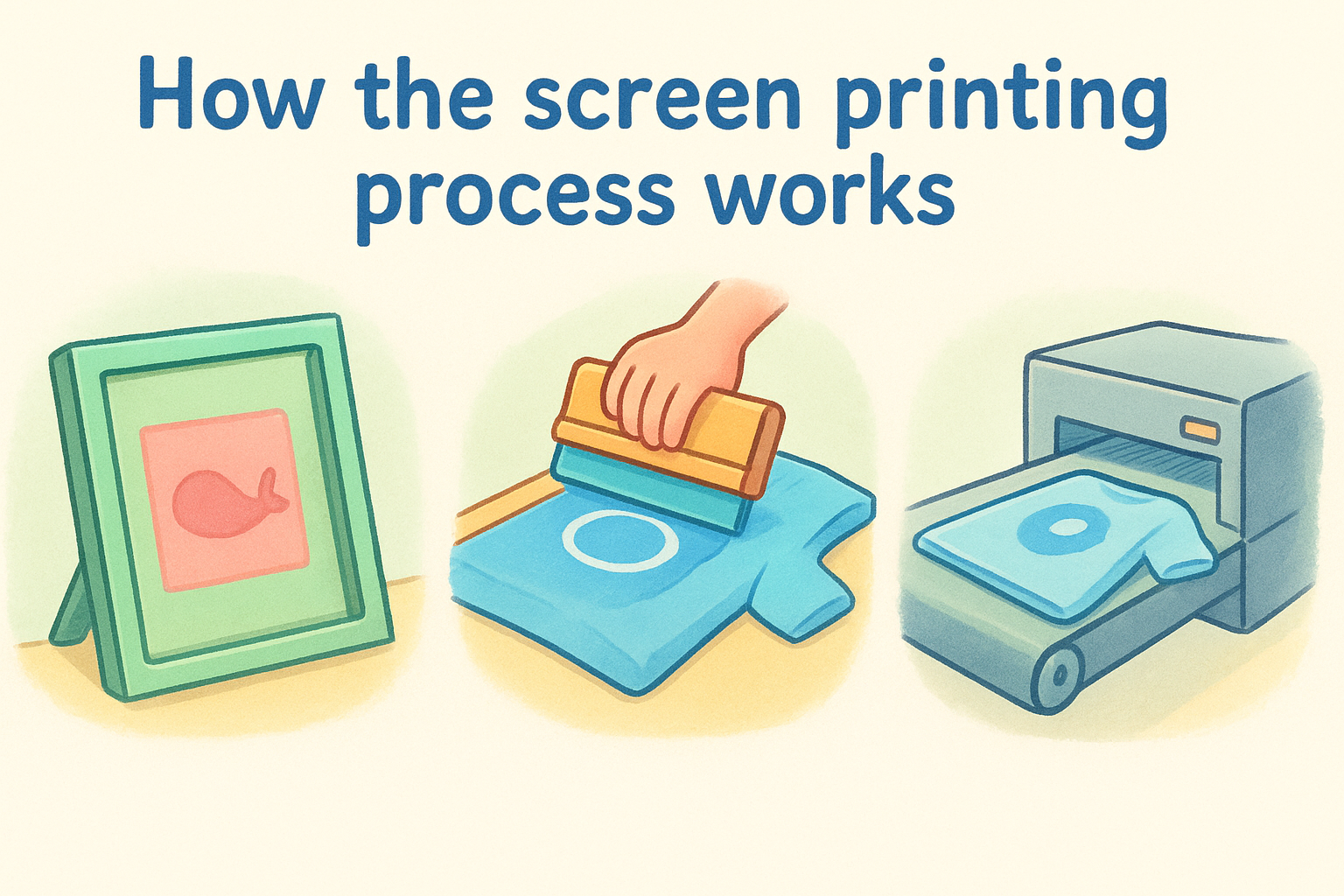
Once your screens are made and your press is running, screen printing produces consistent, high-quality results at a pace that lowers your cost per unit significantly as volume increases.
What you get with screen printing
You get a print with strong color opacity and a firm ink deposit that holds up under heavy use. Screen printing handles bold graphics, solid text, and defined shapes better than almost any other method. The ink bonds well to cotton and cotton-blend fabrics, which makes it the standard choice for work uniforms, athletic gear, and high-volume event apparel where durability is non-negotiable.
When you weigh screen printing vs. direct to film transfers, one trade-off becomes clear quickly: screen printing works best when your design has a limited number of colors and your order size is large enough to absorb the setup cost. A single-color or two-color logo printed on 72 or more shirts is where screen printing typically delivers its best value. Complex photographic images or designs with more than six colors become expensive to separate and screen, so those projects often fit better with a different method.
Direct-to-film transfer basics and what you get
Direct-to-film transfers are a newer print technology that produces a full-color design on a special film sheet, which gets heat pressed onto your garment. Unlike screen printing, the process requires no screens, no color separations, and no minimum color counts. The entire design prints in a single pass, which makes it a fast and flexible option for orders where variety or short runs are the priority.
How the DTF process works
A DTF printer lays your design onto a clear polyester film using CMYK inks plus a white ink layer underneath to ensure vibrant colors on any fabric color, including black and dark garments. Once printed, a powdered adhesive gets applied to the wet ink and then cured with heat. The finished transfer sits ready to press until you apply it to a shirt with a heat press. The adhesive bonds the print to the fabric surface, giving you a smooth, finished result without the screen setup process that screen printing requires.
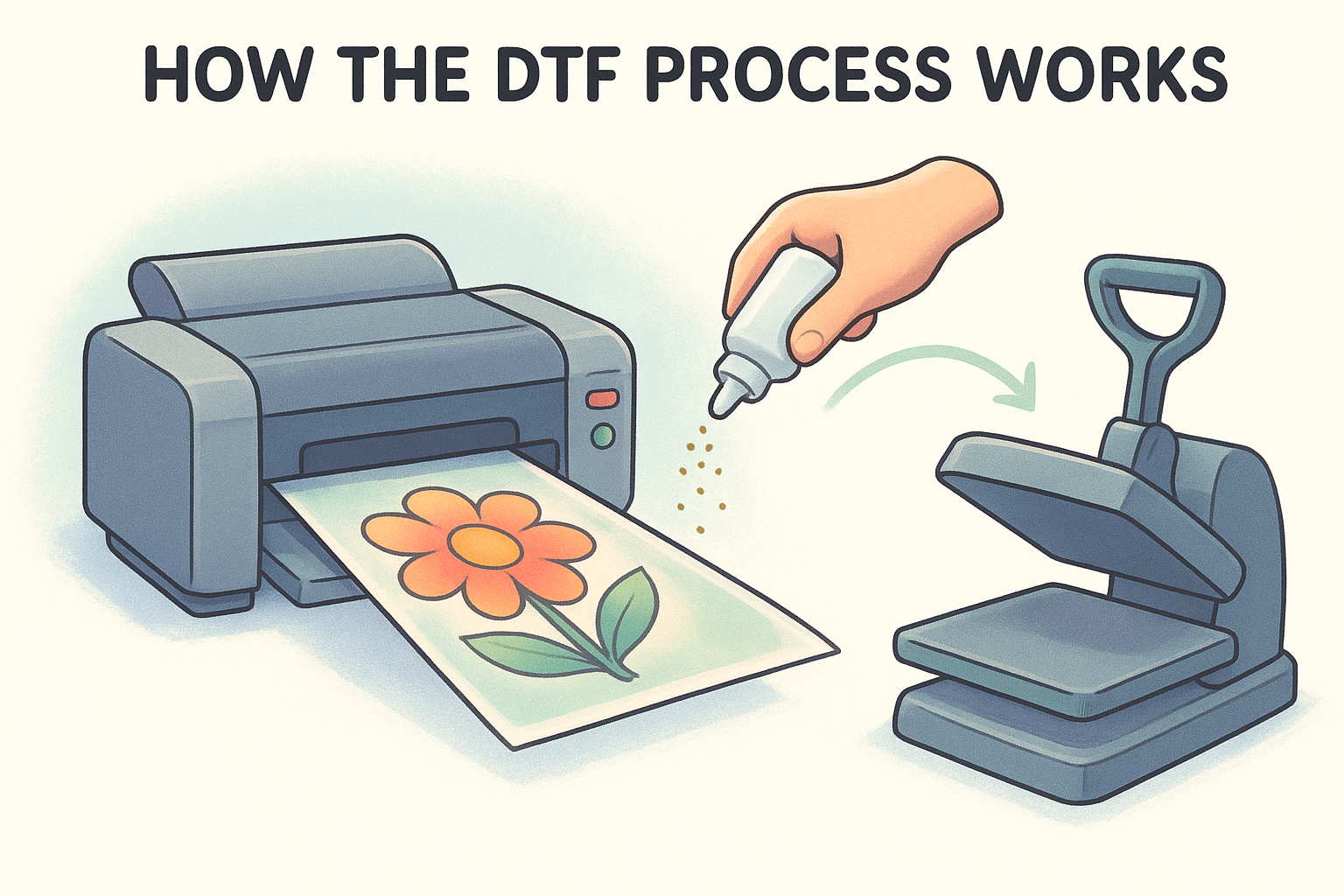
Because the adhesive layer bonds to the fabric rather than soaking into it, DTF transfers work across a wide range of fabric types without the compatibility limitations that other methods carry.
What you get with DTF transfers
You get full-color printing at any order quantity, with no screen charges added to your invoice regardless of how many colors your design contains. That makes DTF transfers a strong fit for photographic artwork, gradient designs, and complex multi-color logos that would carry significant setup fees in screen printing. Your cost stays predictable whether you order 12 shirts or 60, which works well for businesses that need small batches of branded apparel on a regular basis.
When you evaluate screen printing vs. direct to film transfers, DTF’s biggest advantage is its flexibility across design types and order sizes. The trade-off is that the adhesive layer sits on top of the fabric rather than bonding at the fiber level the way plastisol ink does in screen printing. This means the hand feel of a DTF print is slightly more noticeable on lightweight fabrics, and the long-term durability under heavy wash cycles differs from what screen printing delivers. Those differences matter more for some orders than others, which is why understanding both methods helps you make a smarter choice.
Quality and hand feel differences you can expect
Print quality looks different depending on what you’re printing and which method produces it. Both screen printing and DTF transfers can deliver sharp, professional results, but each method has specific strengths that show up clearly when you put finished shirts side by side. Understanding those differences before you order helps you set accurate expectations and pick the method that fits your design goals.
Print sharpness and color vibrancy
Screen printing produces exceptionally opaque, saturated colors because the ink deposits directly onto the fabric in a thick, consistent layer. Solid shapes, bold text, and defined edges look crisp and clean, even from a distance. The colors appear rich and consistent across an entire run because every shirt goes through the same ink application and cure process. When you compare screen printing vs. direct to film transfers on a simple two-color logo, the screen printed version typically shows stronger color punch on cotton fabrics.
DTF transfers handle complex artwork in ways that screen printing cannot match economically. Gradients, photographic images, and multi-color designs all print in a single pass without any additional cost or color limitation. The color accuracy on DTF is high, especially for detailed artwork, because the process uses a full CMYK range plus a white underbase. However, on very light or white garments, the white ink layer in DTF can slightly soften the crispness of fine lines and very small text compared to a direct screen printed result.
For bold, simple designs at high volume, screen printing delivers superior color saturation. For complex, multi-color artwork at any quantity, DTF closes the gap significantly.
How the print feels on the shirt
Screen printing leaves a soft, integrated feel on the garment when done correctly. Plastisol ink bonds with the fabric surface and, after curing, becomes part of the shirt rather than a separate layer sitting on top. On standard cotton and cotton-blend tees, the finished print feels smooth and barely raised, which most wearers find comfortable even on garments worn daily.
DTF transfers feel slightly different because the adhesive layer remains between the ink film and the fabric. On lightweight tri-blend or performance fabrics, you can feel a thin, flexible film when you run your hand across the design. It does not feel stiff or plastic, but it is more noticeable than a well-executed screen print. On heavier cotton garments, the difference in hand feel is less obvious and many wearers cannot distinguish between the two methods without close inspection.
Durability and wash wear expectations
Durability separates a worthwhile purchase from a short-term expense. How a print holds up after repeated washing is one of the most important factors for businesses ordering work uniforms, athletic gear, or any apparel that sees daily use. Both methods can produce long-lasting results, but the conditions that support that longevity differ significantly between screen printing and DTF transfers.
How screen printing holds up over time
Screen printing has a well-established durability record for good reason. Plastisol ink bonds directly to the fabric fibers during the curing process, creating a connection that resists peeling and cracking under normal wash conditions. On cotton and cotton-blend garments washed in cold or warm water, a properly cured screen print can last the full life of the shirt without significant fading or breakdown at the edges of the design.
The two most common causes of early wear in screen printing are under-curing during production and washing garments in hot water with high-heat dryer cycles. When you wash branded work shirts in cold water and tumble dry on low, a quality screen print holds up through hundreds of cycles without visible degradation. Aggressive laundering accelerates wear on any print type, but screen printing gives you the most tolerance for heavy-use applications across trade and service environments.
How DTF transfers hold up over time
DTF transfers are more durable than their reputation sometimes suggests, but the adhesive layer is the variable that determines longevity. When a transfer is pressed correctly with the right temperature, pressure, and dwell time, the adhesive bonds firmly to the fabric and resists peeling through regular wash cycles. Improperly pressed transfers, however, can begin to lift at the edges after several washes, particularly on stretchy or performance fabrics.
Proper care instructions matter more with DTF than with screen printing, so always include washing guidance with garments decorated using this method.
When you evaluate screen printing vs. direct to film transfers on durability alone, screen printing holds a measurable advantage for high-use applications like trade uniforms and athletic gear worn multiple times per week. DTF transfers work well for promotional items, seasonal apparel, and lower-frequency use cases where garments see moderate washing rather than hard daily wear.
Cost and turnaround by order size and colors
Cost and speed shift significantly depending on which method you use and how many shirts you need. When you compare screen printing vs. direct to film transfers, the pricing structures work in completely opposite directions. Screen printing rewards volume and penalizes complexity at low quantities, while DTF keeps costs predictable regardless of color count or order size.
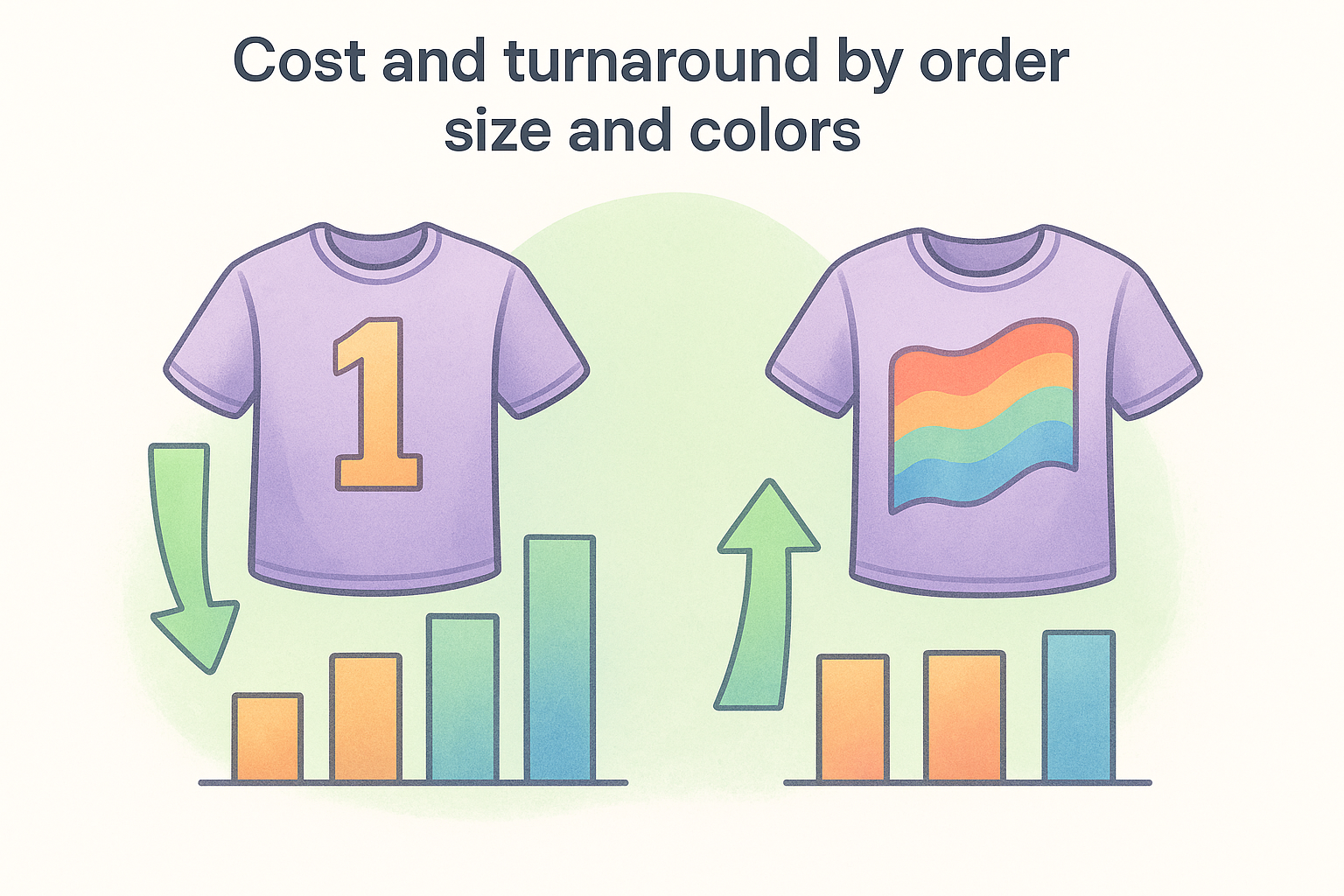
How screen printing costs scale with colors and volume
Screen printing charges you a screen fee for each color in your design, typically ranging from $15 to $35 per screen per order. A four-color logo means four screens, which adds $60 to $140 in setup costs before a single shirt gets printed. That upfront cost spreads across your total order, so at 100 shirts, the screen fees add roughly $0.60 to $1.40 per unit. At 24 shirts, those same fees can add $2.50 to $5.80 per unit, which significantly changes your total budget.
The per-unit ink cost drops steadily as your order size grows. A single-color print on 72 shirts can cost as little as $4 to $6 per shirt in decoration alone, compared to $9 to $14 per shirt on an order of 12. Ordering at or above the 72-piece threshold is where screen printing delivers its best cost-per-unit value for simple to moderate designs.
How DTF transfer costs stay flat across quantities
DTF transfers carry no screen setup fees, which keeps your per-unit cost predictable regardless of how many colors your design contains. A 12-shirt order with a six-color gradient costs the same per-unit rate as a two-color logo at the same quantity. That consistency makes budgeting straightforward for businesses that order branded apparel in small batches throughout the year.
For orders under 48 pieces with complex or multi-color artwork, DTF transfers almost always produce a lower total cost than screen printing. Once your order climbs past 72 to 100 units on a simple design, screen printing’s lower per-unit ink cost typically offsets the screen setup fees and pulls ahead on total price.
If your order size regularly falls below 48 pieces, DTF usually wins on cost. Above 100 pieces with a simple design, screen printing wins.
Turnaround time at different order sizes
Screen printing requires screen production and press setup before any shirts move into production, adding two to four business days to your timeline regardless of quantity. DTF skips that prep phase entirely. For smaller runs, your turnaround with DTF can run one to two days faster, which matters when a crew start date or event deadline does not move.
Fabric and garment compatibility
The fabric you print on affects how well each method bonds and how long that bond lasts. When you compare screen printing vs. direct to film transfers on fabric compatibility, the two methods serve different garment types, and picking the wrong one for your fabric can shorten the life of your print significantly. Your garment selection and your decoration method need to match before you place the order.
What fabrics work best with screen printing
Screen printing performs best on natural and cotton-heavy fabrics where the plastisol ink can cure properly and bond well to the fibers. Standard cotton and cotton-poly blends in the 50/50 to 100% cotton range give you the most reliable results. Fabrics like Next Level, Bella Canvas, and Gildan cotton tees are common screen printing substrates for exactly this reason. The flat, stable surface of a cotton garment lets the screen lay ink down evenly without distortion.
Highly stretchy fabrics and performance polyester present more challenges for screen printing. Moisture-wicking athletic wear often carries a polyester content above 80%, which can cause plastisol ink to bleed or shift color during the curing process. Heat-sensitive fabrics can also warp under the high temperatures required to cure screen printing ink properly, which makes them a poor match for this method.
If your garment contains more than 65% polyester, DTF transfers are typically the safer and more consistent choice.
What fabrics work best with DTF transfers
DTF transfers bond through an adhesive layer that works across a much wider range of fabric types, including polyester, nylon, performance blends, and even canvas. Because the print does not require the same high-cure temperature as plastisol ink, heat-sensitive fabrics face less risk during the application process. This makes DTF a reliable option for athletic jerseys, moisture-wicking work shirts, and branded hats where fabric content varies.
Dark fabrics present no additional challenge for DTF transfers because the white ink underbase prints automatically as part of the process. Screen printing dark garments requires a separate underbase screen and additional setup, which adds cost and complexity. DTF handles black, navy, and dark gray garments without any changes to the process or your per-unit price, giving you more flexibility in garment selection without driving up your total invoice.
How to choose the right method for your order
Choosing between screen printing vs. direct to film transfers comes down to four variables: your order quantity, your design complexity, your fabric type, and how hard the finished shirts will work. Run through each one before you commit, and the right method becomes clear without guesswork.
Start with order size and color count
Your order quantity is the single fastest filter for narrowing down your choice. If you need fewer than 48 pieces, DTF transfers almost always deliver a lower total cost because you avoid screen setup fees entirely. If your order runs above 100 pieces on a simple one-to-three color design, screen printing pulls ahead on per-unit cost once those setup fees spread across the full run.
Color count works alongside quantity to shape your decision. A six-color logo at 24 shirts gets expensive fast with screen printing because each color adds another screen fee to your invoice. That same design costs you a flat, predictable rate with DTF regardless of how many colors it contains. Add up your color count and your quantity together before you pick a method, not one or the other in isolation.
If your design has more than four colors and your order sits below 72 pieces, DTF transfers will almost always cost you less.
Factor in your fabric and how the shirts will be used
Fabric content shapes which method bonds correctly and holds up through regular use. If your order involves standard cotton or cotton-poly blend tees for a work crew or sports team, screen printing gives you the most durable result over heavy wash cycles. If you’re printing on performance polyester, moisture-wicking athletic wear, or dark garments, DTF handles those substrates more reliably without the risk of color shifting or dye migration during cure.
End use matters just as much as fabric. Branded uniforms for plumbers, roofers, or landscapers that go through the wash multiple times per week benefit from the durability of screen printing on cotton. Promotional shirts, seasonal event apparel, or smaller branded runs for an office team work well with DTF because the wash frequency is lower and the short-run economics favor the transfer method.
Match your method to the actual conditions your shirts will face, and you end up with an order that holds up and a total cost that fits your budget.
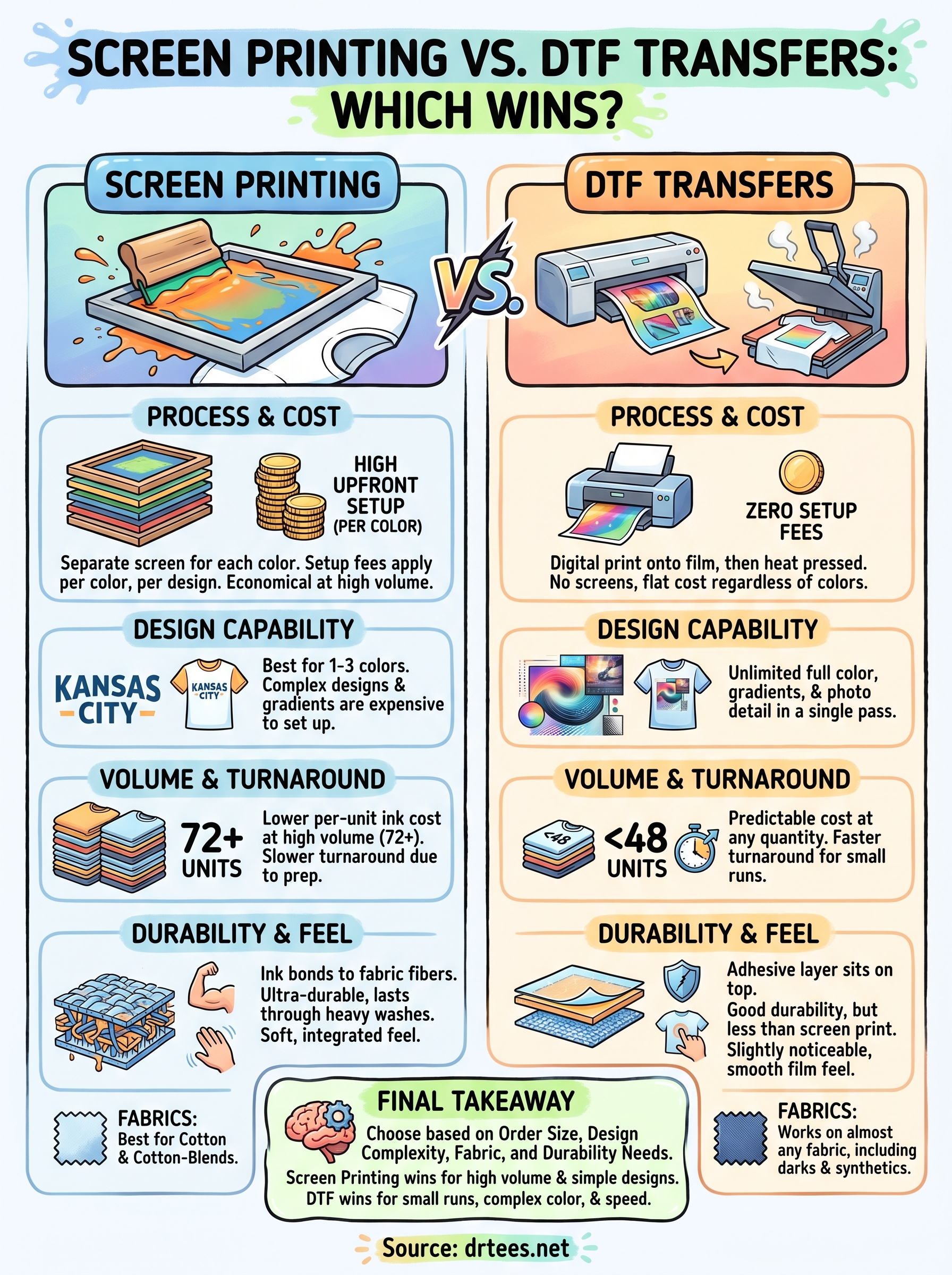
Final takeaway
The decision between screen printing vs. direct to film transfers is not about which method is better overall. It is about which method fits your specific project. Screen printing wins on durability and per-unit cost when your order volume is high and your design stays simple. DTF transfers win on flexibility, color range, and short-run economics when your order is small or your artwork is complex.
Your fabric type, your order size, your color count, and how hard your shirts will work in the field are the four variables that point you toward the right answer every time. Get those details in front of a professional before you commit, and you avoid paying more than you need to for results that fall short of your expectations. Dr. Tee’s has helped Kansas City businesses make exactly this call for over 20 years. Get a quote and talk through your order before you decide.
