
Most roofing companies get jobs the same way, referrals, yard signs, maybe a Google listing. That works until it doesn’t. When the phone slows down, you realize you’ve been relying on luck instead of a system. Marketing for roofing companies isn’t about doing one thing right; it’s about stacking multiple strategies that keep leads flowing whether it’s storm season or a slow February.
At Dr. Tee’s Design & Screen Printing, we work with roofing crews and contractors across Kansas City every day. We see firsthand how something as straightforward as branded work shirts and uniforms can turn every job site into a billboard, and that’s just one piece of the puzzle. After 20+ years helping trade professionals build their brand presence, we’ve picked up a thing or two about what actually moves the needle.
This article breaks down nine proven strategies that roofing companies are using right now to generate leads and grow. Some cost money, some cost time, and a few cost almost nothing. Each one is actionable, and you can start with whichever fits your budget and bandwidth today.
1. Branded apparel and jobsite signage
When your crew shows up to a job, neighbors are watching. Branded work shirts, hats, and yard signs turn every project into a passive marketing touchpoint without any extra effort from you. This is one of the most overlooked forms of marketing for roofing companies, because it works around the clock while your team focuses on the work.
What to order for a roofing crew that looks legit
Your crew should arrive looking like a real company, not a side job. Start with screen-printed t-shirts or polo shirts in a consistent color that aligns with your brand. Add hats for sun protection and crew visibility, and consider a zip-up hoodie or sweatshirt for shoulder-season jobs. Minimum orders of 12 units keep your costs manageable while giving you enough to outfit a full crew and hold a few spares for new hires.
How to design logos and layouts that read fast
A logo on a work shirt needs to communicate your company name and trade in under three seconds. Keep the design simple: one to two colors, clean fonts, and your phone number or website included below the name. Avoid overly detailed graphics that lose clarity when printed at chest size. A professional graphic designer can translate your existing logo into a print-ready file that holds up on fabric and looks intentional from across a yard.
The best branded apparel works at a distance. If a neighbor can’t read your company name from the sidewalk, the design needs to be simplified before you print 50 shirts.
Where to place branding so homeowners notice it
Put a yard sign at every active job site the moment your crew starts work. Neighbors two or three houses down will see it for the full project duration. Magnetic vehicle decals or truck lettering extend that reach across every street your team drives. Left chest logos on shirts are the standard placement, but a large back print adds visibility when your crew faces away from the street while working on the ground.
Budget ranges and reorder cadence
Screen-printed shirts typically run $10 to $20 per unit at standard quantities, with the price dropping as volume increases. Budget $300 to $600 to outfit a crew of 10 with two shirts each. Plan to reorder every season or when you bring on new crew members. Yard signs cost $5 to $15 each and should be treated as a recurring supply expense, the same way you budget for materials.
2. A conversion-first roofing website
Your website is the hub of every marketing for roofing companies strategy you run. Paid ads, yard signs, and referrals all push people there before they call. If the site doesn’t convert those visits into leads, every other channel you invest in leaks money.
Pages every roofing website needs to win leads
A roofing website needs a handful of core pages to capture leads effectively. Build at minimum:
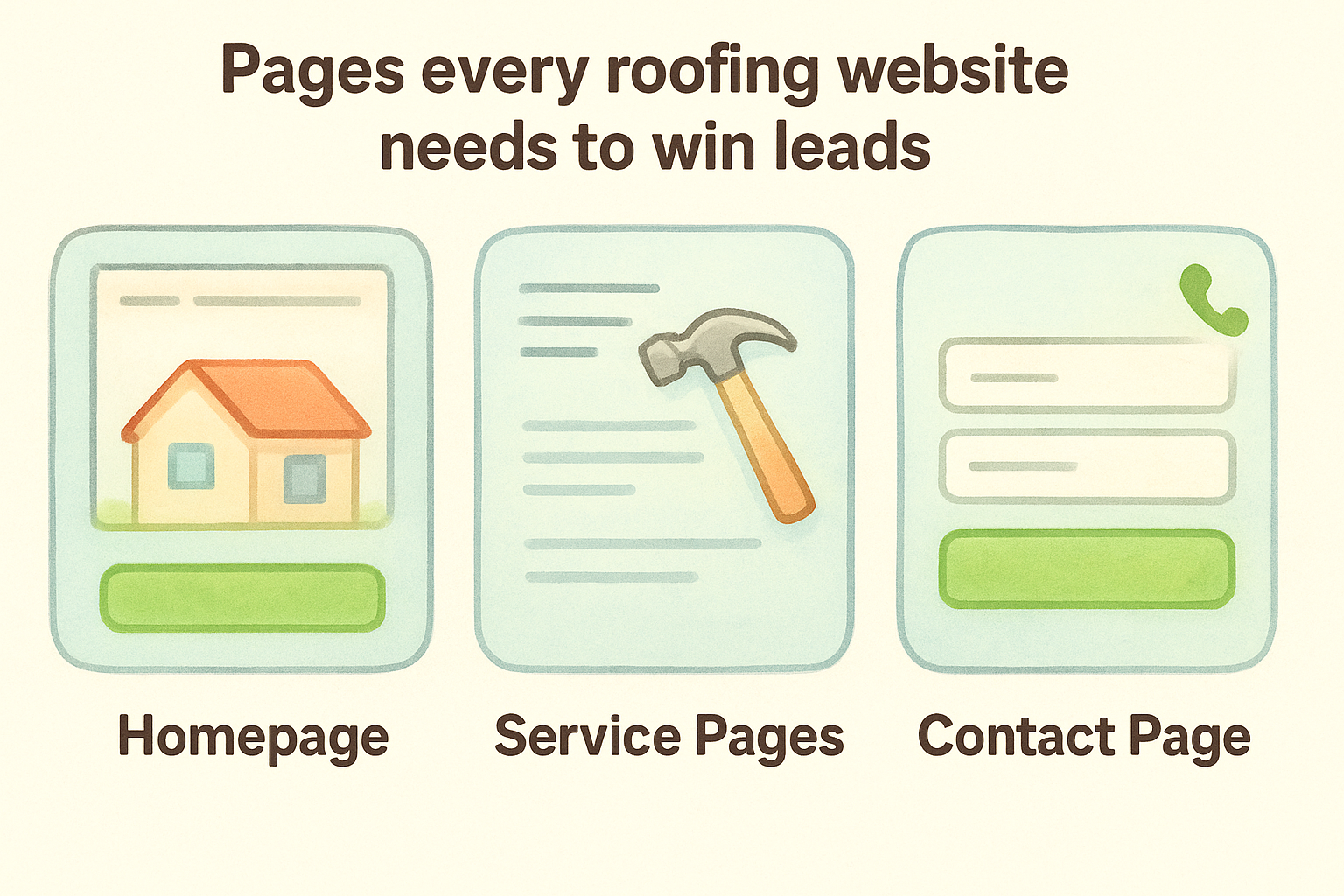
- Homepage: states who you serve, what you do, and how to reach you above the fold
- Service pages: separate pages for roof repair, replacement, and storm damage work
- Contact page: a short estimate form paired with a visible phone number
Each page should focus on one clear action so visitors know exactly what step to take next.
How to turn visits into calls and estimate requests
Put your phone number in the header of every page and add a click-to-call button for mobile visitors. Keep estimate forms to three fields: name, phone number, and job type. Shorter forms get completed more often, and faster submissions mean faster follow-up.
If a visitor has to hunt for your phone number, you’ve already lost the lead.
Mobile traffic accounts for the majority of local service searches. Test your site on a phone monthly to confirm buttons work and your number is tappable without zooming.
Trust builders that reduce price shopping
Add customer reviews and job photos directly to your homepage. These details answer the questions buyers ask before they’re willing to talk price.
Display your license number, insurance details, and years in business so homeowners feel confident requesting a quote rather than shopping around.
Tracking basics so you know what is working
Install Google Analytics and Google Search Console from day one. Connect your contact form to a CRM or email alert so no lead slips through unnoticed.
Both tools are free and show you which pages bring traffic and where visitors leave without converting. Check them monthly to catch problems before they cost you booked jobs.
3. Google Business Profile and local SEO
When someone searches "roof repair near me," Google’s map pack shows three local businesses before any organic results. If your company isn’t in that pack, you’re missing the most ready-to-buy searchers in your area. For marketing for roofing companies, your Google Business Profile is the single highest-leverage free tool available to you.
Google Business Profile checklist for roofers
Claim and verify your profile at Google Business Profile, then complete every available field. Add your service area cities, business hours, phone number, and a link to your website. Upload at least 10 photos showing completed roofing jobs, your crew on site, and your branded trucks. A complete profile outperforms an incomplete one every time.
How to rank in the map pack in your service area
Google ranks local profiles based on relevance, distance, and prominence. You improve all three by keeping your name, address, and phone number identical across every directory listing online. Add your primary roofing services directly in the profile so Google connects your listing to the right searches in your city.
Inconsistent contact information across directories is one of the fastest ways to drop out of the map pack.
Local SEO content that attracts high-intent searches
Write individual pages targeting phrases like "roof replacement [city name]" and "storm damage repair" for each area you cover. Google rewards content that directly matches what local homeowners search when they need a roofer quickly.
Review generation and response workflow
After every completed job, text or email the homeowner a direct link to your Google review page. Respond to every review within 48 hours. Consistent reviews and fast responses signal to Google that your business is active and trustworthy, which pushes your profile higher in local results.
4. Paid search for high-intent roofing leads
Paid search puts your company in front of homeowners who are actively searching for a roofer right now. Unlike social media ads that interrupt people mid-scroll, search ads target buyers with intent, making paid search one of the fastest channels for marketing for roofing companies that need consistent lead flow.
When to run Google Local Services Ads vs Google Ads
Google Local Services Ads (LSAs) appear above everything else in search results and charge you only when a homeowner calls or messages directly through the ad. Run LSAs if you want leads with minimal setup and a built-in Google Guarantee badge. Standard Google Ads give you more control over targeting, bidding, and landing page destination, making them better for companies ready to optimize aggressively.
Running both simultaneously is a common approach for roofing companies that want maximum visibility at the top of search results.
Targeting and keywords that match real roof problems
Skip broad terms and bid on problem-specific phrases like "leaking roof repair," "storm damage roof replacement," and "missing shingles repair." These searches signal immediate need, which means the person calling is ready to book, not just browsing.
Landing pages, call handling, and lead quality filters
Send paid traffic to a dedicated landing page, not your homepage. The page should match the ad’s message, show a phone number above the fold, and include a short form. Answer every call within five minutes to prevent paid leads from calling your competitor instead.
Budget planning, seasonality, and optimization levers
Start with $1,500 to $3,000 per month and scale based on your cost per booked job. Increase budgets during spring and post-storm periods when search volume spikes, and reduce spend in slower months to protect margins.
5. Service and location landing pages that rank
Dedicated landing pages are one of the highest-return investments in marketing for roofing companies. Each page targets a specific service and city combination, so Google can match your content to exactly what homeowners search when they need a roofer in their area.
The right structure for services and cities
Build a separate page for each service you offer in each city you cover. A page targeting "roof repair in Overland Park" outperforms a catch-all services page because it directly matches search intent. Keep your URL structure clean and predictable:
- domain.com/roof-repair/city-name
- domain.com/storm-damage/city-name
- domain.com/roof-replacement/city-name
What to include so pages feel local and credible
Each page needs a clear headline, a description of the specific service, and at least one photo from a real job in that area. Mention local weather patterns, neighborhood names, or common roofing issues specific to that city. Specificity signals relevance to both Google and the homeowner reading the page.
Generic location pages that swap out only the city name get ignored by Google and ignored by readers.
On-page SEO fundamentals you can control
Include the target city and service in your page title, H1, opening paragraph, and at least one subheading. Add a short FAQ section that answers common questions about that service to pull in long-tail searches.
How to scale pages without creating thin content
Create a content template that defines required sections, then fill in location-specific details for each page. Thin pages with minimal unique content hurt rankings more than they help, so set a minimum content standard of 400 words before you publish any new location page.
6. Photos, video, and social proof that sell the job
Visual proof is one of the most underused tools in marketing for roofing companies. Homeowners cannot evaluate workmanship quality from a phone call, but a clear photo of a finished roof does that job instantly. Every project you complete is content waiting to be captured.
A jobsite content checklist your crew can follow
Give your crew a simple routine to run through at every job. Capture a wide shot of the completed roof, close-ups of the flashing and ridge work, and a photo of the branded crew on site before they pack up.
- Full roof wide shot after completion
- Close-up of ridge caps and flashing details
- Crew photo with branded shirts and signage visible
- 30-second walkaround video clip
Before-and-after assets that drive calls
Nothing sells a roofing job faster than a side-by-side comparison of a damaged roof and a finished replacement. Homeowners who see their exact problem reflected in your before photo are far more likely to call than those who only read a description.
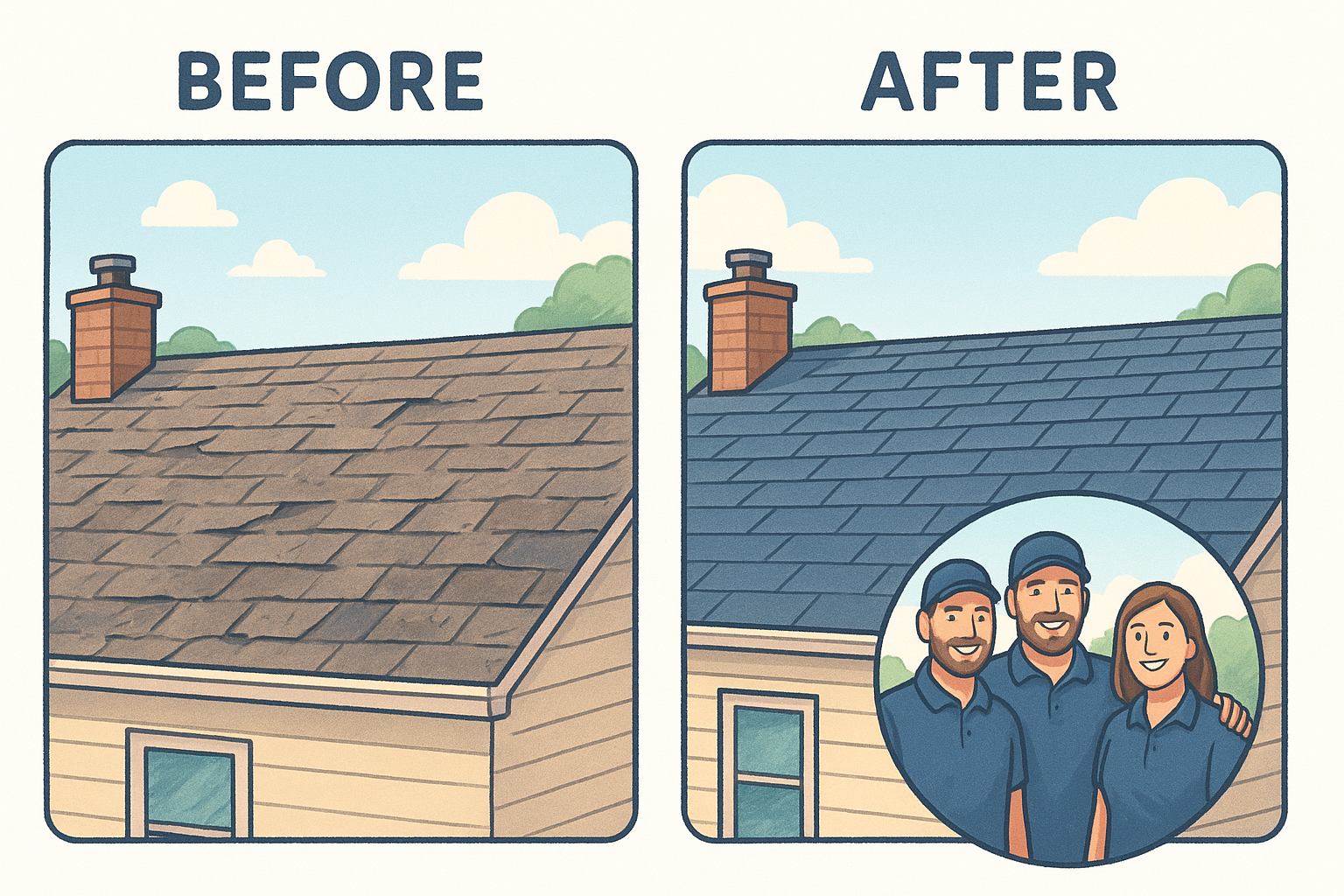
Before-and-after photos are the closest thing to a free sales pitch you can produce.
Testimonial and reputation assets to use across channels
Screenshot five-star Google reviews and turn them into graphics for your website and social pages. Video testimonials carry even more weight because viewers see a real person speaking about a real result on a real house.
How to repurpose one project into weeks of content
One completed job generates multiple pieces of content you can schedule across weeks:
- Google Business Profile photo upload
- Before-and-after social post
- Testimonial graphic pulled from the homeowner’s review
- Short video walkthrough of the finished job
Spreading each piece out over two to three weeks keeps your profiles active without requiring a new project every day.
7. Social and community channels that actually convert
Social media works for marketing for roofing companies when you focus on platforms where homeowners actually make local buying decisions, not where you feel comfortable scrolling.
Best platforms for roofers by audience and job type
Facebook and Nextdoor give you the highest return for residential roofing because both skew toward homeowners with disposable income and strong neighborhood-level trust. Use Instagram if you commit to posting strong before-and-after visuals consistently. Skip platforms that don’t put your content directly in front of local homeowners looking to protect and maintain their homes.
Content pillars that keep posting simple and consistent
Pick three to four content types and rotate through them so posting never becomes a creative bottleneck. A simple rotation might include job photos, quick tips on spotting storm damage, customer reviews, and crew spotlights. Consistency beats creativity at this stage; posting three times a week with straightforward content outperforms one polished post per month every time.
A simple content calendar built in a free spreadsheet is enough to keep your posting on track without overthinking it.
Community marketing on Nextdoor and local Facebook groups
Join neighborhood Facebook groups and Nextdoor as your business page and engage genuinely before promoting. Answer roofing questions, respond to homeowner concerns, and let your expertise do the selling. Direct pitches in these groups get ignored or removed; helpful answers get shared.
Retargeting and light paid boosts without wasting money
Boost your strongest before-and-after posts to a local homeowner audience for $5 to $10 per day to extend reach without large spend. Run retargeting ads on Facebook to re-engage people who visited your website but did not call or submit a form.
8. Follow-up automation and referrals
Winning the lead is only half the job. The other half is following up fast enough to actually close it. For marketing for roofing companies, automated follow-up systems and structured referral programs turn your existing pipeline into a compounding growth engine without adding headcount.
Speed-to-lead and missed-call recovery
Every minute you wait to respond to a new inquiry, your chance of closing that lead drops. Set up an automatic text reply that fires the moment someone submits a form or calls and gets no answer. The message should confirm you received their request and give a realistic callback window.
A lead that gets a response within five minutes is far more likely to book than one that waits an hour.
Email and SMS sequences that move estimates to booked jobs
After your initial contact, set up a short follow-up sequence of two to three messages over five days if the homeowner hasn’t booked yet. Keep each message brief, reference their specific roofing concern, and include a direct link to schedule a call. SMS open rates consistently outperform email, so lead with text when you have the number.
Referral offers that feel natural and easy to track
Ask satisfied customers for referrals at the job closeout, not weeks later. Offer a clear, simple incentive like a gift card or service discount for every referral that books. Use a unique tracking link or code per customer so you know exactly where each referral originated.
KPIs to monitor: lead speed, close rate, CAC, and LTV
Track four numbers monthly: average time from first contact to response, your estimate-to-booked-job close rate, cost to acquire each customer, and average lifetime value per client. These four metrics tell you where your follow-up and referral system is leaking money before it becomes a serious problem.
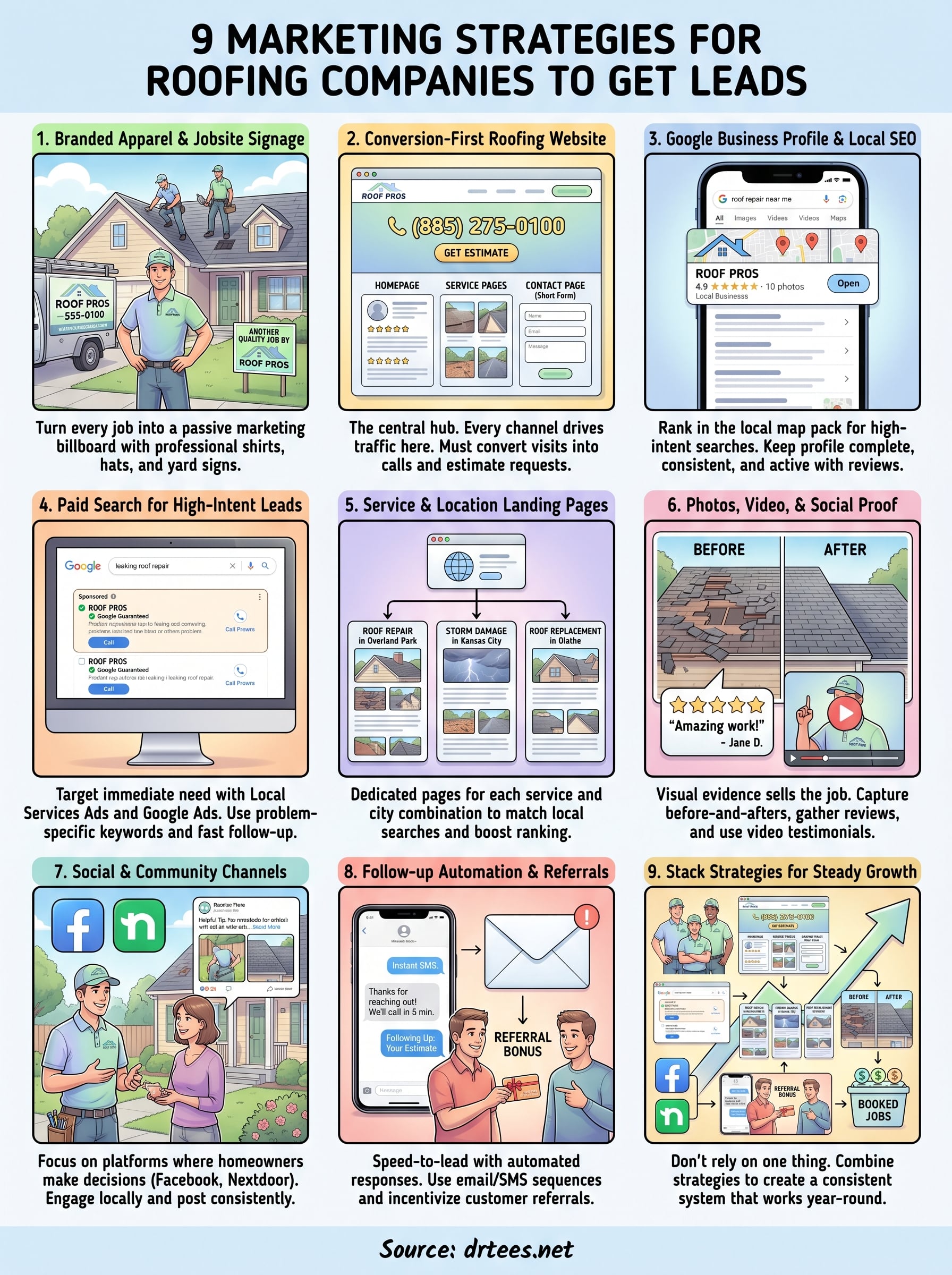
Keep your lead flow steady year-round
No single strategy here works in isolation. Marketing for roofing companies works best when these nine approaches reinforce each other: your branded crew builds neighborhood awareness, your website converts that awareness into form fills, and your follow-up system turns those form fills into booked jobs. Stack these channels intentionally and you stop depending on storm season to keep your schedule full.
Start with the strategies that fit your budget and bandwidth right now, then add layers as revenue grows. Your branded apparel and jobsite signage cost the least and deliver returns on every project you complete, making them a logical first step for any roofing company ready to look more professional on-site. When you’re ready to get your crew looking sharp, request a custom quote from Dr. Tee’s Design & Screen Printing and we’ll help you build a branded look that gets noticed from the street.
