
Most HVAC companies run on referrals and repeat business, until that pipeline dries up. When it does, figuring out marketing for HVAC companies can feel overwhelming, especially when you’re already managing crews, scheduling jobs, and keeping customers happy. But here’s the reality: your competitors are already marketing, and the ones doing it well are the ones booking more calls.
Effective HVAC marketing isn’t just about running ads or posting on social media. It starts with how your brand looks and feels at every touchpoint, from your website and Google listing to the shirts your techs wear on every service call. That’s where we come in at Dr. Tee’s Design & Screen Printing. We’ve spent over 20 years helping Kansas City trade professionals, including HVAC companies, build a professional brand image through custom screen-printed uniforms, embroidered polos, and print-ready design work that makes your business look established and trustworthy.
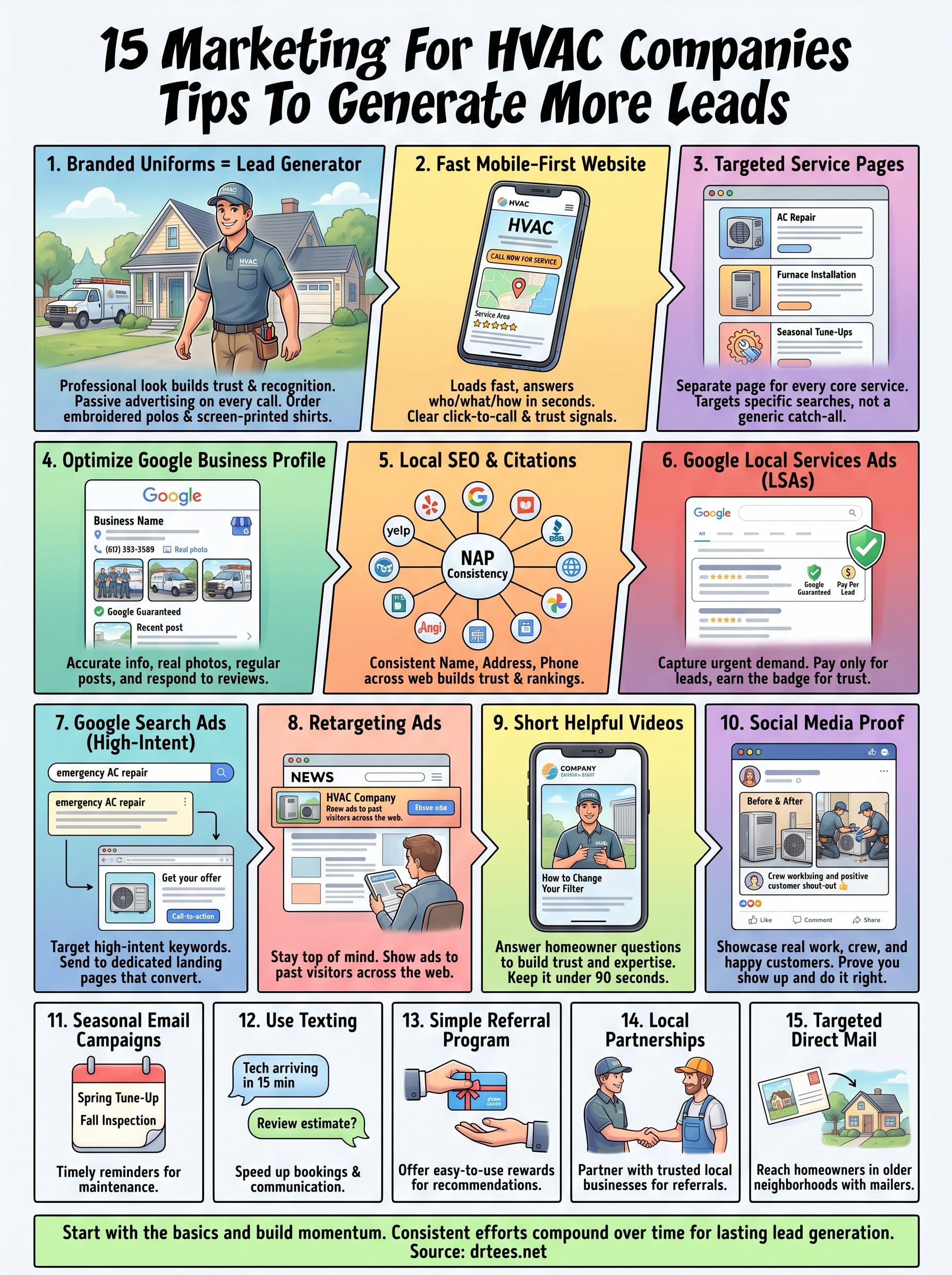
This guide breaks down 15 practical marketing tips designed to help HVAC businesses generate more leads and close more jobs. Whether you’re a one-truck operation or managing a full team, these strategies range from quick wins you can implement this week to long-term plays that compound over time. Let’s get into it.
1. Turn branded uniforms into a lead generator
Most HVAC companies overlook one of the simplest marketing channels available: the people already on the job. Every time your tech shows up at a home, they represent your brand. A clean, professionally branded uniform with your logo, phone number, and company name turns every service call into a passive advertisement in a neighborhood full of potential customers.
How branded apparel drives calls and referrals
Homeowners trust what they see repeatedly. When your crew shows up in matching embroidered polo shirts or screen-printed t-shirts, you look established, organized, and professional, which matters when someone is letting a stranger into their home. Neighbors notice. Other homeowners on the street see the truck, see the crew, and your brand gets burned into memory for the next time their AC goes out.
A branded uniform works every time your tech walks from the truck to the front door, not just when you’re running ads.
Word-of-mouth referrals are already a core part of marketing for HVAC companies, and uniforms amplify them. When a customer recommends you to a friend, that friend is more likely to call a company they already visually recognize from seeing your crew in the neighborhood.
What to order for an HVAC team and when to use it
Your baseline order should include short-sleeve and long-sleeve screen-printed t-shirts for daily field work, plus embroidered polo shirts for customer-facing situations like estimates and inspections. Add embroidered hats for sun protection on outdoor jobs and branded tote bags for leaving behind maintenance checklists or promotional materials.
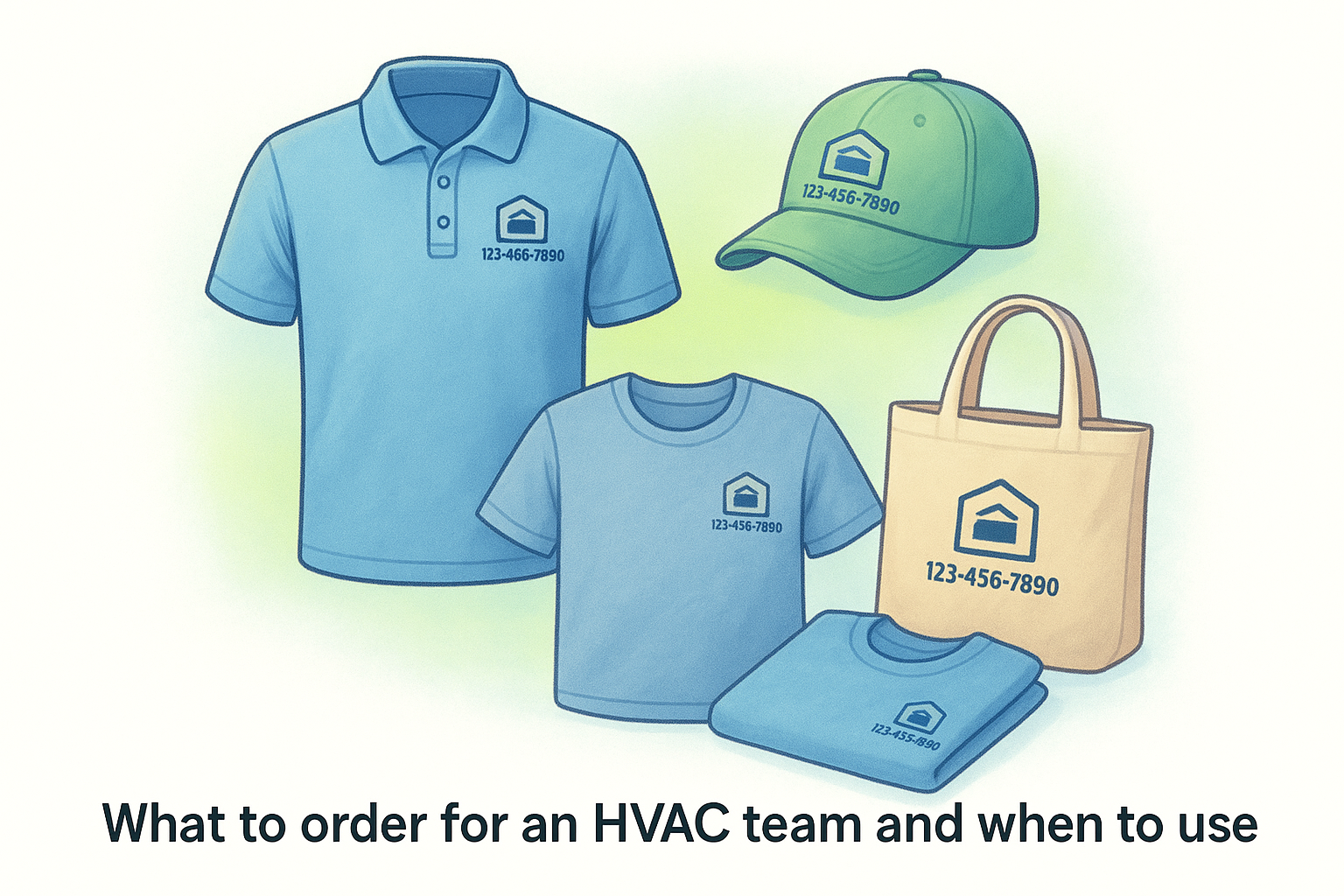
Order new gear at the start of each season, spring and fall, to keep crews looking sharp during your busiest service periods. If you’re onboarding new techs, plan for a two-week lead time so they show up to their first job properly outfitted.
Budget and timeline for uniforms and promo materials
A practical starting point is 12 to 24 units per order, which aligns with the low minimums Dr. Tee’s offers. Budget roughly $15 to $30 per shirt depending on garment quality and number of print colors, with embroidered polos typically running $25 to $45 per unit. For a crew of five, a complete seasonal uniform package lands between $300 and $600, a fraction of what a single paid ad campaign costs per month.
Count on a 7 to 14 day production window for most orders, longer if you need new logo files built from scratch before printing begins.
2. Build a fast mobile-first website that converts
Your website is often the first thing a potential customer checks before calling. Most homeowners search for HVAC help on their phones, so if your site loads slowly or looks broken on mobile, you lose that lead immediately before they ever read your services. A fast, mobile-friendly site is one of the most important foundations in marketing for HVAC companies.
What a high-converting HVAC homepage includes
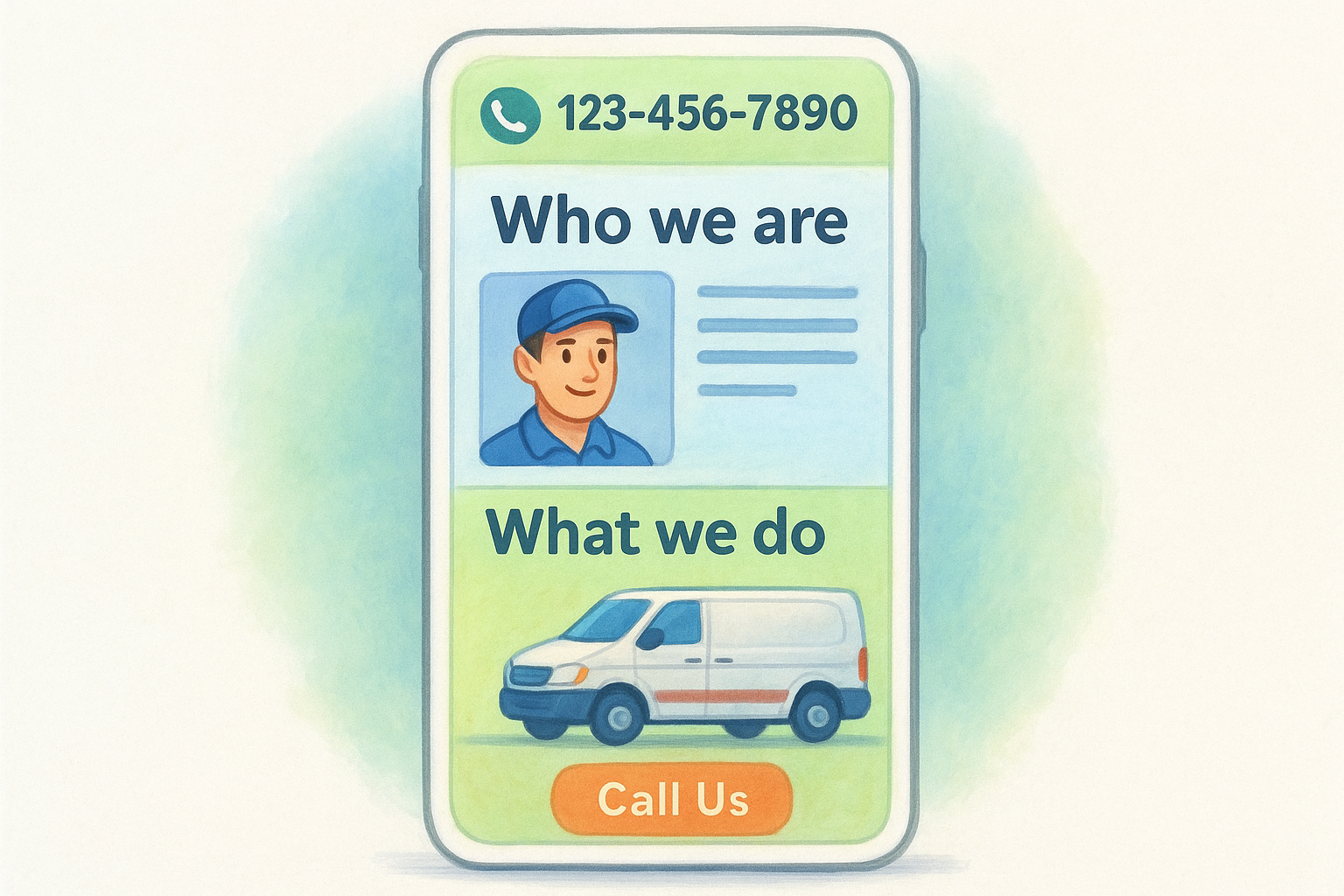
Every HVAC homepage needs to answer three questions within the first few seconds: who you are, what you do, and how to reach you. Put your phone number at the top of every page, include a short service area statement, and display trust signals like years in business, licenses, and customer reviews above the fold. Skip the generic stock photos and use real images of your crew and trucks instead.
How to turn "need help now" visitors into booked calls
Most HVAC visitors are in urgent need, not browsing casually. A prominent click-to-call button and a simple contact form on every page reduce friction between intent and action. Add a short response time guarantee, such as "we call back within 30 minutes," to give hesitant visitors a reason to commit rather than move on to a competitor.
The difference between a site that generates calls and one that doesn’t is usually the number of steps between landing and booking.
Budget and timeline for a rebuild vs improvements
A full website rebuild typically runs $2,000 to $6,000 through a local web developer and takes four to eight weeks. If your site is structurally sound, targeted improvements like mobile speed optimization and adding click-to-call buttons can cost $500 to $1,500 and take one to two weeks.
3. Create service pages that match real searches
Your website needs more than a generic "services" page. Dedicated service pages that target specific searches are one of the most effective tools in marketing for HVAC companies because they put you in front of homeowners who already know what they need and are ready to call.
Which HVAC pages you need to rank and convert
Start with a separate page for every core service you offer: AC installation, AC repair, furnace installation, furnace repair, heat pump services, and seasonal tune-ups. Each page should target a specific search phrase like "AC repair in Kansas City" rather than trying to rank one page for everything. Thin pages that lump services together rarely rank well and rarely convert visitors into calls either.
One focused page per service consistently outperforms one catch-all page trying to cover everything.
How to structure each page for SEO and bookings
Every service page needs a clear headline with your service and city name, a short description of what the service includes, and a visible phone number or booking form near the top. Include a brief FAQ section at the bottom to capture long-tail search queries like "how long does AC installation take" without bloating the main content. Add real photos of your crew doing the actual work to build trust fast.
Budget and timeline for content and on-page SEO
Writing and optimizing one service page typically costs $150 to $400 if you hire a local copywriter or SEO specialist. Building out a full set of six to eight service pages takes four to eight weeks depending on your current site setup and how quickly your team can review drafts for accuracy.
4. Set up and optimize your Google Business Profile
Your Google Business Profile (GBP) is often the very first thing a homeowner sees when they search for HVAC help nearby. It shows up before your website, before ads, and before any competitor who hasn’t claimed theirs. For marketing for HVAC companies, this is the highest-leverage free tool available, and most businesses leave it half-finished.
Which fields and settings move rankings and calls
Every field in your GBP affects how Google decides to show your listing. Make sure your business name, address, and phone number exactly match what’s on your website. Choose the most specific primary category, which for most HVAC companies is "HVAC Contractor," and add secondary categories like "Air Conditioning Contractor" or "Furnace Repair Service." Enable the messaging feature and booking link so customers can reach you directly from the listing without having to hunt for your contact info.
An incomplete GBP hands local rankings to the competitor who took 20 extra minutes to fill everything out.
How to use photos, services, and posts to stand out
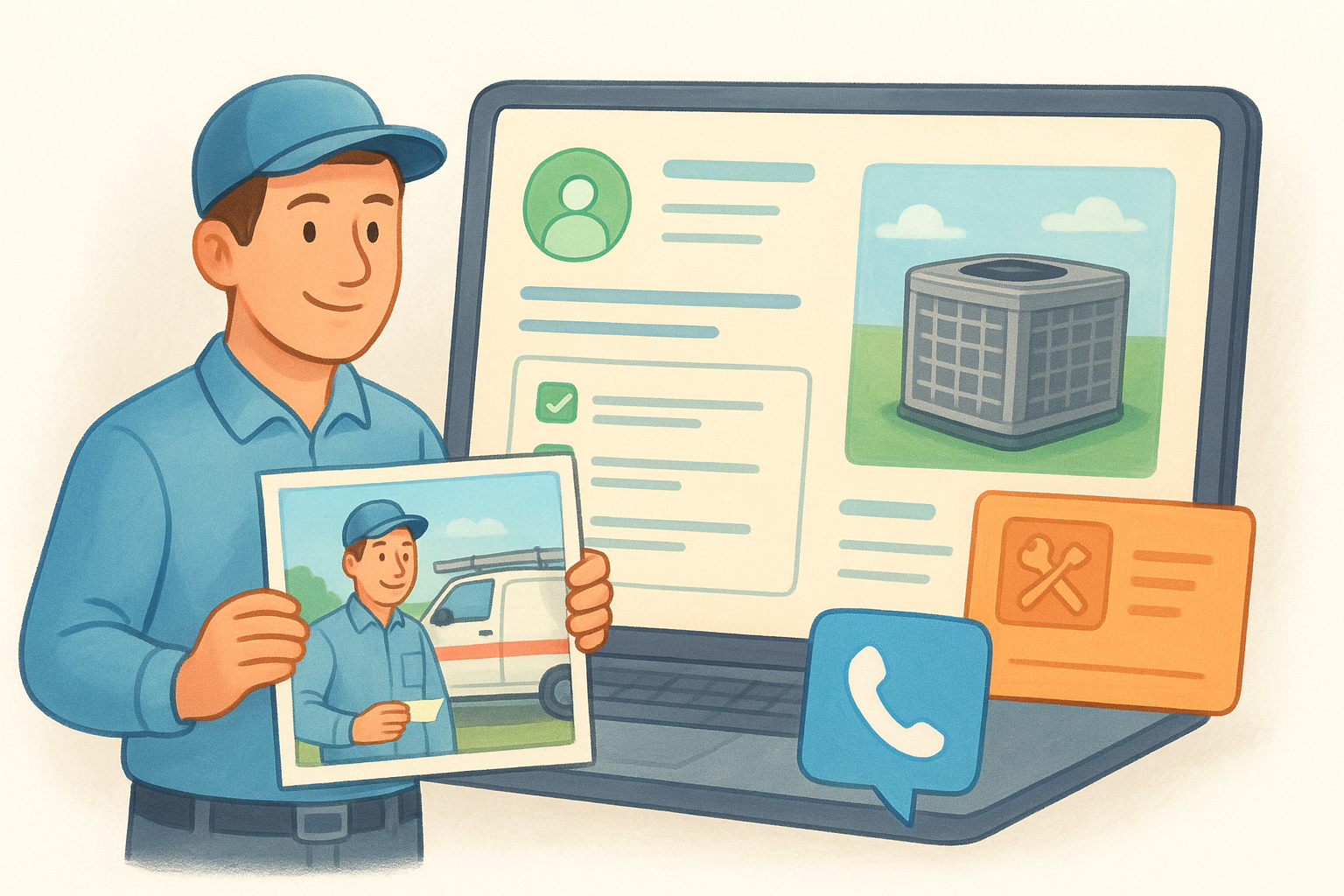
Upload real photos of your crew, trucks, and completed jobs rather than stock images. Listings with original photos generate significantly more clicks and direction requests. Add every service you offer under the "Services" section with short descriptions, and publish a new GBP post at least twice a month to signal activity to Google and give visitors a reason to trust you.
Budget and timeline to set up and maintain GBP
Setting up a complete GBP takes two to four hours for most business owners. Ongoing maintenance, including photo uploads, post publishing, and responding to every review, takes roughly 30 minutes per week and costs nothing beyond your time.
5. Improve local SEO with citations and location signals
Citations are online mentions of your business name, address, and phone number across directories, review sites, and local platforms. They act as trust signals that tell Google your business is legitimate and operating in a specific area. In marketing for HVAC companies, consistent citations across the web quietly strengthen your local search rankings month after month.
What citations and NAP consistency actually do
Every time your business information appears online, Google checks whether it matches what’s on your website and Google Business Profile. If your phone number is listed differently on three different directories, Google loses confidence in your listing and ranks you lower. Consistent NAP data across every platform tells Google you’re a real, established local business worth showing to nearby searchers.
Even one mismatched address across major directories can suppress your local rankings and cost you calls.
Where to list your HVAC business and what to fix
Start with the highest-traffic directories: Yelp, Angi, HomeAdvisor, Houzz, the Better Business Bureau, and your local chamber of commerce website. Run a citation audit using your own name, address, and phone to spot any inconsistencies. Fix outdated listings before adding new ones, since bad data spread to more sites only makes the problem worse.
Budget and timeline for cleanup and ongoing upkeep
A manual citation cleanup across 10 to 20 directories takes four to eight hours of focused work and costs nothing beyond your time. Once cleaned up, checking and updating your listings quarterly keeps everything accurate as your business grows or contact information changes.
6. Use Google Local Services Ads to capture urgent demand
Google Local Services Ads (LSAs) show up above regular search ads and organic results, which means they’re the first thing a homeowner sees when they search "AC repair near me" on a 90-degree afternoon. For marketing for HVAC companies, LSAs are one of the most direct ways to capture demand from people who need help today, not next week.
How LSAs work and what affects your ranking
LSAs charge you per lead, not per click, so you only pay when a homeowner actually calls or messages you through the ad. Google uses several factors to determine your placement: your proximity to the searcher, your review count and rating, your responsiveness to leads, and whether you carry the Google Screened or Google Guaranteed badge. Earning that badge requires a background check and license verification, but it significantly increases homeowner trust.
The Google Guaranteed badge removes the biggest hesitation most homeowners have before calling a new HVAC company.
How to avoid wasted spend with the right categories and hours
Set your service categories precisely to match only the jobs you actually want. If you don’t do commercial HVAC, exclude it. If your team doesn’t handle ductless mini-splits, uncheck that category. Also set your ad schedule to match your actual availability, because a lead that calls at 11pm when nobody answers is money wasted and a damaged ranking signal.
Budget and timeline to launch and optimize LSAs
Most HVAC companies start with a weekly budget between $200 and $500 depending on their service area size. Plan for two to four weeks to complete the verification process and get your first leads flowing consistently.
7. Run Google Search Ads for high-intent leads
Google Search Ads give you direct access to homeowners actively searching for HVAC help right now, not people scrolling a feed. Unlike LSAs, Search Ads let you control your messaging and send traffic to a dedicated landing page. For marketing for HVAC companies, paid search is one of the fastest ways to generate consistent inbound leads while your organic rankings are still building.
Which campaign types work best for HVAC services
Start with a standard Search campaign targeting high-intent keywords like "emergency AC repair," "furnace replacement near me," and "HVAC tune-up." Use exact match and phrase match keyword types to avoid burning budget on irrelevant queries. Broad match can quickly spend your full daily budget on searches that never turn into booked jobs, so avoid it until you have solid conversion data.
Tight keyword targeting from the start saves more money than any bid adjustment you’ll make later.
How to write ads and landing pages that book calls
Your ad headline needs to state exactly what you offer and where, such as "AC Repair in Kansas City – Same Day Available." Send clicks to a dedicated landing page, not your homepage, with one clear call to action.
Include your service area, a short customer review, and a response time guarantee on that landing page. Removing every distraction between the click and the phone call is the single biggest factor in whether your ad spend produces bookings or just traffic.
Budget and timeline to start small and scale safely
Begin with a daily budget of $30 to $50 and run for at least 30 days before making major changes. Give the campaign four to six weeks to collect enough data on which keywords and ads drive real calls before increasing spend.
8. Retarget website visitors to stay top of mind
Most homeowners who land on your site don’t call on the first visit. They’re comparing options, checking reviews, or simply getting pulled away by other tasks. Retargeting ads bring those visitors back by displaying your brand across other websites and apps after they leave. In marketing for HVAC companies, retargeting is one of the most cost-efficient ways to convert warm traffic that already showed interest in your services.
Why retargeting works for HVAC buyers who delay
HVAC purchases often involve hesitation. A homeowner notices their system running inefficiently but waits to see if the problem gets worse before calling anyone. During that delay window, retargeting keeps your company name and offer visible while they’re making their decision. Visitors who see retargeted ads are far more likely to convert than cold traffic because they already recognize your brand and have shown explicit interest by visiting your site in the first place.
Retargeting turns a single website visit into multiple brand impressions without paying for entirely new traffic each time.
What to show in your ads and where to run them
Run retargeting ads on Google Display Network and Meta (Facebook and Instagram), since those platforms reach the widest adult homeowner audience at a manageable cost. Your ads should highlight a specific offer or trust signal, such as a seasonal tune-up discount or a same-day availability guarantee, rather than relying on vague brand awareness messaging that rarely drives action.
Budget and timeline for a simple retargeting setup
Start with a daily budget of $10 to $20 to test performance before scaling up. Most campaigns take one to two weeks to configure properly, including installing your tracking pixel and building the initial audience segments from your existing site traffic.
9. Post short videos that answer homeowner questions
Short-form video is one of the most underused channels in marketing for HVAC companies. Homeowners search YouTube and Google for answers to questions like "why is my AC not cooling" or "how often should I change my furnace filter" before they ever pick up the phone. Showing up with a helpful 60-second answer positions you as the local expert they’ll call when the problem gets worse.
Video topics that attract leads without giving away the job
Your goal is to answer questions that build trust and create urgency without walking homeowners through a full DIY repair. Good topics include warning signs that an AC or furnace needs professional attention, what happens during a seasonal tune-up, and how long HVAC systems typically last before replacement. These videos demonstrate your expertise without replacing your services.
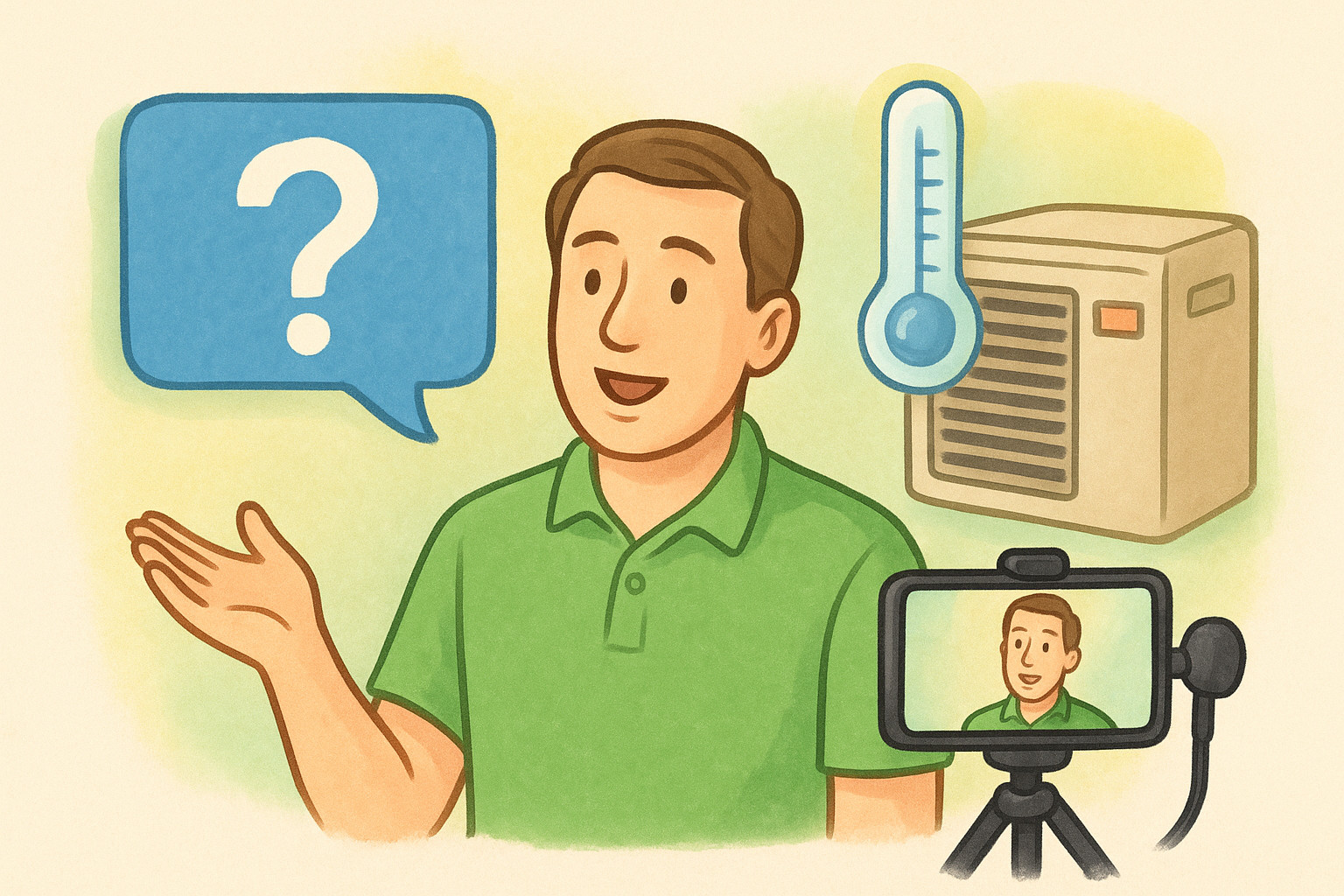
Answering a homeowner’s question on video is more memorable than any ad you could run, and it works long after you stop filming.
How to film, edit, and publish efficiently
You don’t need a production crew. A smartphone with decent lighting and a simple clip-on microphone is enough to produce clear, watchable video. Film one topic at a time, keep each video under 90 seconds, and add your company name and phone number as a text overlay before posting to YouTube and your Google Business Profile.
Budget and timeline for a weekly video cadence
A basic microphone and ring light cost under $60 combined and handle the two biggest quality issues most beginners face: muffled audio and poor visibility. Committing to one video per week gives you a library of 50-plus pieces of content within a year, with each video working independently to bring in new leads long after you filmed it.
10. Use social media to prove you show up and do clean work
Social media for HVAC companies isn’t about going viral. It’s about showing your local service area that you’re an active, professional operation that does good work. Homeowners check Facebook and Instagram before calling a contractor they’ve never used, and a feed full of real job photos and completed installs does more for credibility than any ad you can run.
What to post for trust and recognition in your service area
Post before-and-after photos of real jobs, quick clips of your crew wrapping up a clean installation, and short posts that call out the neighborhoods you serve. Tagging your city or a local area in your posts helps the right audience find your content organically. In marketing for HVAC companies, consistency matters more than production quality, so a sharp phone photo taken on-site beats a polished graphic that took three days to design.
A homeowner who recognizes your truck from a neighbor’s yard and then sees your crew on Facebook is far more likely to call you first.
How to keep content consistent without a full-time marketer
Build a simple weekly habit: snap two or three photos on every job, drop them into a folder on your phone, and post once or twice a week with a short caption. You don’t need scheduling software to start.
Budget and timeline for organic posting and light boosts
Organic posting costs nothing beyond your time. Boosting a strong post to local homeowners within a 15-mile radius runs $5 to $15 per day and takes about 10 minutes to set up directly inside Facebook.
11. Build seasonal email campaigns that bring customers back
Email keeps your business in front of customers who already trust you, making it one of the most cost-efficient tools in marketing for HVAC companies. Most homeowners don’t think about their system until something breaks, so a well-timed email reminding them to book a spring tune-up or fall inspection puts you on their calendar before they call a competitor.
Which email sequences drive tune-ups and replacements
Your highest-value emails are tied to seasonal maintenance windows: a spring campaign promoting AC tune-ups in March and April, and a fall campaign pushing furnace inspections in September and October. Add a replacement reminder sequence for customers whose systems are eight-plus years old, focusing on the cost difference between repeated repairs and a full installation.
A tune-up reminder sent to a past customer costs almost nothing and consistently generates one of your best return-on-investment calls of the season.
How to segment by season, service history, and customer type
Split your list by last service date and equipment type so your messaging stays relevant. A homeowner who just had a new system installed doesn’t need a replacement pitch.
Customers who haven’t called in two or more years respond better to a win-back discount, such as a reduced inspection fee, to pull them back before a competitor steps in.
Budget and timeline for setup and monthly sending
Basic email platforms start at $20 to $50 per month for lists under 1,000 contacts. Plan your launch in two phases:
- Weeks 1 to 2: Write your spring and fall sequences and import your contact list
- Weeks 3 to 4: Test your send schedule and launch your first campaign
After that, budget 30 minutes per month to review open rates and tighten your timing before the next send.
12. Use texting to speed up estimates and bookings
Phone calls still close deals, but texting is often how homeowners prefer to communicate in the first place. In marketing for HVAC companies, SMS creates a faster, lower-friction path between initial contact and a booked appointment, cutting the time it takes to move a lead from interested to confirmed.
Where texting fits in the HVAC customer journey
Texting works best at three specific moments: right after a lead submits a contact form, when you need to confirm or reschedule an appointment, and when you’re following up on a sent estimate. Responding to a new inquiry via text within five minutes dramatically increases your chance of booking that job compared to calling hours later and reaching voicemail.
Speed of response is one of the most overlooked competitive advantages in HVAC, and texting closes that gap faster than any other channel.
What messages reduce no-shows and increase close rates
Send a confirmation text with the tech’s name and arrival window the evening before every appointment. A simple follow-up text asking "Did you get a chance to review the estimate?" after sending a quote prompts a response far more reliably than a follow-up call. Keep every message short, direct, and professional, and always include your company name since most customers don’t save contractor numbers.
Budget and timeline for tools, templates, and compliance basics
Basic SMS platforms like those connected to your CRM start at $20 to $50 per month. Budget one week to write your core templates and configure automated triggers. Make sure your opt-in process follows TCPA compliance rules to avoid fines before your first message goes out.
13. Create a referral program people actually use
Word-of-mouth is already the backbone of marketing for HVAC companies, but most businesses leave it entirely to chance. A structured referral program turns your satisfied customers into an active source of new leads by giving them a clear reason and a simple process to recommend you to neighbors and friends.
What to offer and how to keep it simple
Your referral incentive should be easy to understand and worth acting on. A $25 to $50 bill credit or gift card for each new customer a referral brings in works well because the value is concrete and immediate. Avoid complicated point systems or tiered rewards that require explanation, because if a customer has to think too hard about how the program works, they simply won’t participate.
The simpler your referral program is to explain in one sentence, the more likely customers are to actually use it.
How to ask for referrals at the right moment
Timing your ask matters more than how you phrase it. The best moment to request a referral is right after a job wraps up, when your customer is satisfied and the experience is fresh. Train your techs to mention the program during their post-job walkthrough and follow up with a short text or email reminder within 24 hours that includes an easy link to submit a referral name and contact.
Budget and timeline to launch and track referrals
Launching a referral program costs very little upfront. Budget $200 to $500 per month in incentives as participation grows, and plan for one to two weeks to write your customer messaging and set up a basic tracking spreadsheet to log referral sources and payouts.
14. Partner with local businesses that already have trust
Local business partnerships give you warm referrals from sources homeowners already trust, which is one of the most underrated strategies in marketing for HVAC companies. When a plumber, electrician, or property manager recommends you by name, that homeowner skips the comparison shopping and calls you first.
The best partner types for HVAC leads in your market
The strongest partners are businesses that work inside homes regularly and encounter HVAC issues without being able to fix them. Plumbers, electricians, general contractors, and property managers all fit that profile. Real estate agents are another high-value source since buyers and sellers often need HVAC inspections or system replacements right before or after a transaction closes.
A single property manager overseeing 50 rental units can send you more consistent work than a paid ad campaign running all year.
How to pitch a win-win arrangement and follow through
Your pitch should lead with what the partner gains, not what you need. Offer to refer their services to your customers in return, and consider creating a simple co-referral card that both businesses hand out with each recommendation. Make the process easy and the benefit clear so partners have a reason to keep bringing up your name months after you first met.
Budget and timeline for outreach and relationship building
Set aside two to three hours per week for the first month to identify and contact potential partners in your area. A small welcome gift or branded item for each new partner, such as a custom pen set or logoed notepad from a local print shop, keeps your name visible every time they sit at their desk. Budget $100 to $200 for initial outreach materials and plan to follow up with every partner at least once a month to keep the relationship active.
15. Use direct mail and door hangers in targeted neighborhoods
Digital channels dominate most conversations about marketing for HVAC companies, but physical mail still reaches homeowners in a way that a Google ad cannot. A well-designed piece in someone’s hand carries more weight and longer shelf life than a banner ad they scroll past in two seconds.
When direct mail outperforms digital for HVAC
Direct mail works especially well when you already know which specific neighborhoods have older housing stock or when you’ve recently completed a job on a street and want to target the surrounding homes. Neighbors who saw your truck, noticed your branded uniforms, and watched a clean job get done are far more receptive to a follow-up mailer than cold digital traffic ever will be.
Physical mail that arrives right after a neighbor’s job gets completed catches homeowners at peak awareness of their own HVAC needs.
How to target, design, and time campaigns by season
Use Every Door Direct Mail (EDDM) through the USPS to saturate specific carrier routes without needing a mailing list. Keep your design simple: your logo, phone number, service area, and one strong seasonal offer should do most of the work. Time your campaigns so spring mailers land in March and fall mailers arrive in September, right before homeowners start thinking about seasonal maintenance.
Budget and timeline for printing, mailing, and repetition
EDDM postage runs about $0.20 to $0.25 per piece, and local printing for door hangers or postcards typically costs $0.10 to $0.30 per unit at a print shop. Budget two weeks from design approval to delivery and plan to repeat each campaign at least twice per season since repetition drives response rates significantly higher than a single send.
Your 30-day marketing plan
You don’t need to launch all 15 strategies at once. Start with the three highest-impact moves in your first week: order branded uniforms for your crew, claim and complete your Google Business Profile, and set up your LSA account. In week two, focus on your website and service pages to make sure inbound traffic actually converts. By week three, activate a referral program and send your first email to your past customer list. Week four is for testing one paid channel, either Google Search Ads or retargeting, so you enter your busiest season with active lead generation running in the background.
Consistent marketing for HVAC companies is what separates businesses that scramble for work from the ones that turn away jobs. Every strategy in this guide compounds over time when you stick with it. If branded uniforms are your first step, get a quote from Dr. Tee’s Design & Screen Printing and get your crew looking the part before the next job.
