
You need a logo. Maybe you’re launching a new business, rebranding an existing one, or finally replacing that clip-art disaster from 2008. Either way, the first question hits hard: how much should this actually cost?
Logo design pricing ranges from $5 on a freelance marketplace to $50,000+ from a top-tier agency, and somehow, both ends of that spectrum stay busy. The gap exists because logo design isn’t a commodity with fixed inputs and outputs. You’re paying for strategy, experience, revisions, and the rights to use the final work however you want. Understanding what drives those numbers helps you avoid overpaying for mediocre work or underpaying and getting exactly what that budget deserves.
At Dr. Tee’s Design & Screen Printing, we’ve spent over 20 years creating logos for Kansas City businesses, from trade contractors who need clean marks that embroider well on work shirts to professional offices wanting polished branding across all their materials. We’ve seen clients come to us after spending thousands on logos that couldn’t be screen printed, and others who tried the $50 route and ended up with unusable files and zero support. That hands-on experience shapes everything in this guide.
This article breaks down current market rates across freelancers, agencies, and design platforms. You’ll learn what’s included at each price tier, which factors push costs up or down, and how to match your budget to your actual needs.
Why logo design prices vary so much
Logo design pricing varies wildly because you’re not just buying a picture file. You’re paying for the designer’s ability to solve visual problems, the rights to use that solution across every possible application, and often the strategy that determines what makes an effective mark for your specific business. A logo that works on a billboard, a business card, and an embroidered polo shirt requires more planning than one that only lives on Instagram. The gap between cheap and expensive reflects differences in skill, process, legal rights, and how much thought goes into making the design actually work for your business goals.
The designer’s experience level
Junior designers and hobbyists typically charge $100 to $500 for a logo because they’re building portfolios or working as a side income. They can create competent work, but they lack the pattern recognition that comes from completing hundreds of projects. You’ll spend more time explaining what you want, and you might get designs that look good in isolation but fail when you try to print them on a hat or scale them down for a favicon. Experienced professionals who’ve solved branding problems for dozens of businesses charge $1,500 to $10,000 because they anticipate issues you haven’t thought about yet. They know which typefaces embroider cleanly, how to balance a mark so it doesn’t look lopsided on a square social media avatar, and which color combinations print reliably across different materials.
Mid-level designers with three to five years of focused work usually land in the $800 to $2,500 range. They’ve made enough mistakes to know what causes problems down the road, but they haven’t built the reputation or specialized expertise that commands premium rates.
Strategy vs execution
Cheap logo services treat design as a purely aesthetic task. You get something that might look fine, but nobody asked whether it differentiates you from competitors, appeals to your target customer, or reflects your actual positioning in the market. Strategic designers start by researching your industry, analyzing competitor visuals, and understanding what matters to your customers. That research phase adds cost but dramatically improves the odds your logo actually helps your business grow instead of just existing as decoration.
This strategic layer explains why agencies charge so much more than freelancers for similar execution quality. You’re paying for account managers, brand strategists, and multiple rounds of internal review before you see anything. For a small trade business, that’s often unnecessary overhead. For a venture-backed startup entering a crowded market, that strategic thinking might be worth every dollar.
Strategic logo design considers how your mark will perform across every touchpoint in your customer’s journey, not just how it looks on your website.
Licensing and file types
Basic logo packages might give you a single PNG file and limited usage rights. You can use it on your website, but technically you don’t own it, and the designer could restrict how you apply it. Full rights packages transfer complete ownership, meaning you can trademark the mark, modify it, license it to others, or do whatever you want without asking permission. That transfer of intellectual property adds significant cost because the designer gives up all future claims to the work.
File format matters more than most buyers realize. You need vector files (AI, EPS, or SVG) to scale your logo from business card to billboard without quality loss. Many budget designers only provide JPEGs or PNGs, which work fine for digital use but fail the moment you need to print on fabric or vinyl. Professional packages include vectors, high-resolution rasters in multiple formats, and often color variations for different backgrounds. That file variety costs the designer time to prepare but saves you hundreds or thousands when your screen printer doesn’t need to recreate your logo from scratch.
Revision rounds and support
Fixed-price packages typically include two or three revision rounds. You see initial concepts, pick a direction, get refined versions, and request specific changes. Once you hit the revision limit, additional changes cost extra. Some designers charge per revision after the included rounds, others require purchasing a new package. Ongoing relationships with designers or agencies cost more upfront but include support when you need to adapt the logo for a new application or make minor tweaks as your business evolves.
Budget services often deliver files and disappear. When you realize six months later that you need a version with transparent background or different color scheme, you’re on your own. Established designers maintain project files and client relationships specifically to handle these requests quickly. That accessibility and institutional knowledge justifies higher rates because you’re paying for long-term partnership, not just a one-time transaction.
Typical logo design price ranges in 2026
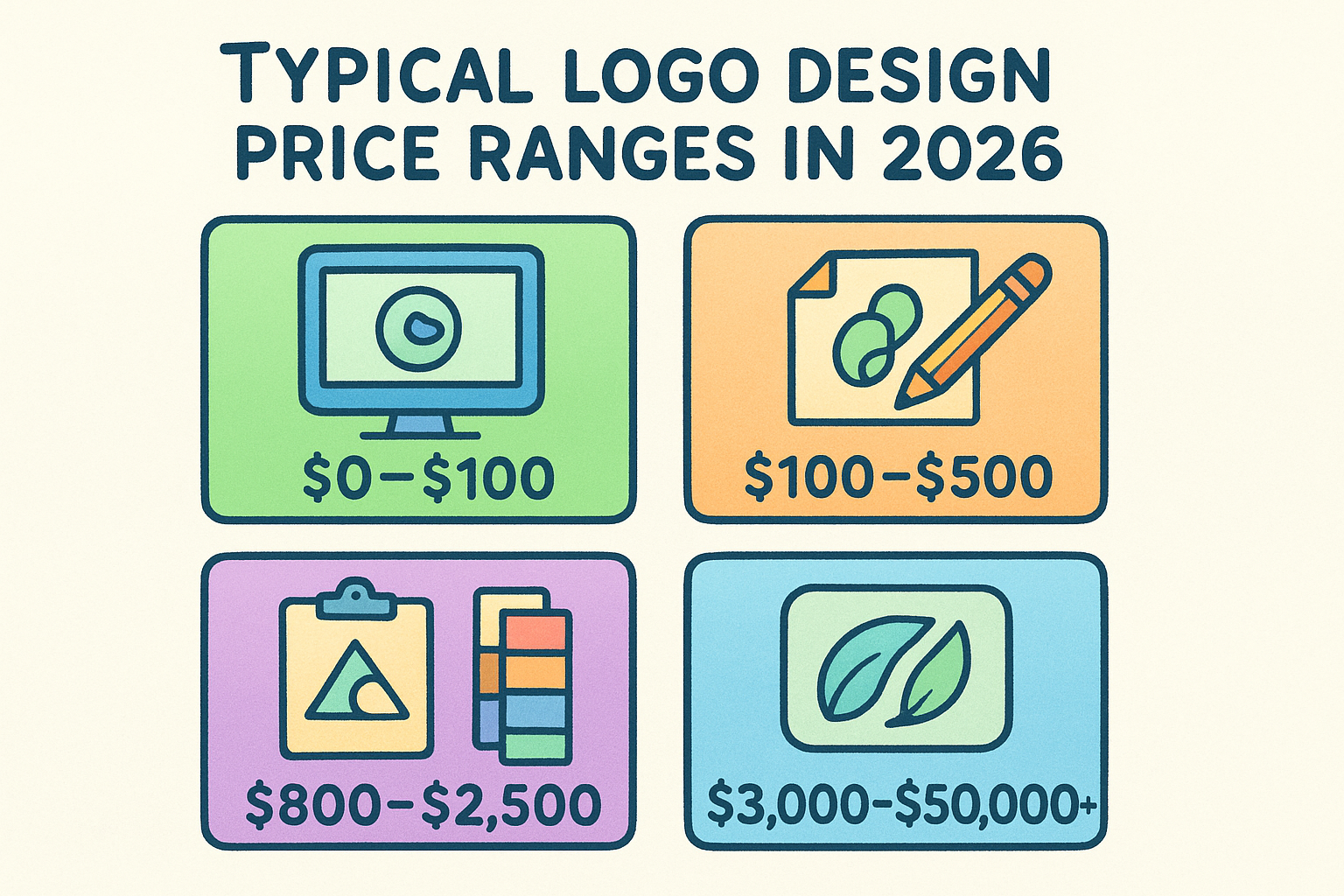
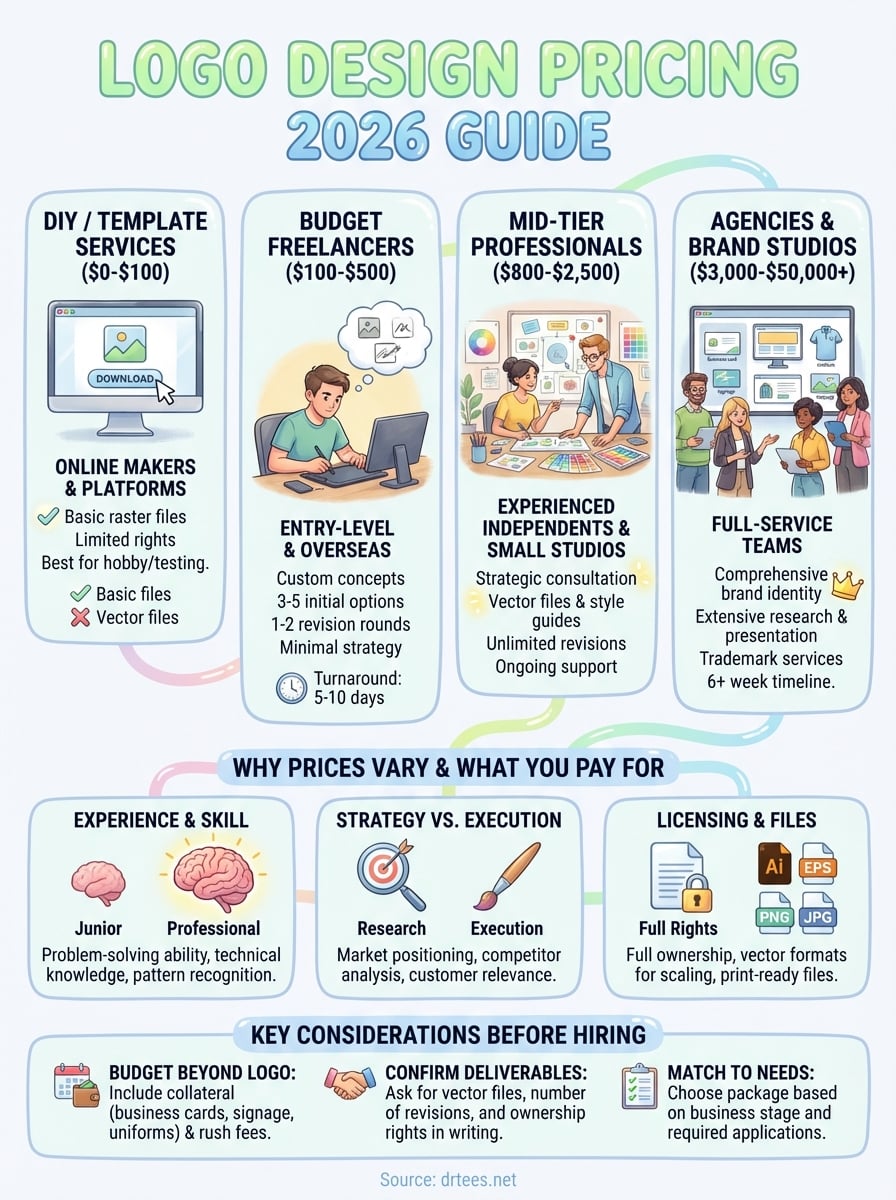
Logo design pricing in 2026 breaks down into four distinct tiers, each reflecting different levels of service, expertise, and deliverables. You can spend anywhere from nothing to tens of thousands depending on whether you need a simple mark for a side project or a comprehensive brand identity system for a business entering competitive markets. The ranges below represent what you’ll actually pay in the current market, not theoretical numbers from outdated guides. These prices reflect independent research across freelance platforms, agency websites, and direct quotes from designers serving small to mid-sized businesses.
DIY and template platforms ($0-$100)
Logo makers like Canva, Looka, and Wix let you create and download a logo for free or under $100. You pick from templates, customize colors and text, and download files in basic formats. These tools work when you need something immediately for a hobby project, early-stage startup testing an idea, or temporary placeholder while you save for professional work. The main limitation hits when you try to use these logos beyond digital applications. Template-based designs rarely include proper vector files, and you’ll find dozens of other businesses using similar or identical marks because everyone pulls from the same library of icons and layouts.
Rights become problematic with some platforms. You might technically license the logo rather than own it, limiting your ability to trademark or modify the design later. For a Kansas City contractor who needs a mark that works on truck wraps and embroidered uniforms, these platforms usually create more problems than they solve.
Budget freelancers ($100-$500)
Entry-level designers and overseas freelancers occupy this range, typically found on platforms like Fiverr or Upwork. You’ll get custom work instead of templates, and many deliver solid execution for straightforward needs. Expect three to five initial concepts with one or two revision rounds. The designer creates your logo from scratch based on a brief you provide, but strategic thinking and research remain minimal.
Communication challenges and file preparation issues appear frequently at this tier. Your designer might not understand technical requirements like pantone matching for screen printing or the difference between RGB and CMYK color modes. Turnaround typically runs five to ten business days, and ongoing support after delivery is rare.
Mid-tier professionals ($800-$2,500)
Experienced independent designers and small studios charge these rates after building strong portfolios and repeat client bases. You get strategic consultation before design work begins, competitive analysis, and multiple concept directions that reflect actual understanding of your market position. Deliverable packages include vector files, color variations, style guides explaining proper usage, and typically unlimited revisions within a defined timeline.
Professional designers in this tier have completed enough projects to anticipate problems before they happen, saving you time and money on applications you haven’t considered yet.
These designers maintain long-term relationships with clients, making themselves available when you need to adapt the logo for new uses or troubleshoot technical issues with vendors. For most small businesses and professional services, this tier delivers the best value proposition between cost and quality.
Agencies and brand studios ($3,000-$50,000+)
Full-service agencies bring teams including strategists, art directors, copywriters, and account managers. You pay for extensive research phases, presentation decks, multiple designer iterations, and comprehensive brand identity systems beyond just the logo. Projects at this level include full brand guidelines, application examples across dozens of touchpoints, and often trademark research or filing services. Timelines stretch from six weeks to several months depending on project scope.
Most small businesses don’t need this level of investment unless they’re entering saturated markets where differentiation matters critically or seeking venture funding where professional branding affects valuation. Regional agencies in markets like Kansas City typically charge $5,000 to $15,000, while national firms serving Fortune 500 clients start at $25,000 and climb based on complexity and usage rights.
What you get at each price tier
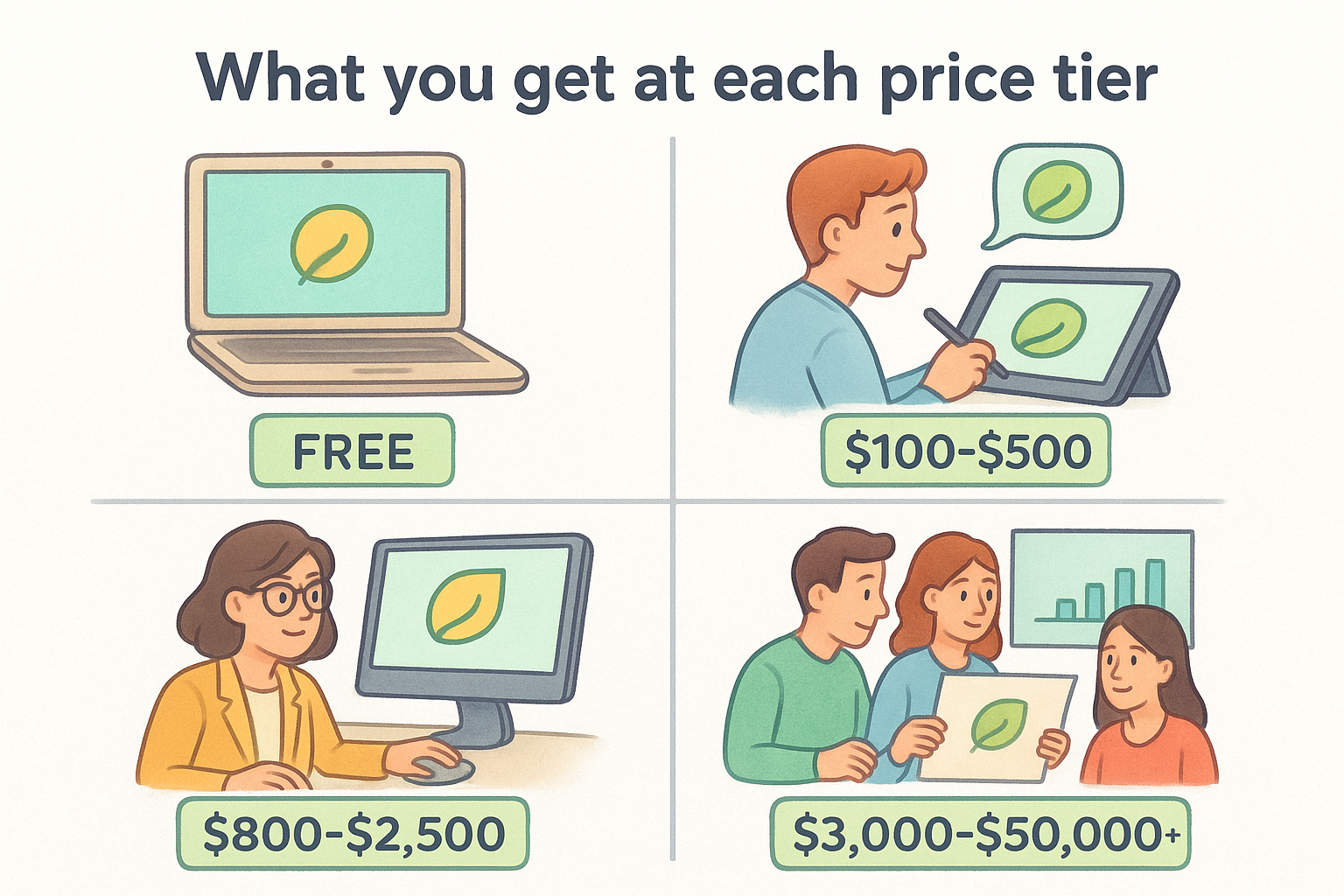
Understanding what you actually receive at different price points helps you match budget to realistic expectations. Logo design pricing determines not just the quality of the final mark, but the files you own, the support you get, and how usable the logo becomes across different applications. Here’s what each investment level typically delivers.
Template and DIY services ($0-$100)
Online logo makers generate your mark in minutes and provide PNG or JPG downloads suitable for social media and websites. Most platforms limit free versions to low-resolution files with watermarks. Paid versions remove branding and increase resolution, but you still get raster formats that pixelate when enlarged. Vector files, when available, come as basic SVG exports without the refinement professional software provides.
Customization stays limited to preset options. You select from icon libraries, adjust colors using basic pickers, and type your business name in predetermined layouts. File ownership varies by platform, with some granting full commercial rights while others maintain licensing restrictions that technically prevent trademarking or resale. Customer support means FAQ pages and automated chatbots, not human designers who can solve technical problems or explain how to prepare files for specific vendors.
Budget freelancer packages ($100-$500)
Custom concepts start appearing at this tier, with designers creating original work based on your brief rather than modifying templates. You receive three to five initial options, typically presented as JPG previews. After you select a direction, the designer refines that concept through one or two revision rounds where you request specific changes to colors, fonts, or layout elements.
Final deliverables include the logo in multiple raster formats (PNG with transparent background, JPG for web) and usually a basic vector file (AI or EPS). Color specifications remain informal, often just RGB values without pantone matching for print consistency. Style guides and usage instructions rarely accompany budget packages. Support ends at file delivery, meaning you handle any future modifications or format conversions yourself. These packages work when you have technical knowledge to manage files or when logo applications stay simple and primarily digital.
Budget tier packages provide functional files for immediate use but leave you responsible for technical preparation and future modifications.
Professional designer packages ($800-$2,500)
Comprehensive file packages define this tier, including vector source files in multiple formats (AI, EPS, SVG, PDF), high-resolution PNGs at various sizes, and print-ready files with proper color modes. You get both RGB versions for screens and CMYK versions for print, plus pantone color specifications when needed for branded merchandise or signage. Most designers include color variations (full color, black, white, reversed) and simplified versions that work at small sizes or when embroidered.
Strategic consultation precedes design work. Your designer researches competitors, discusses positioning, and presents concepts with rationale explaining how each option serves your business goals. Revision rounds become unlimited within a reasonable timeframe, typically two to four weeks. Professional packages include basic brand guidelines covering minimum sizes, clear space requirements, approved color combinations, and incorrect usage examples.
Ongoing relationships mean you can contact the designer months or years later when you need a file reformatted or adjusted for specific applications. This accessibility and institutional knowledge about your brand saves significant time and money compared to starting fresh with new designers.
Agency and studio packages ($3,000-$50,000+)
Full brand identity systems replace simple logo delivery at agency level. You receive comprehensive visual language including logo variations, typography systems, color palettes, graphic elements, photography style guidance, and detailed brand standards documents. Agencies provide application mockups showing how your identity functions across business cards, letterhead, packaging, signage, websites, and advertising materials.
Team-based approaches involve strategists conducting market research, copywriters developing messaging, art directors guiding visual direction, and designers executing across multiple touchpoints. Projects span six to twelve weeks with formal presentations at milestone stages. Legal services like trademark searches and filing often accompany agency packages, protecting your investment from infringement issues.
Pricing models designers use
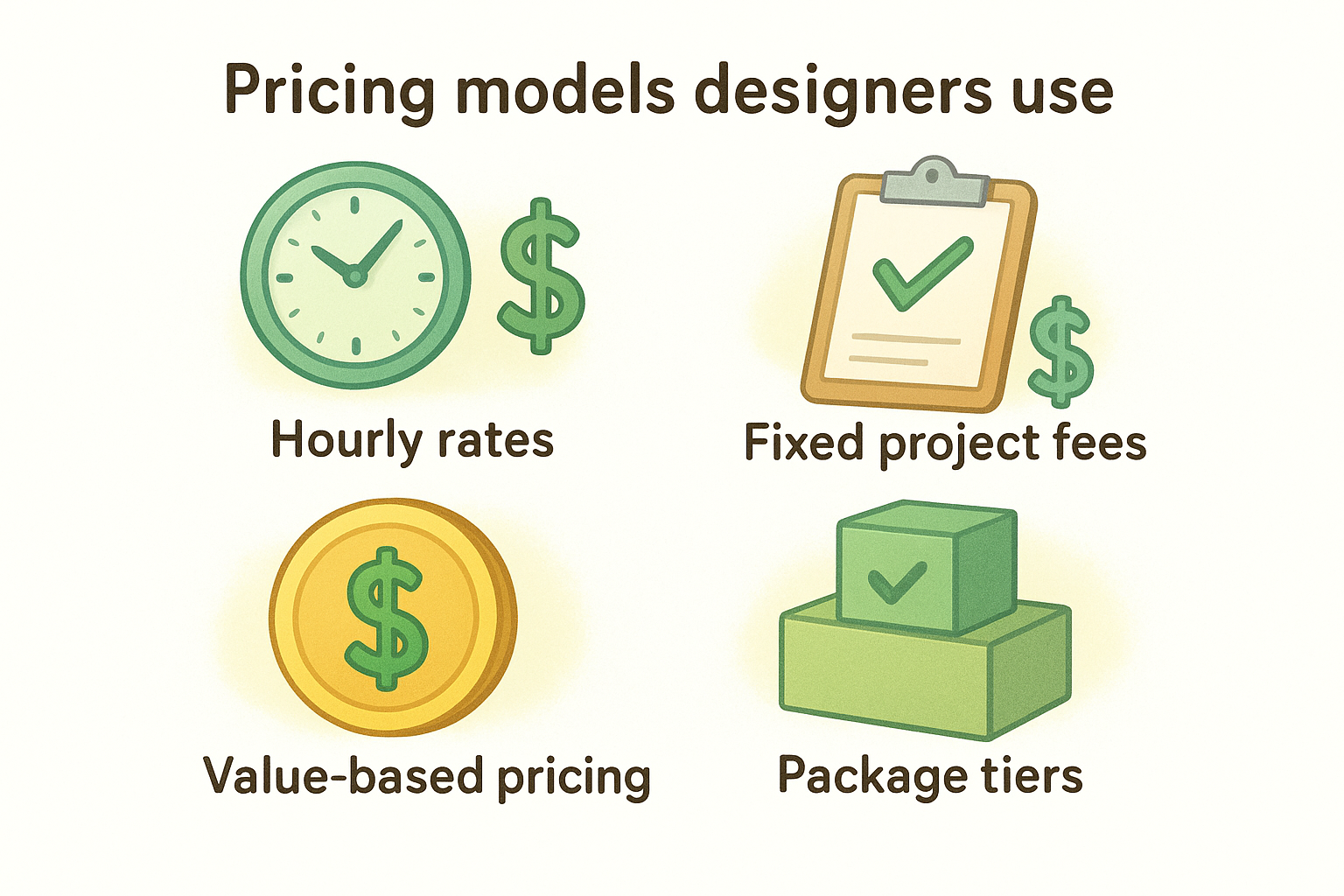
Logo design pricing structures fall into four main models, and understanding which one your designer uses helps you predict total costs and avoid surprises. Some designers let you choose your preferred billing method, while others stick to one approach based on their business model and client type. The model affects not just how you pay, but how much flexibility you get during the project and whether costs can escalate beyond your initial budget.
Hourly rates
Hourly billing charges you for actual time spent on your project, typically ranging from $50 to $250 per hour depending on the designer’s experience and location. Junior designers in smaller markets might charge $50 to $75, while senior designers in major cities reach $150 to $250. You receive time tracking reports showing hours allocated to research, sketching, digital execution, revisions, and file preparation.
This model works when project scope remains unclear or when you expect significant iteration and exploration. You pay only for work completed, avoiding overcharges for simple projects that finish quickly. The risk comes from unpredictable final costs. A designer who estimates 10 hours might need 15 if you request extensive revisions or if technical complications emerge. Fixed hourly contracts sometimes cap total hours to protect you from runaway costs, though designers reserve the right to stop work when you hit the limit.
Hourly rates give you maximum flexibility but require trust that your designer works efficiently and bills accurately.
Fixed project fees
Flat-rate packages dominate professional logo design pricing because they eliminate billing uncertainty for both parties. The designer quotes a single price covering everything from initial consultation through final file delivery. You know your total investment before work begins, making budget planning straightforward. Package definitions specify exactly what you receive: number of concepts, revision rounds, file formats, and timeline.
Designers calculate flat fees by estimating hours required and multiplying by their effective rate, then adding buffer for unexpected complications. This approach incentivizes efficiency because designers profit more when they complete work faster. You benefit from predictable costs but lose flexibility if your needs change mid-project. Additional concepts or revision rounds beyond the package terms cost extra, sometimes at premium rates.
Value-based pricing
Strategic designers and agencies sometimes price based on business impact rather than time or deliverables. A logo for a local service business might cost $2,000, while identical execution for a venture-backed startup costs $15,000 because the stakes and budget differ dramatically. Designers ask about your revenue, funding, market size, and how critical branding is to your success, then price accordingly.
This model frustrates buyers who see identical deliverables priced differently, but it reflects economic reality. Your lawn care company and a tech startup can both afford fair prices relative to business scale, even though one pays significantly more. Expect value-based pricing from established designers with strong portfolios who can justify premium rates through demonstrated business results.
Package tiers
Tiered packages let you choose between basic, standard, and premium options, each including progressively more concepts, revisions, and deliverables. Basic tiers might offer two concepts with one revision round for $800. Premium tiers provide five concepts, unlimited revisions, and comprehensive file packages for $2,500. This structure helps designers serve different budget levels while maintaining profitability across all tiers.
You select the tier matching your budget and complexity needs, knowing exactly what each level includes. Designers profit by standardizing deliverables, reducing time spent on custom proposals and scope negotiations. The limitation comes from rigidity. Your needs might fall between tiers, forcing you to either overpay for features you don’t need or settle for less than ideal service.
How to choose the right logo package
Selecting the right logo package starts with honest assessment of where your business sits right now and where you plan to take it over the next two to three years. Your choice shouldn’t just match your current budget. It needs to deliver files and rights that support your actual applications without creating expensive problems later. A contractor who needs embroidered uniforms and truck wraps has different requirements than an online consultant who only needs social media graphics and a website header.
Match package to business stage
Startups testing market fit can justify basic packages in the $500 to $800 range because your brand might pivot completely within six months. You need clean, professional identity that works across essential touchpoints without investing thousands in strategy you’ll potentially discard. Established businesses rebranding or formalizing informal identities should invest in the $1,500 to $3,000 range because you know your market position and need comprehensive file packages that work across existing applications.
Growth-stage businesses entering new markets or seeking investors benefit from strategic packages starting at $3,000. Your logo becomes part of competitive positioning and investor presentation materials, making strategic thinking and polish worth the premium. If you’re a Kansas City trade business that’s been operating five years with steady growth, you fall in that established category where professional tier makes sense.
Identify must-have deliverables
Start by listing every place your logo needs to appear in the next 12 months. Website, business cards, and social media profiles make every list. Add vehicle graphics, uniforms, signage, promotional products, or packaging based on your business model. Each application has technical requirements that your file package must support. Embroidery needs simplified designs without thin lines or tiny text. Large format printing requires high-resolution files. Screen printing works best with limited colors and solid shapes.
Your logo package should include every file format needed for your planned applications, not just what looks good on a computer screen.
Compare packages against your application list. Budget packages rarely include embroidery-ready simplified versions or pantone specifications for consistent screen printing. Professional packages build these variations into base pricing. If your list includes four or more physical applications (uniforms, vehicles, signage, promotional items), invest in professional tier packages that anticipate technical requirements instead of forcing modifications later.
Consider long-term support needs
Technical knowledge matters when evaluating packages. If you understand vector files, color modes, and print specifications, budget packages work because you can handle file preparation yourself. Most business owners lack this expertise, making designer accessibility after delivery genuinely valuable. Professional packages typically include reasonable ongoing support when you need files adjusted or reformatted for new applications.
Ask potential designers how they handle post-delivery requests before committing. Some charge hourly for any work after final files deliver. Others include basic support for six to twelve months as relationship-building. That accessibility difference justifies paying $1,200 instead of $600 when you know you’ll need help preparing files for your screen printer or sign company.
How to budget for a logo and brand basics
Realistic logo budgeting extends beyond the design fee itself to include complementary brand elements and implementation costs that most businesses overlook. You need more than just a logo file to launch or rebrand a business. Business cards, letterhead, email signatures, website graphics, and social media assets all require design work that either happens during the initial project or gets added later at premium rates. Setting your budget based only on logo design pricing creates gaps that force rushed decisions or compromised quality when you realize your brand package remains incomplete.
Calculate your total visual identity needs
Start by listing every branded item you need within 90 days of logo completion. Business cards top most lists, followed by letterhead or email signatures for professional communications. If you attend trade shows or networking events, add folder designs, one-sheets, or promotional materials. Service businesses need vehicle graphics, uniform embroidery files, yard signs, and door hangers. Professional offices require lobby signage, appointment cards, and branded forms or documents.
Assign rough costs to each item based on vendor quotes or estimates. Business cards cost $50 to $200 for initial runs. Vehicle wraps range from $1,500 to $5,000 depending on size and coverage. Embroidered polo shirts run $25 to $45 each including garment cost. Add these implementation costs to your logo design budget to understand true investment requirements. A $1,500 logo becomes a $4,000 project when you include business cards, basic signage, and uniform setup fees.
Many designers offer package deals combining logo design with essential collateral at better rates than purchasing separately. Ask about bundled pricing for logo plus business cards, letterhead template, and social media graphics. These packages typically save 15 to 25 percent compared to individual item pricing.
Budgeting only for logo design without considering immediate implementation needs leads to either delayed launches or compromised quality across your brand materials.
Factor in timeline and rush fees
Standard logo projects run two to four weeks from kickoff to final file delivery, depending on revision complexity and designer workload. Designers build this timeline into quoted rates, assuming reasonable response times and decision-making from you. Rush projects requiring completion in one week or less typically add 25 to 50 percent to base pricing because designers must decline other work or extend hours to meet your deadline.
Plan logo projects to finish at least two weeks before you need materials in hand. This buffer accommodates unexpected revision needs or technical issues without triggering rush fees. If your grand opening happens in six weeks, start your logo project now rather than waiting until you feel ready.
Build in contingency for unexpected needs
Reserve 20 percent beyond your calculated logo and collateral budget for modifications or additions that emerge during implementation. You might discover your logo needs a simplified version for embroidery after seeing initial samples. Your sign company might require specific file formats not included in your original package. Brand color adjustments sometimes become necessary when you see printed samples and realize your chosen shade doesn’t match your vision.
This contingency prevents project delays when your screen printer requests different artwork or when you decide to add promotional items not in your original plan. Most businesses spend this buffer on applications they hadn’t considered during planning phases.
Questions to ask before you hire a designer
Smart questioning before hiring separates successful logo projects from frustrating experiences that drain your budget and delay your launch. Most designers expect questions and respect clients who ask them because it demonstrates you understand what makes logo design pricing worthwhile versus wasteful. These questions reveal whether a designer matches your needs, spot potential problems early, and establish clear expectations that prevent disputes later. You want specific answers, not vague reassurances or marketing language that sounds good but commits to nothing.
What file formats are included
Vector source files (AI, EPS, SVG) matter more than anything else because they let your logo scale infinitely without quality loss. Ask explicitly whether the package includes these formats or only raster files like PNG and JPG. Designers who provide only raster files either work in programs that don’t create vectors or intentionally withhold them to force you back for future modifications. Professional packages include both vector originals and exported rasters in multiple resolutions for different uses.
Request color variations during this conversation. You need full-color, black, white, and reversed versions at minimum. If you plan to embroider or screen print, ask whether simplified versions with reduced detail come standard or cost extra. Clarify whether you receive RGB files for digital use and CMYK or pantone specifications for print consistency.
How many revision rounds do I get
Revision policies vary dramatically between designers, and misunderstanding them causes most project conflicts. Some include two rounds, meaning you get initial concepts, then two opportunities to request changes. Others offer unlimited revisions within a timeframe like 30 days. Define what counts as a revision versus a new concept direction because designers interpret these terms differently.
Ask what happens when you exceed included revisions. Some charge hourly rates, others require purchasing additional revision packages. Understanding these costs upfront helps you budget accurately and encourages focused feedback that respects included revision limits.
Clear revision policies protect both you and your designer from scope creep while ensuring you get designs that actually work for your business.
Can I see examples of similar work
Portfolio review should focus on projects serving businesses like yours, not just attractive design. A designer with stunning logos for tech startups might struggle creating marks that work embroidered on work shirts for trade contractors. Request examples showing logos across multiple applications, not just pristine presentations on white backgrounds. Physical application photos (embroidered uniforms, printed signage, vehicle graphics) demonstrate the designer understands technical requirements beyond making something look good on screen.
Ask about the designer’s process for those projects. How did they research the industry? What problems did they solve? This conversation reveals whether they approach logo design strategically or just execute whatever the client requests without guidance.
Who owns the final files
Copyright and usage rights determine whether you truly own your logo or just license it from the designer. Most professional packages transfer full rights, meaning you can trademark the mark, modify it, use it however you want, and prevent others from using it. Budget packages sometimes retain designer copyright, limiting your ability to adapt or license the logo without permission.
Request written confirmation of rights transfer in your contract or agreement. Clarify whether you receive working files (the layered source files designers use) or only final exports. Working files give you maximum flexibility for future modifications but aren’t always necessary if you plan to return to the same designer for updates.
Common traps and red flags
Recognizing warning signs early protects you from wasting money on unusable logos, getting trapped in revision loops, or discovering too late that you don’t actually own the files you paid for. Most logo design scams and problem scenarios follow predictable patterns that become obvious once you know what to watch for. Budget pressure tempts businesses to ignore red flags when prices seem too good to refuse, but cheap disasters cost far more than mid-tier professional work when you factor in time lost, redoing projects, and missed business opportunities while your brand sits in limbo.
Suspiciously low prices with premium promises
Designers offering full brand packages for $99 or promising agency-quality logos for $200 either resell stock graphics, use automated tools, or plan to upsell aggressively once you’re committed. They advertise unlimited revisions and comprehensive deliverables that would cost any legitimate designer hours of work. The catch reveals itself after you pay: revisions take weeks, files come in wrong formats, or the designer ghosts you entirely after delivering initial concepts. Check reviews carefully, and if pricing seems impossibly low for what’s promised, you’re looking at either inexperience or deliberate deception.
Legitimate budget designers charge $300 to $500 and clearly limit what they deliver. They don’t promise everything because they understand their work’s actual value and time requirements.
If a designer’s pricing and promises seem too good compared to market rates, you’re almost certainly looking at a trap that wastes both money and time.
Vague contracts and missing deliverable lists
Professional designers provide written agreements specifying exactly what you receive: number of concepts, revision rounds, file formats, usage rights, timeline, and payment terms. Red flags appear when designers work from verbal agreements, send vague proposals that avoid specifics, or rush you to start before paperwork exists. Missing deliverable details let designers claim they fulfilled the agreement while delivering far less than you expected based on initial conversations.
Request itemized proposals before paying anything. Your agreement should list every file format and deliverable by name, not use phrases like “all necessary files” or “industry standard package” that mean nothing specific.
Designers who won’t share work samples
Portfolio reluctance signals major problems, whether the designer lacks experience, has only completed terrible projects, or plans to resell stock logos instead of creating custom work. Legitimate designers eagerly share portfolios because previous work proves their capabilities. Excuses about client confidentiality or claims that all their best work remains under NDA suggest the designer has nothing worth showing.
Ask for at least five examples of completed logo projects with multiple application photos. Designers who can’t or won’t provide this minimum proof should be eliminated from consideration regardless of their pricing.
Pay-in-full-upfront requirements
Milestone-based payment protects both parties by ensuring designers get compensated as work progresses while you retain leverage if quality or timeline problems emerge. Designers demanding 100 percent payment before starting work take your money with zero accountability. Professional payment structures typically request 50 percent upfront and 50 percent at final file delivery, or split payments across concept, revision, and completion phases.
This applies regardless of logo design pricing tier. Budget freelancers and premium agencies both use milestone payments as standard practice. Full-payment-first requests almost always indicate problems ahead.
How to price logo design as a freelancer
Setting your rates requires honest calculation of expenses, desired income, and market positioning rather than copying what other designers charge. Your logo design pricing directly affects which clients you attract, how busy you stay, and whether your business remains sustainable long-term. Underpricing fills your calendar with low-budget clients who demand endless revisions, while overpricing for your experience level leaves you struggling to book projects. The goal sits between these extremes, where you charge enough to build a profitable business while remaining competitive for your skill level and target market.
Calculate your minimum hourly rate
Start with annual income needs including both business expenses and personal salary. Add your health insurance, software subscriptions, equipment costs, marketing expenses, taxes, and target take-home pay. If that total reaches $75,000, you need to bill roughly $50 per hour assuming 1,500 billable hours per year. This calculation reveals your absolute floor, the rate below which you lose money regardless of how busy you stay. Beginning freelancers often set rates at this floor while building portfolios, then increase pricing as demand grows and skills improve.
Track actual hours spent on each project for at least three months. Most designers underestimate time requirements by 30 to 50 percent when starting out. Your minimum hourly rate multiplied by realistic project hours determines your baseline flat-rate packages.
Your minimum viable rate comes from basic math about expenses and desired income, not from guessing what clients might pay or what competitors charge.
Factor in experience and specialization
Portfolio quality and client results justify higher rates faster than years in business alone. You can charge premium pricing after two years if your work demonstrably helps clients grow their businesses and your portfolio shows consistent quality. Specialization increases your value because businesses pay more for designers who understand their specific industry. A designer who only works with healthcare practices commands higher rates than generalists because that focused experience solves problems faster and more effectively.
Research competitor pricing in your local market and skill tier. Your rates should fall within 20 percent of similar designers unless you offer clear advantages like faster turnaround, specialized expertise, or exceptional customer service that justify premiums.
Choose your pricing structure
Package-based pricing works better than hourly billing for most freelancers because it eliminates tracking overhead and gives clients budget certainty. Create three tiers matching different business needs and budgets. Your basic package might include two concepts with two revisions for $800, while your premium package offers five concepts with unlimited revisions and comprehensive files for $2,500. Mid-tier packages should represent your best value, priced to attract the majority of inquiries while maintaining healthy profit margins.
Avoid hourly billing until you’ve completed at least 50 logo projects and can accurately estimate time requirements. Clients prefer fixed pricing, and you eliminate disputes about billable hours.
When to raise your rates
Booking solid for four to six weeks ahead signals you’re underpriced for current demand. Raise package rates by 15 to 20 percent and monitor inquiry volume. If you stay fully booked, raise again in three months. This gradual approach lets you find market equilibrium without losing all inquiries by jumping too high too fast. Alternatively, maintain current rates for existing clients while charging new clients higher fees, grandfathering loyal relationships while capturing increased value from new business.
Next steps
Understanding logo design pricing gives you the foundation to make informed decisions, but the real work starts when you begin evaluating designers and requesting quotes. Create a shortlist of three to five designers whose portfolios match your business type and budget range. Request detailed proposals that specify deliverables, revision policies, and file formats rather than accepting vague price quotes.
Schedule brief consultations with your top candidates to assess communication style and strategic thinking. You’ll spend weeks working with whoever you choose, so personality fit matters as much as design skill. Prepare a clear brief explaining your business, target customers, competitors, and where your logo needs to appear. This preparation speeds up the process and helps designers provide accurate quotes.
If you need custom logo design with professional screen printing and embroidery support, Dr. Tee’s Design & Screen Printing combines over 20 years of graphic design experience with in-house production capabilities. We create logos that work across all applications, from business cards to embroidered uniforms.
