
You spent time and money getting a custom logo designed for your business. It shows up on your shirts, your business cards, your website, it’s how customers recognize you. But without a trademark, nothing stops another company from using something dangerously similar. Knowing how to trademark a logo protects the brand identity you’ve worked to build, and the process is more straightforward than most people expect.
At Dr. Tee’s Design & Screen Printing, we’ve spent over 20 years helping Kansas City businesses develop logos and put them on everything from work uniforms to promotional apparel. We see firsthand how much a logo means to a business owner, it’s the visual anchor of their brand. That’s exactly why we put together this guide. Once you’ve invested in a logo you’re proud of, the next smart move is legal protection.
This article walks you through the entire USPTO trademark registration process, step by step. You’ll learn how to run a proper trademark search, what the filing requirements look like, how much it actually costs, and how long the timeline typically runs from application to registration. Whether you just had a logo designed or you’ve been using one for years without registering it, this guide gives you a clear path forward.
What a logo trademark protects and why it matters
A trademark is a legal identifier that tells the market a product or service comes from you, not someone else. When you trademark a logo, the registration gives you exclusive rights to use that image in connection with the goods or services you listed in your application. The USPTO registers trademarks to prevent consumer confusion, so the protection ties directly to your industry and the markets you serve, not to intellectual property in a general sense.
What trademark registration actually covers
Registration covers the specific visual elements of your logo, including the combination of shapes, colors, fonts, and graphics that make it distinctive. If someone else uses a confusingly similar mark on the same or related type of goods or services, your registration gives you the legal standing to stop them. The USPTO will also block future applicants from registering marks that are too close to yours, which means protection extends beyond active infringement cases.
A federal trademark registration gives you a legal presumption of ownership nationwide, which is something a state registration or an unregistered common law mark cannot fully provide.
Your registration applies to the design as a whole. If your logo uses a specific color combination or stylized font, that combination becomes part of what’s protected. You can also register a word mark separately for the business name itself, but a logo trademark specifically protects the visual design. Both registrations together build a stronger legal foundation than either one alone.
What trademark registration does not cover
A trademark is not the same as a copyright, and many business owners confuse the two. Copyright protects original creative works from the moment they are created, and your logo likely qualifies for copyright protection automatically. But copyright does not give you the ability to stop a competitor from using a similar logo in the same marketplace. Trademark law specifically addresses commercial identity and consumer confusion, which is what makes it the right tool for protecting a business logo used on branded apparel, signage, or marketing materials.
Trademark protection also does not cover the underlying concept or idea behind a logo. If your logo shows a stylized wrench for a plumbing company, you don’t own the concept of wrenches in branding, only the specific visual expression you registered. That distinction becomes important when you run your clearance search and evaluate whether other marks pose a conflict.
Why registration beats common law rights
You technically gain some trademark rights the moment you start using a logo in commerce, and those are called common law trademark rights. They are geographically limited, however, to the areas where you actively do business. If you’re a Kansas City company using an unregistered logo, your common law rights may not stop a business in another state from using something nearly identical on the same type of goods.
Federal registration through the USPTO gives you nationwide priority from the date you file, even if you haven’t yet expanded into every market. It also lets you use the registered trademark symbol, which signals to competitors and counterfeiters that your mark is protected. On top of that, a federal registration is required before you can file a lawsuit in federal court for infringement, giving you far more enforcement options than common law status alone.
Beyond enforcement, registration creates a public record of your ownership in the USPTO database. That record serves as constructive notice, meaning other businesses searching the database before they launch a new logo are legally considered to have known about your mark. This makes it much harder for infringers to claim innocent use. Understanding these layers of protection is why learning how to trademark a logo through the USPTO is a practical business decision, not just a legal formality.
Step 1. Run a clearance search the right way
Before you file anything, you need to confirm that your logo doesn’t conflict with an existing trademark. Skipping this step is one of the most common and costly mistakes business owners make. The USPTO will not refund your filing fee if your application gets rejected because of a conflicting mark, so a thorough clearance search saves you both time and money before you commit to the process.

Search the USPTO TESS database first
The USPTO’s Trademark Electronic Search System, known as TESS, is your first stop, and you can access it at USPTO.gov. Start by searching the word elements in your logo. If your logo includes your business name or a tagline, search those exact terms, then search variations, misspellings, and phonetic equivalents. The USPTO evaluates marks based on how they sound and how they look, not just whether they match character for character.
A mark doesn’t have to be identical to yours to block your registration. If it sounds similar, looks similar, or creates a similar commercial impression in the same goods or services category, it can be cited as a conflict.
For logo-only marks with no text, use the USPTO Design Search Code Manual to search by visual elements. Every registered logo gets coded by its design features such as geometric shapes, animals, or human figures, and you can run searches against those specific design codes to find visually similar marks already on the register.
Expand your search beyond exact matches
Once you finish the USPTO database, broaden your search to catch common law marks that aren’t federally registered. Search your business name and logo elements across Google, major social media platforms, and industry-specific directories. A competitor using an unregistered mark in your region or trade may still have common law rights that complicate your application or create a conflict down the road.
Pay close attention to marks in your specific goods or services class. A plumbing company and a bakery can both use similar imagery without conflict because they serve completely different markets, but if another Kansas City contractor is using something close to your design, that creates a real problem. This distinction is central to understanding how to trademark a logo correctly, because the risk isn’t just rejection at the USPTO. It’s also the cost of rebranding after you’ve already printed uniforms, ordered signage, and built customer recognition around that mark.
Step 2. Choose owner, basis, and classes
Three decisions you make at this stage shape your entire application, and getting them wrong creates problems that are expensive to fix later. You need to identify the correct legal owner, select a filing basis that matches your current situation, and pick the international classes that accurately describe what your business sells or provides.
Determine who owns the mark
The owner listed on your trademark application must be the legal entity that controls the quality of goods or services associated with the logo, not simply the person who designed it. If you operate as a sole proprietor, you file under your own name. If your business is an LLC or corporation, that entity should be the applicant, not you personally. Transferring trademark ownership after filing requires a formal assignment, which adds legal paperwork and fees you can avoid by getting this right at the start.
The USPTO does not allow you to change the owner on a pending application without going through a formal assignment process, so confirm your business structure before you begin filling out the form.
Select your filing basis
Your filing basis tells the USPTO whether you are already using the logo in commerce or plan to use it. There are two primary options for most applicants.
| Basis | Code | When to use it |
|---|---|---|
| Use in commerce | 1(a) | Logo is already on products, packaging, or in ads tied to real sales |
| Intent to use | 1(b) | Logo is finalized but you haven’t started selling under it yet |
Filing under 1(a) requires proof of use at the time you submit. Filing under 1(b) reserves your priority date and lets you submit proof later, but each extension beyond the initial period carries an additional USPTO fee, so don’t file 1(b) as a delay tactic if you can document current use.
Pick the right international class
The USPTO uses the Nice Classification system, a list of 45 classes that group goods and services by type. You pay a separate filing fee for each class you select. For a branded apparel business, Class 25 covers clothing items like t-shirts, hats, and uniforms. If you also provide printing or design services, Class 40 applies to manufacturing processes and Class 41 covers certain design-related services depending on how you describe them.
Choosing the wrong class means your registration won’t protect you in the markets that matter most. Review the full class descriptions at USPTO.gov before finalizing your selection. This is one detail that many guides on how to trademark a logo skip over, but your class choices directly define the scope of your legal protection.
Step 3. Prep your logo file and USPTO specimens
The USPTO has specific technical requirements for both your logo image file and the specimen that proves you’re using the mark in commerce. Getting these wrong delays your application and can trigger an office action that costs you months. Knowing exactly what the examiner expects before you upload anything keeps your application moving forward on schedule.
Format your logo file correctly
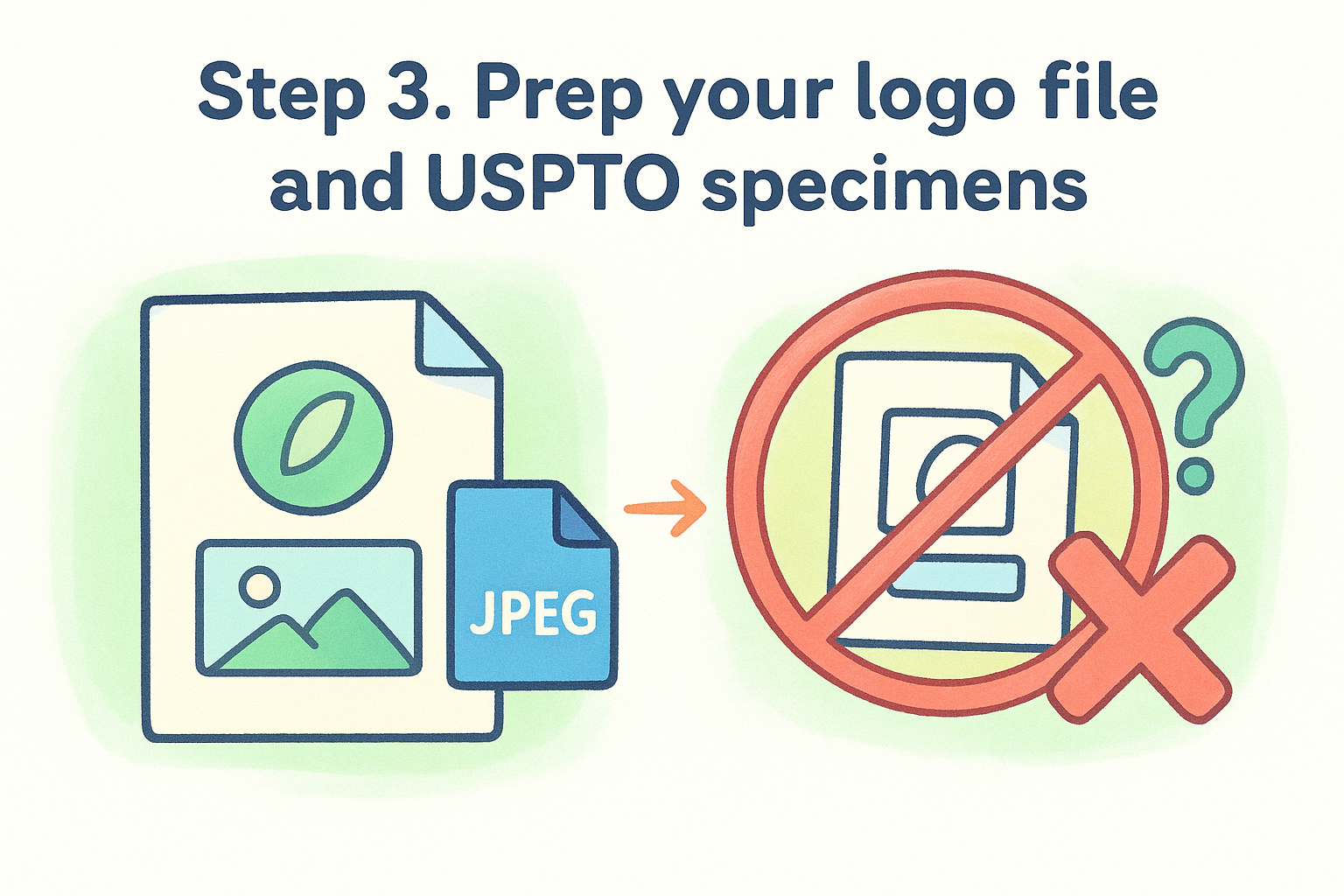
Your logo file must meet the USPTO’s technical specifications to avoid a rejection at the upload stage. The system only accepts JPEG format files with a maximum file size of 5MB. Keep your image dimensions under 944 x 944 pixels, and make sure the background is white or transparent with no extra border space around the mark.
When you want to claim a specific color combination as part of your trademark, you must submit a color image and add a color description in the application listing each color and the element it appears on. If you don’t claim color, the registration covers the design in any color. Most trademark attorneys recommend filing in black and white when possible so your protection applies regardless of color variations you use across different applications.
Filing in black and white gives you broader protection because it covers the logo design across all color versions, not just the specific palette you happened to use on your initial branded apparel.
What counts as a valid specimen
A specimen is real-world proof that you’re already using the logo in commerce. For a 1(a) use-in-commerce application, you must submit at least one specimen at the time of filing. The specimen needs to show the logo as it actually appears on your goods or in connection with your services, not a mock-up or a concept image. This step is one part of learning how to trademark a logo that many applicants underestimate.
For product-based businesses, acceptable specimens include tags attached to clothing, printed labels on packaging, or a clear photograph of the logo on a finished product already being sold to customers. A t-shirt with your logo screen printed on it qualifies as long as it’s actively in commerce.
Service-based businesses can submit screenshots of a live website showing the logo alongside a description of services and a way for customers to contact or purchase from you. The screenshot must capture the full URL and the date to satisfy the examiner. A printed advertisement or signage photograph also works.
| Acceptable | Not Acceptable |
|---|---|
| Hang tag or label on product | Mock-up or design concept |
| Photograph of finished goods with logo | Business card with logo only |
| Live website screenshot with URL | Social media profile image alone |
| Printed advertisement showing logo and services | Invoice or purchase order |
Step 4. File in Trademark Center and pay USPTO fees
The USPTO replaced its old TEAS filing system with Trademark Center, the current online portal where you submit all trademark applications. You can access it at USPTO.gov. Before you open the form, create or log into your USPTO.gov account, because the system requires authentication and will time out if you leave it idle for too long. Gather your logo file, specimen, owner information, and class descriptions before you start so you can move through each section without interruption.
Complete the application form in Trademark Center
Trademark Center walks you through the application in sections, and each one maps directly to the decisions you made in earlier steps. Enter your owner name and address exactly as they appear on your business registration documents. In the mark section, upload your JPEG logo file and confirm whether you are claiming color or filing in black and white. Add your goods and services description for each class you selected, keeping the language specific enough to be accurate but broad enough to cover reasonable variations of what you actually sell or provide.
When you reach the specimen section, upload your image file and select the specimen type from the dropdown menu. Double-check that your description of the specimen matches what you uploaded, because mismatched descriptions are one of the most common reasons examiners issue office actions. Review every section before you submit, since the USPTO does not allow substantive amendments to the owner name or mark after filing without significant legal steps.
Trademark Center auto-saves your progress as a draft, so if you need to step away, your work stays in the system and you can return without starting over.
Know the USPTO fee structure before you pay
The USPTO charges per class, per application, and the fee depends on which filing option you select. As of early 2025, the two standard options break down as follows:
| Filing Option | Fee Per Class |
|---|---|
| TEAS Plus | $250 |
| TEAS Standard | $350 |
TEAS Plus requires you to use pre-approved descriptions from the USPTO ID Manual and meet stricter upfront requirements, but the lower cost makes it worth the extra care during filing. TEAS Standard gives you more flexibility in describing your goods and services, but the higher fee adds up quickly if you file across multiple classes. Knowing this structure is a practical part of learning how to trademark a logo without spending more than necessary for the same level of protection.
Step 5. After filing: timeline, office actions, upkeep
Once you submit your application, the USPTO assigns it to a trademark examining attorney who reviews it against existing registrations and the technical filing requirements. The current wait time from filing to first examiner review runs approximately eight to ten months, though the USPTO posts updated processing times on its website so you can track where your application stands. Understanding this timeline is the final piece of learning how to trademark a logo the right way.

What to expect during examination
The examining attorney checks your application for conflicts, proper classification, and compliance with the rules you followed in earlier steps. If everything clears, the USPTO publishes your mark in the Official Gazette, a weekly publication that gives third parties 30 days to oppose your registration. If no opposition is filed, the USPTO issues a Notice of Allowance for intent-to-use applications or moves directly to registration for use-in-commerce filings.
| Stage | Approximate Timeframe |
|---|---|
| Filing to first action | 8 to 10 months |
| Response to office action | Up to 3 months to issue |
| Publication in Official Gazette | After approval |
| Certificate of registration issued | 11 to 13 months total (no opposition) |
The USPTO offers a free status tracking tool called TSDR at USPTO.gov where you can monitor every update on your application using your serial number.
How to handle an office action
An office action is a formal letter from the examining attorney listing specific issues you must address before your application can move forward. Common reasons include a likelihood of confusion with an existing mark, a description of goods or services that’s too vague, or a specimen that doesn’t meet the technical standards. The USPTO gives you three months to respond, with the option to request a single three-month extension for a fee.
Read the office action carefully and respond to every issue the examiner raised, not just the ones you find easy to address. If the refusal involves a likelihood of confusion, you can argue that the marks are distinct in appearance, sound, or commercial impression. A trademark attorney can strengthen your response significantly if the office action involves a substantive legal refusal rather than a simple technical fix.
Keep your registration alive after it issues
Registration is not permanent by default. Between the fifth and sixth year after registration, you must file a Declaration of Use with the USPTO to confirm you’re still using the mark in commerce. Then you renew the registration every ten years using a combined renewal and declaration form. Missing either deadline cancels your registration, which means you lose the legal protections you worked to establish.
Wrap up
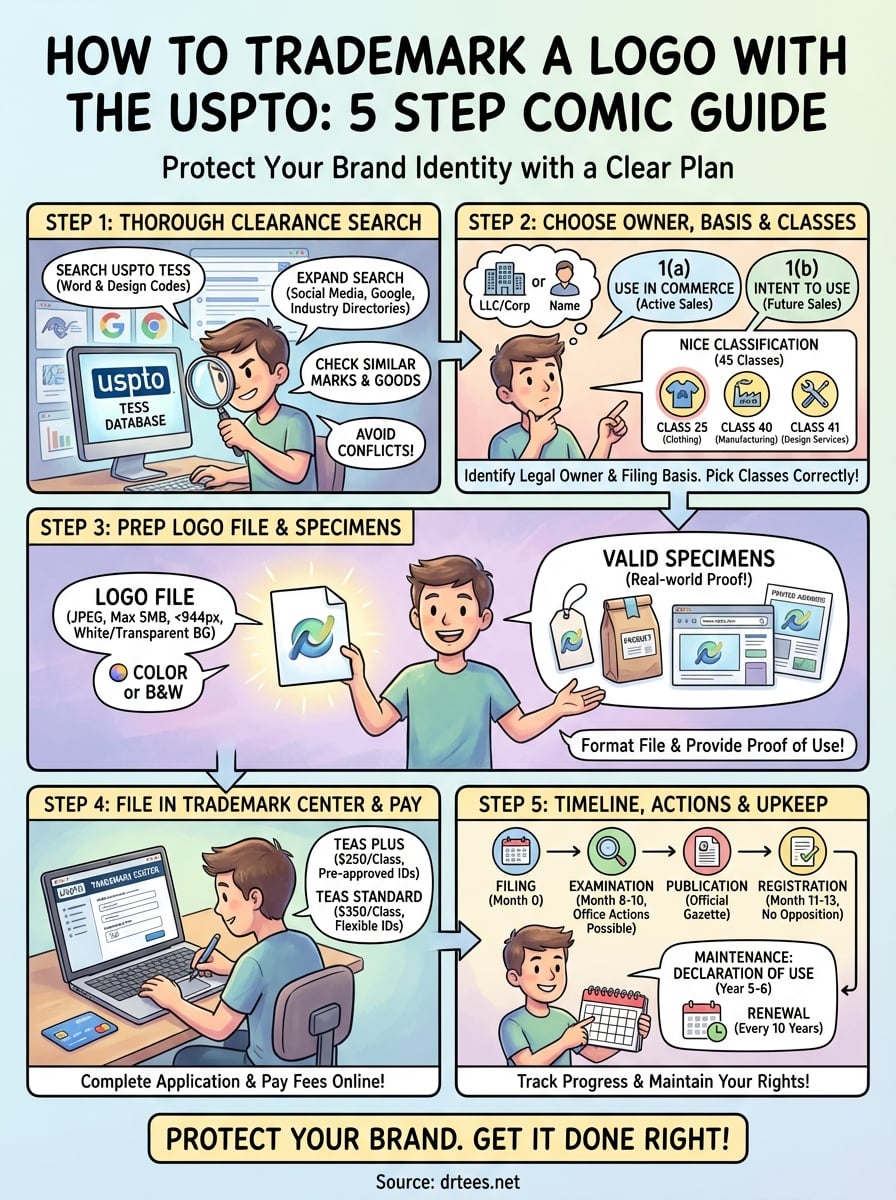
Learning how to trademark a logo comes down to five concrete steps: run a thorough clearance search, choose the right owner and classes, prepare a compliant logo file and specimen, file in Trademark Center with the correct fee, and stay on top of maintenance deadlines after your registration issues. Each step builds on the last, and skipping any one of them creates a problem that costs more to fix than it would have cost to get right the first time.
Your logo is the most visible part of your brand. It goes on your uniforms, your vehicles, your marketing materials, and your storefront. Protecting it legally is one of the smartest investments you can make in the business you’ve built. Once your trademark is in place, the next step is putting that logo on quality branded apparel that represents your company well. Start your custom order at Dr. Tee’s Design & Screen Printing and see what 20 years of experience looks like on a finished product.
