
If you’re trying to decide between dye sublimation vs screen printing, you’re asking the right question, because the method you choose directly affects how your finished product looks, feels, and holds up over time. Both techniques have earned their place in custom apparel, but they work in fundamentally different ways, use different materials, and come with distinct cost structures that matter when you’re spending real money on shirts for your team or business.
At Dr. Tee’s Design & Screen Printing, we’ve spent over 20 years helping Kansas City businesses, from roofing crews to dental offices, get the right print on the right garment. That experience has taught us that choosing a printing method isn’t just a technical decision; it’s a practical one that depends on your budget, your fabric, your design, and how many pieces you need. We’ve seen customers waste money picking the wrong method, and we’d rather help you avoid that upfront.
This article breaks down the real differences between dye sublimation and screen printing, covering how each process works, where each one excels, what they cost, and which one makes sense for your specific project. By the end, you’ll have a clear picture of which method fits your needs without having to guess or rely on a sales pitch.
Why the print method you choose matters
The print method you pick sets the ceiling for everything your finished product can achieve. Color vibrancy, wash durability, how the ink sits on the fabric, whether your design cracks after 20 washes – all of these outcomes trace back to a single upstream decision: how the ink gets applied. When you understand the core differences between dye sublimation vs screen printing, you stop guessing and start making a decision based on the actual requirements of your project. A wrong method choice doesn’t just cost money. It costs time, because you’ll need to reorder, and it damages the impression your brand makes on everyone wearing those shirts.
Your fabric determines what’s possible
Not every print method works on every fabric, and this single factor eliminates options faster than any other variable. Dye sublimation requires a synthetic fiber, typically polyester or a polyester-rich blend, to bond the dye into the fabric at the molecular level. If you try sublimation on a 100% cotton shirt, the dye has nothing to grip, and the colors will either wash out quickly or fail to transfer fully in the first place.
Screen printing, by contrast, works on cotton, cotton-poly blends, performance fabrics, and most other materials your team might wear daily. That broad material compatibility makes it the default choice for most custom apparel projects. If you’re outfitting a plumbing crew in heavy-duty cotton work shirts, screen printing is the realistic path. Sublimation simply isn’t built for natural fibers, and no amount of pressure or heat will change that.
The fabric in your hand before you place the order is the first filter that narrows your options down to one method or the other.
Design complexity changes your options
Your artwork plays just as big a role as the fabric. Screen printing separates each color into its own screen, which means a six-color logo requires six separate screens, six passes of ink, and additional setup time. That process works extremely well for bold, high-contrast graphics with defined edges, like a company logo or a team mascot. Where it gets complicated is with full-color photographs, gradients, or designs with dozens of shades blending into each other.
Dye sublimation handles unlimited color in a single pass because the design transfers digitally all at once. A full-color product photo, a gradient background, or a complex illustrated pattern all print the same way with no extra cost per color added. If your design relies on photorealistic detail or smooth color transitions, sublimation gives you results that screen printing cannot replicate at any price point.
Order size and budget shape the decision
Screen printing involves physical setup costs. Each color in your design requires a separate screen, and those screens take time to burn, align, and register before a single shirt gets printed. Setup fees typically run $20 to $50 per color, which means a three-color design carries real upfront cost before you print a single unit. That cost spreads out as your order grows, making screen printing very cost-effective at higher quantities like 100 pieces or more.
Sublimation carries no screen setup costs, but the per-unit price stays relatively flat regardless of order volume. You don’t get the same economy of scale that screen printing delivers at 100 or 200 units. For small batches of full-color polyester items, sublimation can be the more economical choice. But if you’re ordering 150 shirts for a large company event, screen printing almost always wins on total cost. Understanding this math before you commit to an order size is what separates a smart buying decision from an expensive one.
How dye sublimation works and when it fits
Dye sublimation is a heat-transfer process where dye converts directly from solid to gas without ever becoming liquid. The dye gets printed onto transfer paper first, then a heat press applies high temperature and pressure to the garment. At that point, the gaseous dye bonds with the polyester fibers at the molecular level, becoming part of the fabric itself rather than sitting on top of it.
The science behind the bond
When heat gets applied, the polyester fibers temporarily open at the molecular level, and the dye gas enters those openings. Once the heat is removed, the fibers close back around the dye, locking the color permanently inside the fabric. This is why sublimated prints feel completely smooth to the touch with no raised texture, no cracking, and no peeling over time. The print literally lives inside the fibers.
That built-in bond means sublimated garments hold their color through repeated washing far better than prints that rest on the surface. For branded apparel that needs to stay sharp through heavy use, that long-term color retention is a real advantage worth considering despite its material limitations.
Because the dye is embedded in the fiber, sublimation prints resist fading far better than methods where ink sits on top of the fabric.
What sublimation does best
Sublimation handles full-color, photorealistic designs with no color count limitations. A photograph, a complex gradient, or a design with 50 blended shades each prints in a single transfer with no setup screens and no per-color cost. That makes it the right tool when your artwork demands color accuracy and detail that screen printing simply cannot deliver cleanly.
The process also supports edge-to-edge printing across the entire garment with no print boundary limitations. Sports jerseys, all-over print apparel, and custom polyester promotional items are the classic applications where sublimation outperforms every other method.
When sublimation is the wrong fit
Comparing dye sublimation vs screen printing, one hard limitation stands out right away: sublimation only works on light-colored polyester or polyester-blend fabrics. Because the dye is transparent in nature, printing onto a dark fabric produces muted or invisible results. A white or very light base color is required for the dye to show up correctly.
Cotton shirts, dark garments, and natural fiber fabrics of any kind fall outside what sublimation can handle. If your team wears cotton uniforms or your company shirts are navy blue, sublimation is simply not a viable option regardless of how much you prefer the process.
How screen printing works and when it fits
Screen printing pushes ink through a mesh screen onto the surface of a garment using a squeegee. Each color in your design gets its own separate screen, and the printer applies them one layer at a time. The ink sits on top of the fabric rather than bonding inside it, and once it cures under heat, it holds up through years of regular washing without cracking or fading when applied correctly.
The mechanics behind the process
Before a single shirt gets printed, the shop creates a stencil for each color in your design by coating a mesh screen with a light-sensitive emulsion and exposing it to UV light through a film positive of your artwork. The unexposed areas wash away, leaving open areas where ink passes through onto the garment below. This setup process is what drives the per-color fees you’ll see on most screen printing quotes, and it’s also what makes the process so consistent when you’re running hundreds of identical pieces.
Every print in a large run looks the same because the screens stay registered throughout the job. That repeatability is one of the strongest arguments for screen printing when you need volume.
For orders above 50 pieces with a straightforward logo, screen printing delivers consistent, durable results at a per-unit cost that most other methods can’t match.
Where screen printing outperforms sublimation
When you’re comparing dye sublimation vs screen printing for cotton garments or dark fabrics, screen printing wins by default. It works on virtually any fabric, including 100% cotton, cotton-poly blends, performance polyester, and even canvas tote bags. It also handles dark-colored garments without issue because the ink is opaque and covers the base color underneath.
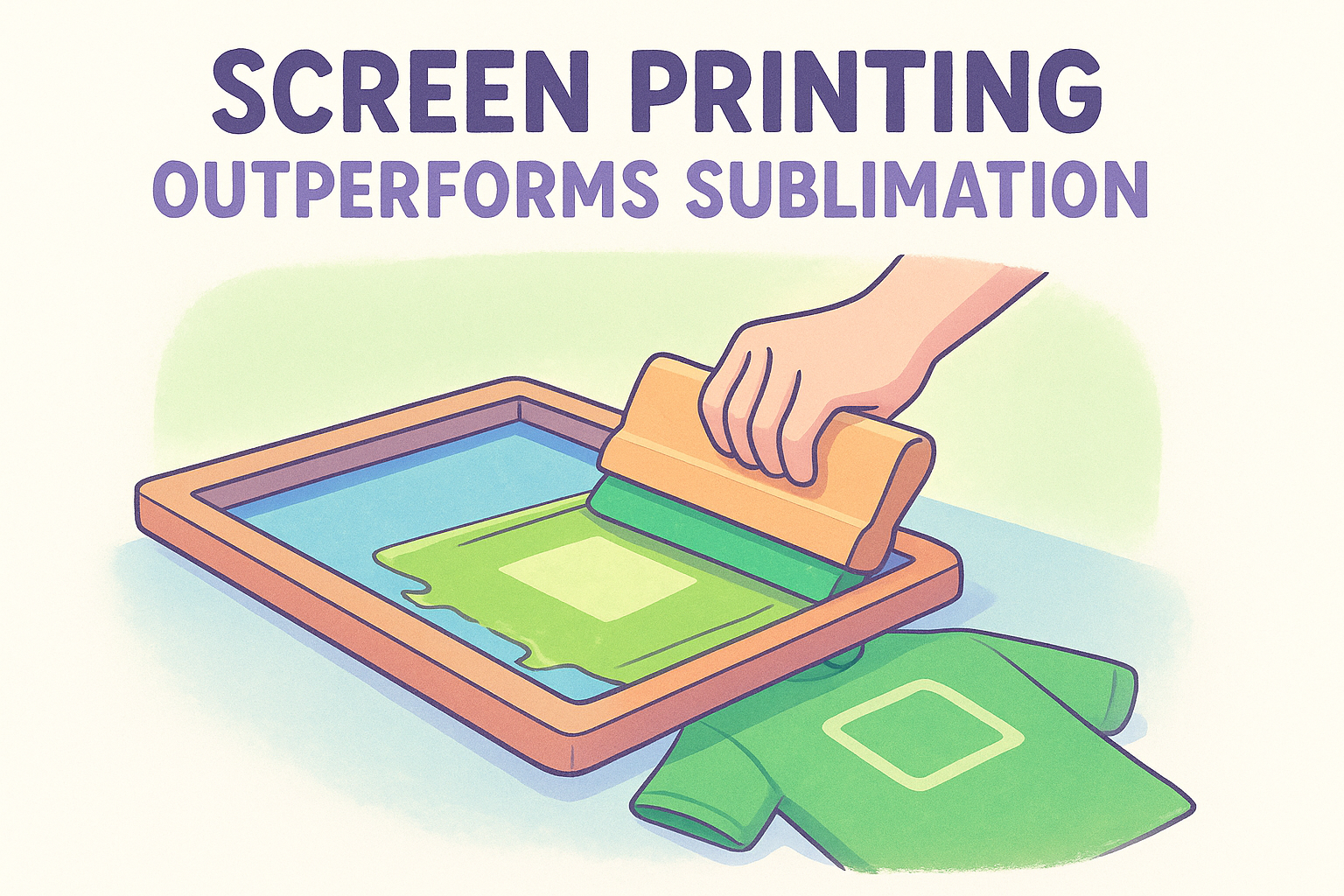
Screen printing also scales economically. Setup costs are fixed, so they shrink as a percentage of your total order the more pieces you print. A 150-piece run for a company event or uniform order will cost far less per shirt than nearly any other method, making it the practical choice for businesses outfitting large teams.
When screen printing isn’t the right call
Complex artwork with photorealistic images, fine gradients, or dozens of blended colors pushes against the limits of screen printing. Each additional color adds setup cost, and achieving smooth color transitions requires halftone techniques that reduce the crispness of the final result. If your design looks more like a photograph than a logo, the cost and the quality ceiling of screen printing may push you toward a different process for that specific project.
Key differences that decide the best choice
When you line up dye sublimation vs screen printing side by side, a few core differences consistently determine which method wins for a given project. Neither process is universally better. Each one has a clear set of conditions where it outperforms the other, and knowing those conditions upfront saves you from expensive reorders and disappointing results.
Durability and feel on the finished garment
How a print holds up over time, and how it feels under your hand, differs significantly between these two methods. Sublimation embeds dye inside the polyester fibers, so the surface stays completely smooth with no texture difference between the printed area and the surrounding fabric. There’s nothing to crack, peel, or flake because the color is part of the garment rather than a layer on top of it.
Screen printing leaves a layer of cured ink on the fabric surface, which means you can feel the print with your fingertips. When a shop applies the ink correctly and cures it fully, screen printed graphics hold up through hundreds of washes without significant fading. If the ink is under-cured or applied too thick, cracking becomes a real problem over time. Both methods are durable when executed well, but they achieve that durability through entirely different mechanisms.
A sublimated print will never crack or peel because there is no surface layer to separate from the fabric.
Color range and design flexibility
Screen printing handles solid colors, bold graphics, and defined shapes extremely well. Adding colors increases setup costs, so designs with one to four colors produce the best cost-to-quality ratio. Gradients and photorealistic images require halftone printing techniques that reduce sharpness at the edges of color transitions.
Sublimation faces no color count limitation because the entire design transfers digitally in one pass. Photographic images, smooth gradients, and full-color illustrations all reproduce with the same accuracy and cost regardless of how many shades your design contains. If your artwork looks more like a photograph than a company logo, sublimation gives you output that screen printing cannot match cleanly at any price.
Fabric and garment compatibility
This difference is the most decisive factor for most buyers. Screen printing works on cotton, blends, performance fabrics, and dark garments across the full range of apparel types. Sublimation only bonds correctly to light-colored polyester or high-polyester-blend fabrics. Your garment choice locks you into one method or the other before any other variable even enters the conversation.
Cost, turnaround, and order size math
Understanding the cost structure of dye sublimation vs screen printing helps you build a realistic budget before you commit to an order. Both methods carry real upfront expenses, but they hit your wallet at different points in the process, and the gap between them widens or narrows significantly depending on how many pieces you order.
Setup costs and what drives the price
Screen printing charges setup fees per color, typically ranging from $20 to $50 for each screen your design requires. A three-color logo means three screens, and you pay that cost whether you print 12 shirts or 500. Once those screens exist, each additional unit costs very little extra, which is why the per-unit price drops sharply as your order volume increases. At 150 pieces, a three-color screen print might run $8 to $12 per shirt. At 25 pieces, that same shirt could cost $18 to $25 once setup gets factored in.
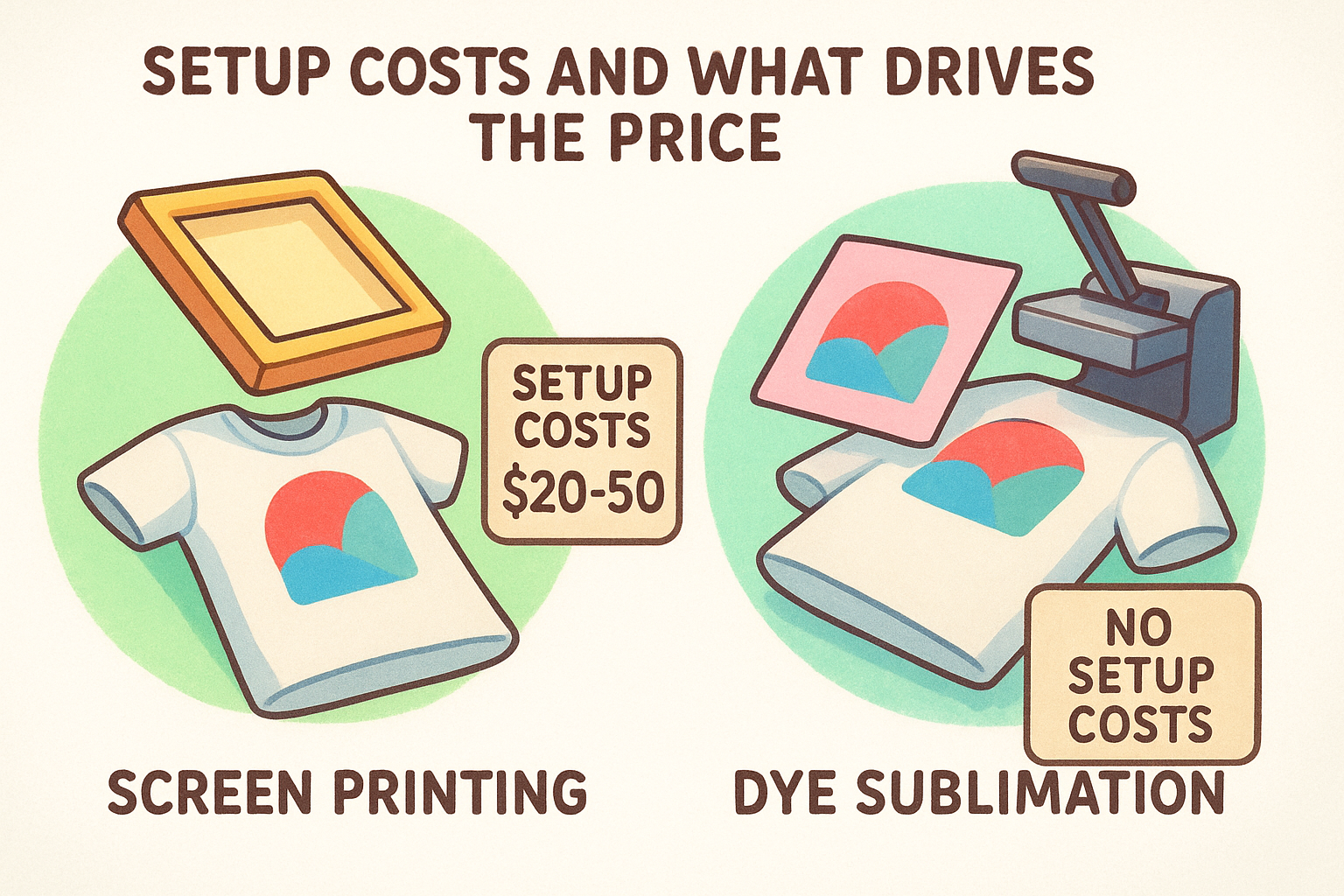
Screen printing becomes significantly more affordable per unit once you cross the 50-piece threshold, and the savings compound as your order grows.
Sublimation carries no screen setup fees, which removes that fixed upfront cost entirely. You pay a flat per-unit rate regardless of how many colors your design uses. That sounds appealing, but the per-unit price stays relatively consistent whether you print 12 pieces or 120, so you miss the volume discounts that make screen printing attractive for larger orders. For small runs of 12 to 30 pieces with full-color artwork on polyester, sublimation often costs less in total than screen printing would after setup fees.
Turnaround and production timelines
Screen printing production time typically runs 7 to 14 business days from final art approval, depending on order volume and how many colors your design requires. Larger runs with multiple ink colors take longer to set up and print because each screen needs to be burned, registered, and run separately before the first shirt gets printed.
Sublimation turnaround tends to be faster for small quantities because the digital setup eliminates screen production time. A short run of sublimated polyester items can often turn around in 5 to 10 business days. Your overall timeline still depends on garment availability, art approval speed, and current shop workload, not just the print method itself. Factor all of these variables into your deadline before you choose a vendor based on speed alone.
How to choose for your project in Kansas City
Most Kansas City businesses ordering custom apparel fall into one of two categories: teams that need durable branded uniforms on cotton or dark garments, and organizations that want full-color polyester performance wear for sports or events. Once you know which category describes your project, the decision between dye sublimation vs screen printing becomes straightforward rather than overwhelming.
Match your garment and design to the right method
If you’re ordering cotton shirts, hooded sweatshirts, or dark-colored garments for a crew, a school, or a business uniform program, screen printing is the right call. Dr. Tee’s works with a wide range of garment brands including Bella Canvas, Gildan, Next Level, and Hanes, all of which pair well with screen-printed ink. Your logo or team graphic will hold up through regular washing and hard use, which matters when the shirts are going on a roofing crew or a landscaping team.
When your design is photo-quality, gradient-heavy, or relies on edge-to-edge coverage, and you’re working with light-colored polyester or performance fabric, sublimation gives you results that screen printing cannot match at the same detail level. Sports jerseys and promotional polyester items are the strongest use case here.
When you’re unsure which method fits, look at your fabric tag first. That single detail eliminates one option before you spend another minute comparing.
Factor in your order size and budget
Small orders under 30 pieces with full-color artwork on polyester often cost less with sublimation because there are no screen setup fees eating into your budget. If your order is larger, the math shifts. Screen printing spreads its fixed setup costs across more units, and the per-shirt price drops significantly once you cross the 50-piece mark.
At Dr. Tee’s, minimum orders start at 12 units, and we handle runs up to 1,000 pieces with the same attention to quality control at every size. Whether you’re printing matching polo shirts for a dental office staff of eight or outfitting 200 employees for a company rebrand, your order size and artwork directly shape which method delivers the best value for your specific situation. Bringing your design and your fabric choice to the conversation upfront saves you time and avoids budget surprises after the quote comes back.
Next steps
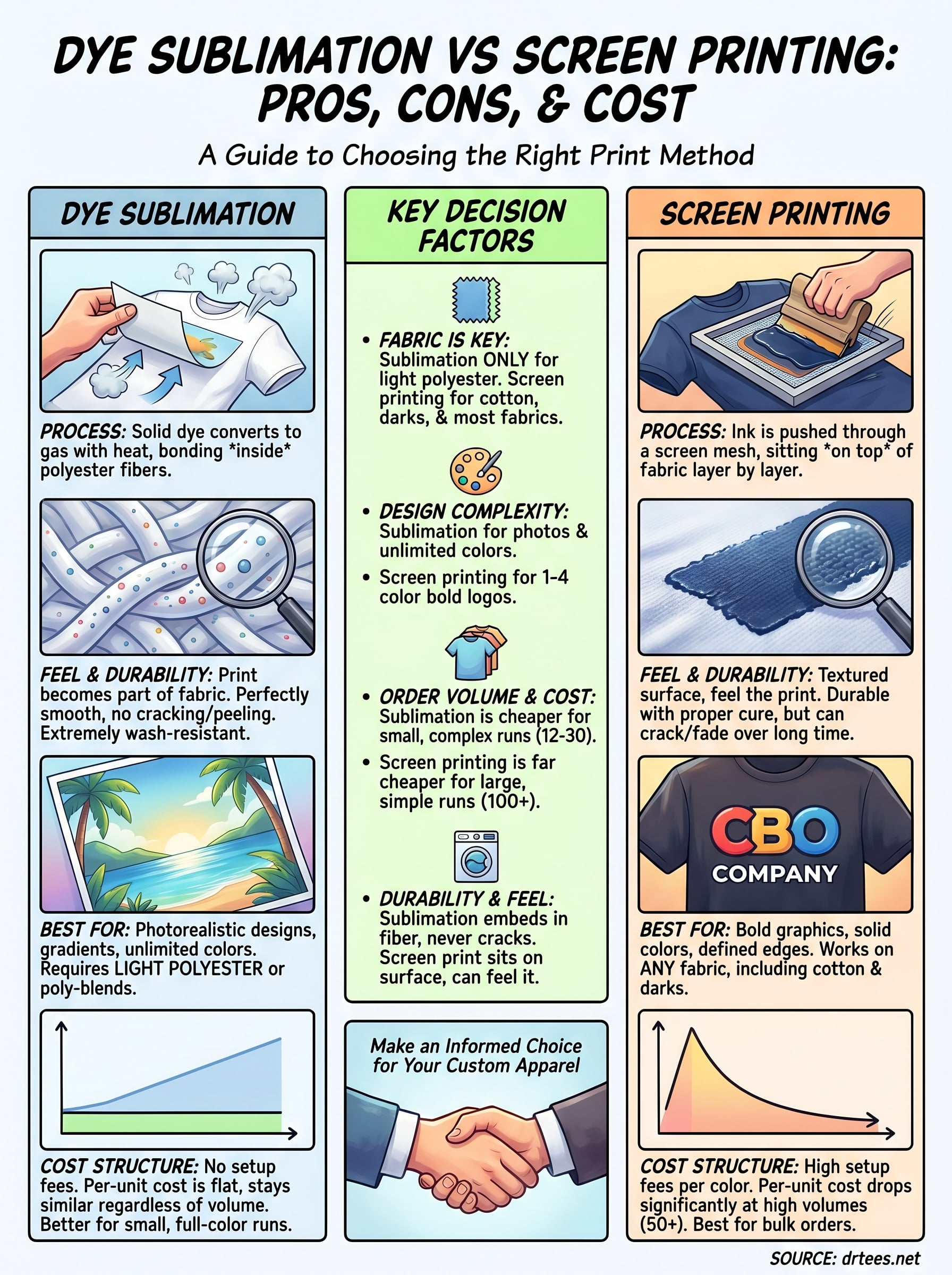
You now have the full picture on dye sublimation vs screen printing, covering how each process works, what it costs, and which conditions push you toward one method or the other. The decision comes down to three things: your fabric, your design complexity, and your order volume. Check your garment first, match your artwork to the right process, and run the cost math against how many pieces you actually need.
Dr. Tee’s Design & Screen Printing has worked with Kansas City businesses for over 20 years, handling everything from 12-piece uniform orders for small service companies to large runs of 1,000 pieces for major events. If you’re still unsure which method fits your project, or you’re ready to move forward and want a straight answer with no guesswork, get a quote and start your order and we’ll walk through the details with you directly.
