
Ordering custom t-shirts should be straightforward, but most people find themselves overwhelmed by endless options, confusing pricing structures, and uncertainty about what they’ll actually receive. Whether you’re outfitting your crew, promoting your business, or creating merchandise for an event, the decision to buy custom t shirts online comes with real questions about quality, sizing, and cost.
At Dr. Tee’s Design & Screen Printing, we’ve spent over 20 years helping Kansas City businesses and organizations navigate these exact decisions. This guide breaks down what actually matters when purchasing custom apparel online, from selecting the right fabric and fit to understanding pricing tiers and minimum orders. You’ll walk away knowing how to get shirts that look professional, feel comfortable, and stay within budget.
What you need before you order
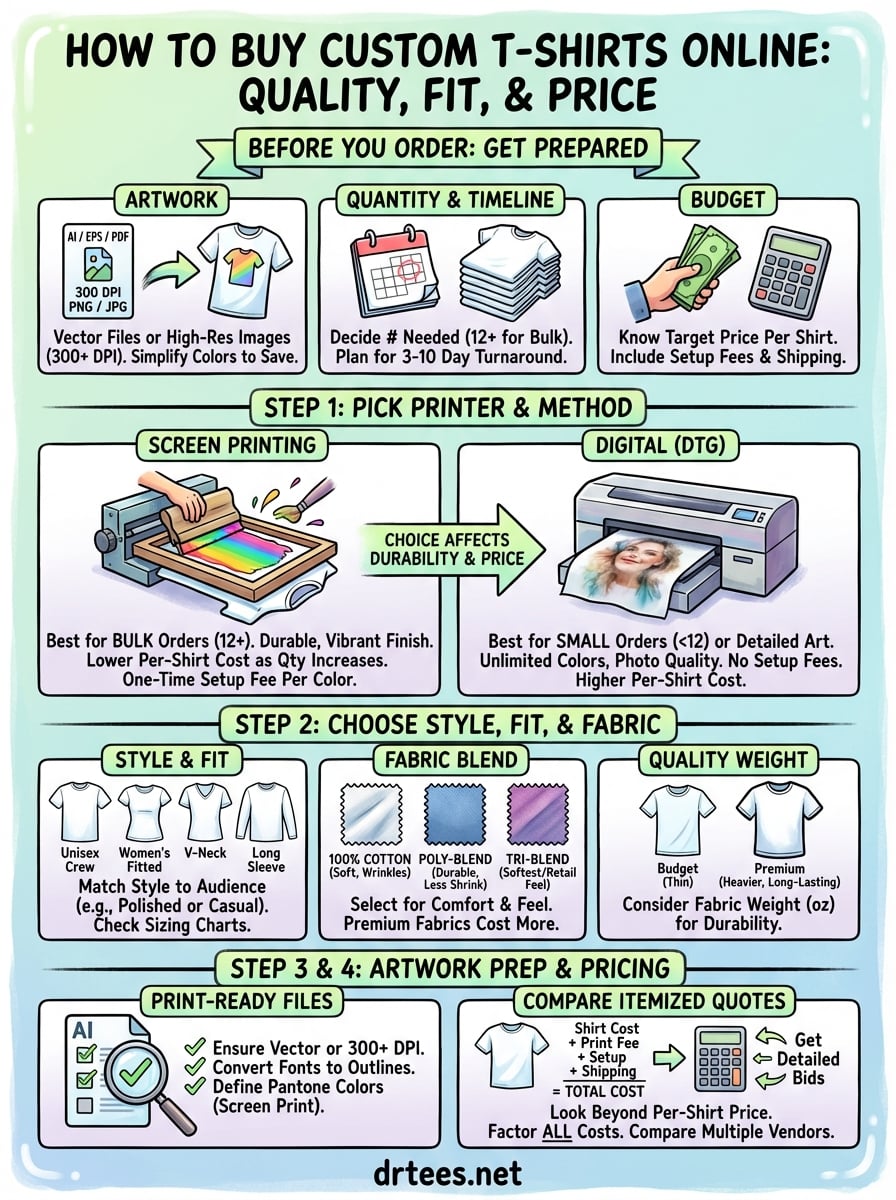
Before you buy custom t shirts online, gather a few key pieces of information to avoid delays and extra costs. Most custom apparel projects fail or get held up because buyers skip this preparation step. You need three essential items: artwork or design files, a clear quantity and timeline, and a realistic budget range that includes shipping.
Your design or logo files
You need your artwork in a vector format (AI, EPS, or PDF) or a high-resolution image (at least 300 DPI) saved as PNG or JPG. Photos taken with your phone of printed logos rarely work because they lack the detail needed for clean printing. If you don’t have professional files, find out if your printer offers design services or can redraw your logo from a sketch or low-quality image.
Most print shops can work with imperfect files, but providing high-quality artwork upfront saves you money on setup fees and reduces turnaround time.
Quantity and timeline details
Decide how many shirts you actually need and when you need them delivered. Custom orders typically require 12 to 24 pieces minimum at smaller shops, though some online platforms accept single-item orders at higher per-piece costs. Lead times range from 3 to 10 business days for standard orders, so plan accordingly if you have an event deadline.
Budget parameters
Know your price per shirt target before you start comparing vendors. Bulk orders cost less per unit, and your choice of garment affects pricing significantly. A basic cotton tee might cost $8 to $12 each with printing, while premium tri-blend or performance fabrics run $15 to $25 each. Factor in setup fees (usually $15 to $50 per color) and shipping costs to calculate your true total.
Step 1. Pick the right printer and method
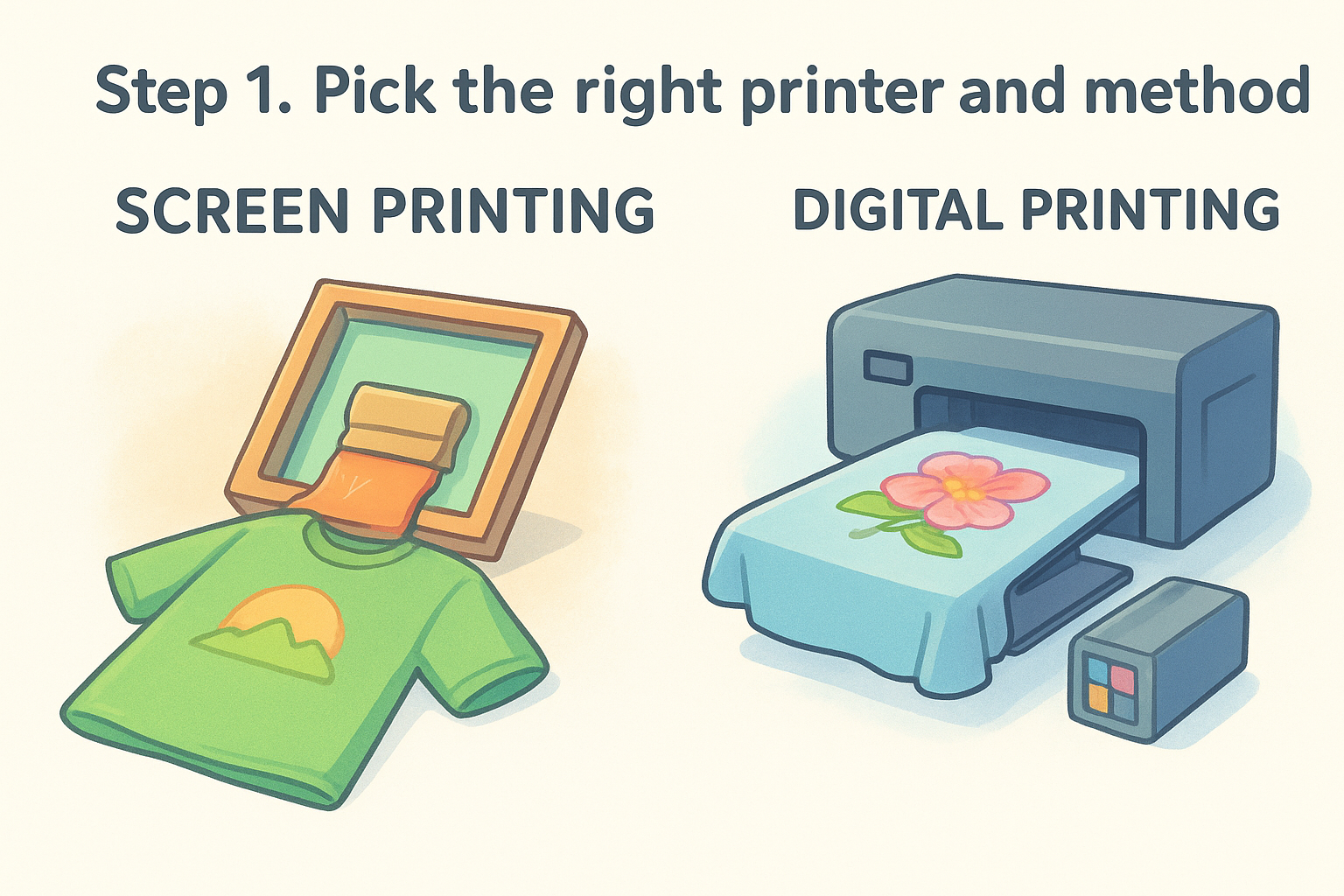
Your choice of printing method directly affects the durability, feel, and cost of your custom shirts. When you buy custom t shirts, you typically choose between screen printing and digital methods like direct-to-garment (DTG). Screen printing works best for orders of 12 or more shirts with simple designs in one to eight colors, while DTG suits complex full-color artwork or very small quantities.
Screen printing for bulk orders
Screen printing produces vibrant, long-lasting results that hold up through repeated washing and heavy wear. This method uses mesh screens to apply layers of ink directly onto fabric, creating a durable finish that works perfectly for business logos, team uniforms, and promotional apparel. You’ll pay a one-time setup fee per color (typically $15 to $50), but the per-shirt cost drops significantly as your quantity increases.
Screen printing delivers the best value when you order 24 or more shirts, especially for designs with three or fewer colors.
Digital printing for detailed designs
DTG printing sprays ink directly onto the fabric using specialized printers, which allows for photographic detail and unlimited colors without setup fees. This method suits orders under 12 shirts or designs with gradients, photographs, and complex color work. The process takes longer per shirt and costs more per unit, but you avoid the high upfront investment of screen printing.
Step 2. Choose shirt style, fit, and fabric
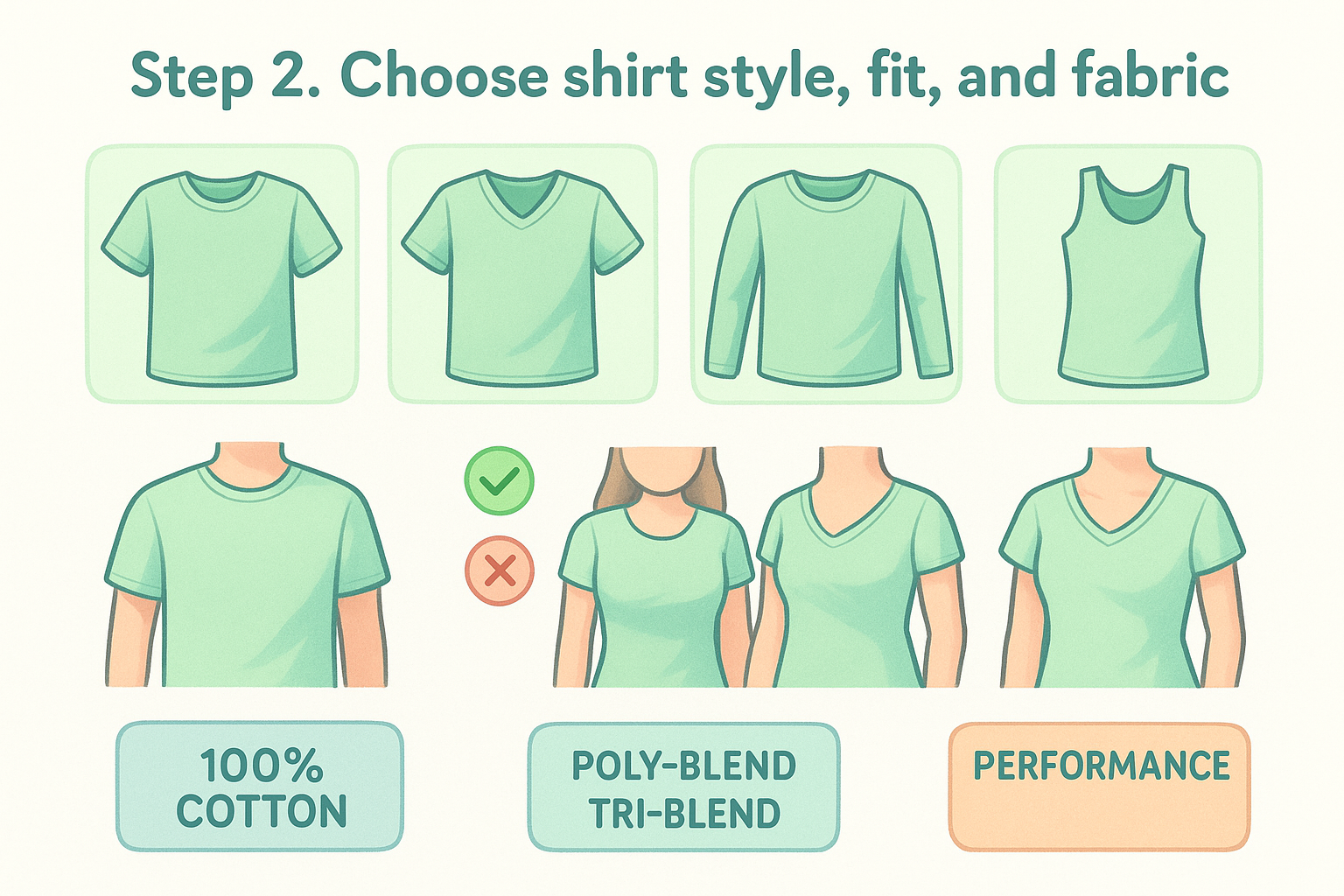
The garment you select determines how your printed design looks and how long people actually wear your shirts. When you buy custom t shirts, you face three core decisions: shirt style (crew neck, v-neck, long sleeve, tank), fit type (men’s, women’s, unisex, youth), and fabric blend (100% cotton, poly-blend, tri-blend, performance). Each choice affects comfort, price, and durability in different ways.
Match style to your audience
Unisex crew neck tees work for most general purposes like company events, trade shows, and casual uniforms. Women’s fitted styles prevent the boxy look that unisex shirts create on female wearers. Polo shirts suit professional environments like real estate offices or healthcare clinics where you need a polished appearance. Long sleeve options work better for outdoor crews or cooler climates.
Select fabric for durability and feel
Cotton-poly blends (50/50 or 60/40) resist shrinking and hold their shape better than 100% cotton shirts, which feel softer but wrinkle more easily. Performance polyester fabrics wick moisture for athletic teams or outdoor workers. Tri-blend options (cotton-poly-rayon) offer the softest hand feel and a retail-quality look but cost $3 to $7 more per shirt.
Budget shirts use thinner fabric (3.5 to 4.5 oz) that shows wear faster, while premium options (5.5 to 6 oz) maintain their appearance through repeated washing.
Step 3. Get your artwork print-ready
Your artwork needs to meet specific technical requirements before any printer can produce quality results. Most shops reject files that don’t meet their minimum resolution or come in the wrong format, which delays your order by several days. When you buy custom t shirts, you pay for both the printing and the pre-production work, so submitting print-ready files from the start saves money and speeds up delivery.
File format and resolution requirements
Provide your logo or design as a vector file (AI, EPS, or PDF with embedded fonts) for the sharpest possible print quality. Vector files scale to any size without losing detail, which matters when your design gets enlarged for the back of a shirt. If you only have raster images (PNG or JPG), they must be at least 300 DPI at the actual print size.
Use this checklist before uploading your files:
- File format: AI, EPS, PDF (vector) or PNG/JPG at 300+ DPI
- Color mode: RGB for digital printing, Pantone or spot colors for screen printing
- Text: Convert all fonts to outlines or curves
- Image size: At least 10 inches wide at 300 DPI for chest prints
Color matching and simplification
Screen printing costs increase with each additional color in your design, so simplify complex artwork to reduce your per-shirt price. A four-color design costs more than a two-color version of the same logo. Request Pantone color codes from your designer to ensure accurate ink matching across multiple orders.
Limiting your design to three or fewer colors cuts setup costs by 40% to 60% compared to full-color screen printing.
Step 4. Compare pricing, minimums, and speed
Getting accurate quotes from multiple printers reveals the true cost difference between vendors who appear similar at first glance. When you buy custom t shirts, the advertised per-shirt price rarely tells the full story because it excludes setup fees, shipping costs, and quantity breaks. Request itemized quotes that break down every charge so you can compare vendors accurately and spot hidden fees before placing your order.
Calculate total project cost
Use this pricing structure to compare quotes properly:
| Cost Element | Example Cost | Notes |
|---|---|---|
| Base shirt price | $6.50 each | Varies by fabric quality and brand |
| Printing fee | $2.50 per shirt | Depends on color count and method |
| Setup fees | $30 per color | One-time charge per design color |
| Shipping | $25 flat rate | Faster options cost $50 to $100 |
Multiply your quantity by the combined shirt and printing costs, then add setup fees and shipping to see your real bottom line. A vendor charging $8 per shirt with free setup beats one charging $7 with $50 in setup fees if you’re ordering 24 pieces.
Always request a detailed quote that separates garment costs, printing charges, setup fees, and shipping before comparing vendors.
Weigh minimums against turnaround time
Most professional shops require 12 to 24 pieces minimum, while instant online platforms accept single orders at double the per-unit cost. Standard production takes 5 to 7 business days, but rush service cuts that to 2 to 3 days for an extra 30% to 50% fee.
Next steps for a smooth order
You now have the framework to buy custom t shirts that meet your quality standards, fit requirements, and budget constraints. Start by organizing your artwork files in vector format, confirming your quantity needs, and setting a realistic delivery date. Contact two or three printers with your specifications and request itemized quotes that break down every cost.
Review each vendor’s portfolio and customer reviews to verify they deliver consistent quality on projects similar to yours. Ask about their revision policy, return options, and what happens if the printed shirts don’t match your approved proof. Most professional shops offer a sample shirt or digital mockup before running your full order.
If you’re looking for a Kansas City printer who combines low minimums with professional design support, Dr. Tee’s Design & Screen Printing handles everything from logo creation to final delivery. We offer transparent pricing, quality control checks, and over 20 years of experience helping businesses get exactly what they need. Request a quote from Dr. Tee’s to start your custom apparel project today.
